
Fixing an Open Bite: What Clear Aligners Can and Cannot Do
Can clear aligners fix an open bite? Learn when aligners work for dental vs. skeletal cases, success rates, and limitations.


Can Clear Aligners Fix an Open Bite?
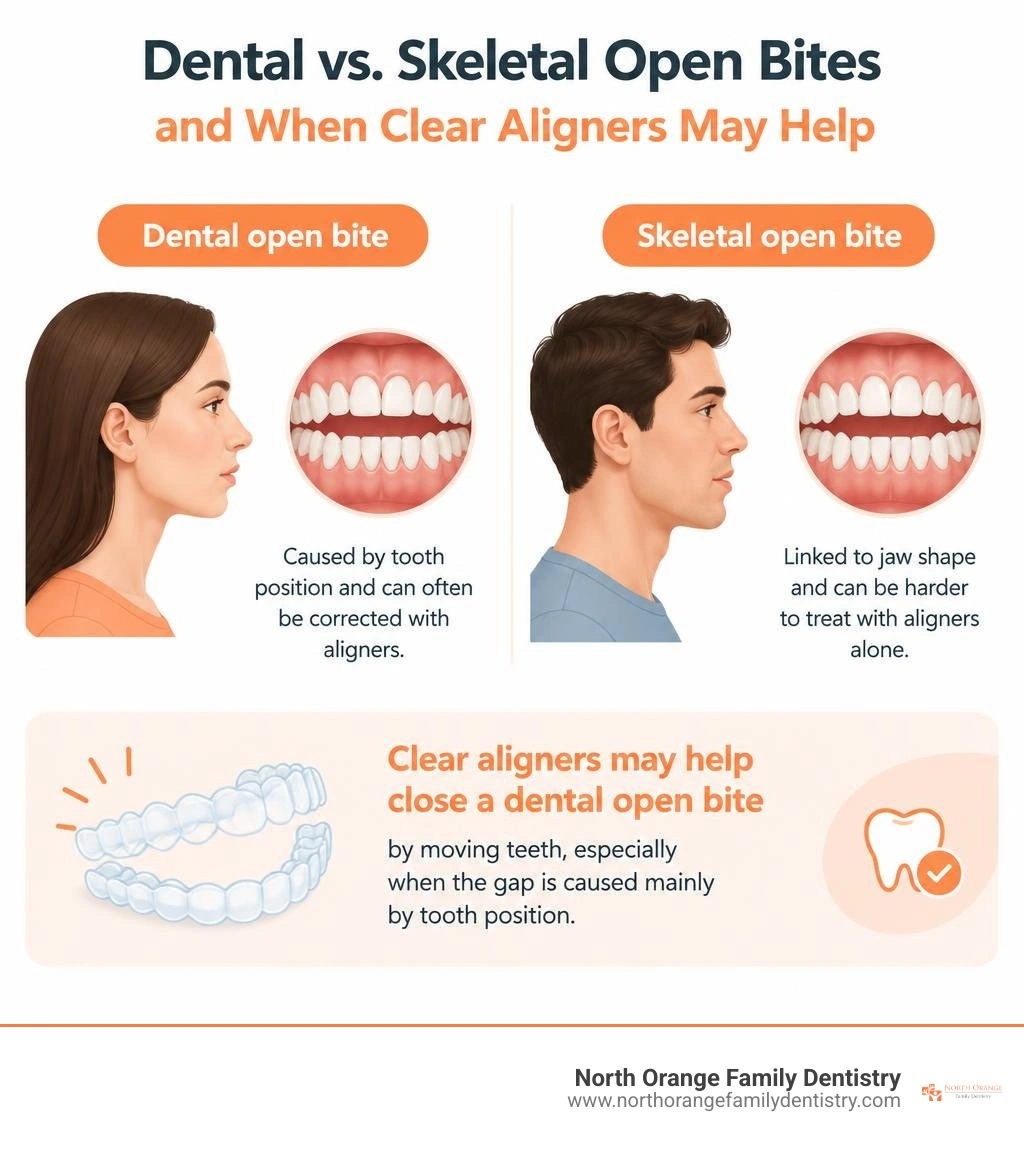
Yes, clear aligners can close an anterior open bite in many adults, especially when the gap is caused mainly by tooth position. In one study of 69 adults treated without extractions, 94% finished with their front teeth overlapping. That result is promising, but it does not mean aligners will work for every open bite.
The key question is why the front teeth do not meet. A dental open bite may be corrected by moving teeth. An open bite tied to jaw shape can be harder to treat with aligners alone. This guide explains what aligners can change, where their limits lie, and why an exam matters before choosing treatment.
Quick look at can clear aligners fix an open bite:
Understanding Anterior Open Bite: Dental vs. Skeletal Malocclusion
An anterior open bite occurs when the back teeth touch when biting down, but the upper and lower front teeth fail to overlap vertically. This leaves a visible space between the dental arches. Patients with this malocclusion often struggle with biting into foods like sandwiches or apples, experience speech changes (such as a lisp), and face uneven wear on their posterior molars.
To determine how to address this bite issue, we must first classify whether the condition originates from the teeth or the underlying jaw structure. Modern clear aligners provide remarkable control, but success depends entirely on making the correct initial diagnosis.
- Dental Open Bite: The jaw bones are normally proportioned, but the teeth have erupted improperly or shifted out of alignment. Common culprits include childhood thumb sucking, pacifier use, tongue thrust habits, or mouth breathing.
- Skeletal Open Bite: The discrepancy stems from the growth pattern of the facial skeleton. The upper jaw (maxilla) may have excess vertical growth, or the lower jaw (mandible) may grow in a downward, backward direction. This is often characterized by a high mandibular plane angle (hyperdivergence) and increased lower facial height.
Dental vs. Skeletal Factors: When Can Clear Aligners Fix an Open Bite?
When evaluating patients who want to straighten crooked teeth and close an anterior gap, we rely on lateral cephalometric radiographs and 3D digital scans.
A dental open bite is the ideal scenario for clear aligner therapy. Because the basal bone structure is harmonious, we can reposition the teeth through dentoalveolar movements—pulling the incisors slightly inward and vertically into a functional overlap.
Skeletal open bites present greater complexity. In mild-to-moderate skeletal cases, aligners can achieve functional bite closure by controlling the vertical height of the back molars. However, severe skeletal discrepancies with significant vertical maxillary excess may require a combination of orthodontics and orthognathic (jaw) surgery to achieve optimal esthetics and long-term joint stability.
Can Clear Aligners Fix an Open Bite? Clinical Evidence and Success Rates
Substantial peer-reviewed literature confirms the clinical efficacy of clear aligner systems like invisalign for closing anterior open bites. Clinical investigations, including studies on the Treatment of anterior open bites using non-extraction clear aligner therapy in adult patients (Suh et al., 2022), show that a positive vertical overlap (overbite) was achieved in 94% of adult patients using non-extraction protocols.
Key statistical findings from orthodontic research include:
- High Success Rate: 94% of adult open bite patients achieved positive overbite without tooth extractions.
- Significant Bite Closure: The mean change in overbite across clinical cohorts was 3.3 ± 1.4 mm, with individual closures ranging from 0.7 mm up to 7.1 mm.
- Efficient Timeline: The average treatment duration for comprehensive open bite closure with aligners is approximately 1.5 years (1.4 ± 0.72 years).
These outcomes highlight why aligner therapy has become a premier non-surgical treatment modality, as detailed in our invisalign complete guide 2026.
Biomechanical Mechanisms: Molar Intrusion and Incisor Extrusion
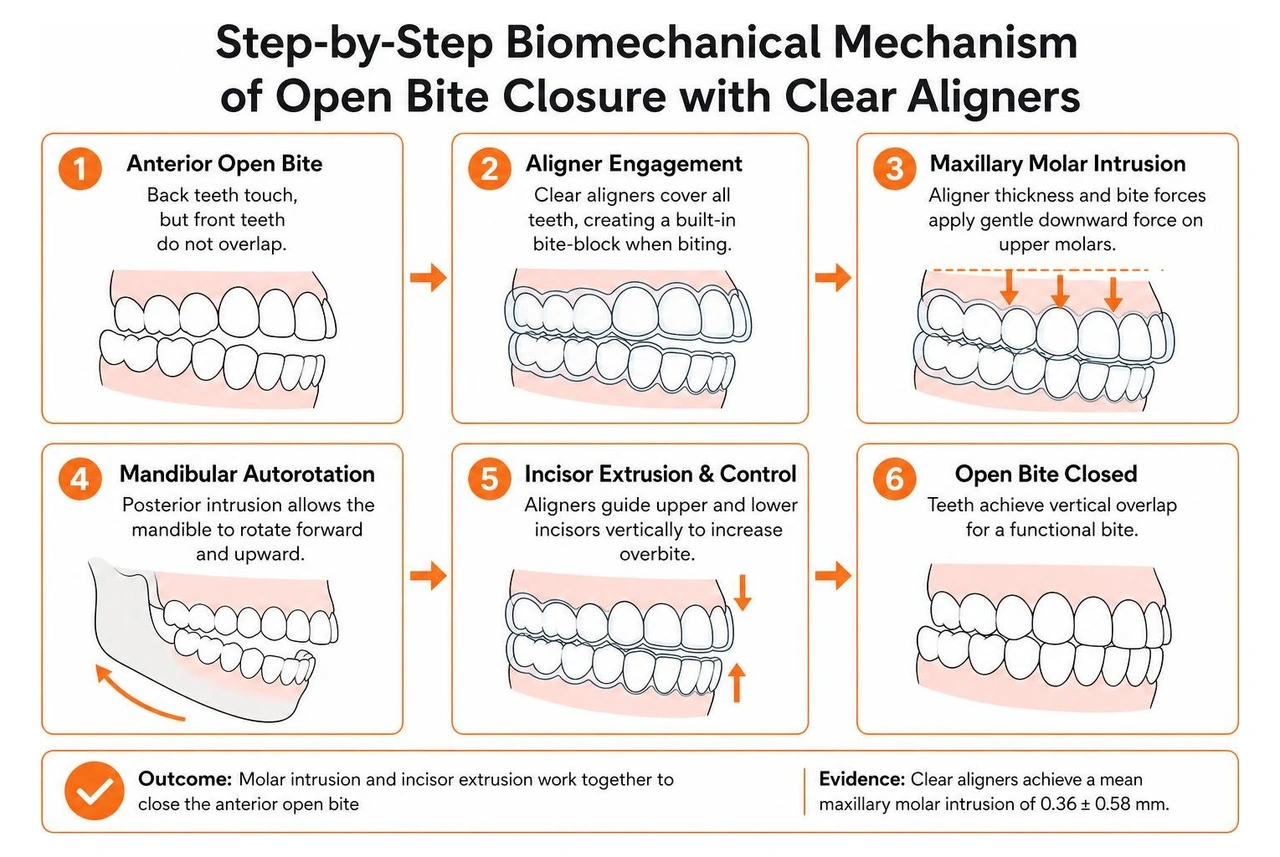
How do clear aligners close an open bite? Traditional fixed braces can sometimes extrude posterior molars, worsening an open bite. In contrast, clear aligners cover the entire biting surface of the teeth, providing a built-in "bite-block" effect.
Research, including the Efficacy of Clear Aligner Therapy for the Treatment of Anterior Open Bite in Adults: A Systematic Review and Meta‐Analysis, identifies two primary mechanisms:
- Maxillary Molar Intrusion: Every time a patient bites down, the thickness of the aligner material applies an intrusive vertical force on the posterior teeth. Studies show clear aligners alone achieve a mean maxillary molar intrusion of 0.36 ± 0.58 mm. Even a fraction of a millimeter of posterior intrusion allows the mandible to rotate forward and upward (mandibular autorotation), significantly closing the anterior gap.
- Anterior Incisor Extrusion: Clear aligners use engineered composite attachments placed on the front teeth to guide them vertically toward each other, establishing a natural, healthy overbite.
In dental open bites, maxillary incisor extrusion is the primary driver of closure. In skeletal open bites, mandibular plane angle reduction combined with mandibular incisor extrusion plays the most significant role.
Malocclusion Class Variations: Class I, Class II, and Class III Mechanics
Open bites do not occur in isolation; they appear alongside different sagittal bite classifications:
- Class I Malocclusion: The molars are properly aligned front-to-back, but an anterior gap exists. Closure relies on balanced incisor extrusion and mild molar intrusion.
- Class II Malocclusion: The upper teeth sit significantly forward of the lower teeth. For patients wondering how can clear aligners fix an overbite and an open bite simultaneously, aligners utilize Class II elastics combined with molar intrusion to counter jaw divergence while retracting front teeth.
- Class III Malocclusion: The lower jaw sits forward. In these cases, research shows closure relies heavily on mandibular incisor extrusion and retroclination rather than molar intrusion.
Limitations and Predictability of Aligner Therapy for Open Bites
While aligners are highly effective, digital treatment planning in software like ClinCheck does not always translate to 100% expression in the mouth. As highlighted in a Scoping Review—The Effectiveness of Clear Aligners in the Management of Anterior Open Bite in Adult Patients, pure vertical extrusion is one of the most biomechanically challenging movements in orthodontics.
To ensure predictable results, experienced dentists apply specific protocols:
- Optimized Attachments: Small, tooth-colored composite shapes are placed on specific teeth to give the aligner plastic a firm grip for vertical movements.
- Refinement Trays: Approximately 70% to 80% of open bite cases require a brief refinement phase (an extra set of aligners) to fine-tune final contact.
- Strict Compliance: Aligners must be worn 20 to 22 hours per day. Because vertical forces require constant stimulation, removing aligners for extended periods causes immediate tracking loss.
Beyond orthodontic movement, comprehensive wellness matters. At North Orange Family Dentistry, we also utilize advanced therapeutic modalities, including laser treatments that assist with soft tissue management, canker sore healing, and TMJ pain relief associated with bite disharmony, as well as laser periodontal therapies.
Long-Term Retention and Relapse Prevention
Anterior open bites have historically carried a higher risk of relapse than other malocclusions. The primary culprit is often muscle function—specifically an unconscious tongue thrust habit, where the tongue pushes forward between the teeth during swallowing or speaking.
To ensure stability after treatment:
- Custom Retention: Patients must transition immediately to durable retainers. Wearing dedicated aligners and retainers maintains vertical positioning.
- Myofunctional Therapy: Retraining resting tongue posture against the roof of the mouth ensures the tongue does not reopen the anterior space.
Frequently Asked Questions About Open Bite Correction
Can clear aligners fix an open bite without surgery?
Yes. Mild-to-moderate open bites—especially dental open bites and moderate skeletal variations—can routinely be corrected without surgery using clear aligners for teeth. Only severe skeletal deformities with extreme vertical maxillary excess typically necessitate combined orthognathic surgery.
How long does it take clear aligners to close an open bite?
Most adult anterior open bite treatments take between 12 and 18 months (an average of 1.5 years). The exact timeline depends on the severity of the gap, the patient's underlying skeletal pattern, and strict adherence to the 22-hour daily wear schedule across different types of invisalign.
Why are anterior open bites prone to relapse after treatment?
Open bites are sensitive to oral habits. If chronic mouth breathing, airway obstruction, or a tongue thrust swallowing pattern persists after orthodontic treatment, the continuous forward pressure of the tongue can push the front teeth apart again. Long-term compliance with transparent aligners teeth retainers is vital for lasting stability.
Conclusion
Closing an anterior open bite can dramatically transform your ability to chew, improve your speech, protect your molars from premature wear, and give you complete confidence in your smile. Thanks to modern digital treatment planning and targeted attachment biomechanics, clear aligners have established themselves as an effective, non-invasive treatment option for adults.
At North Orange Family Dentistry, led by Dr. Kyle Bogan (FICD fellow) alongside Dr. Cindy Ellinger, Dr. Richard Hall, Dr. Daniel Brumley, and Dr. Blaine Griffiths, our clinical team delivers personalized orthodontic and restorative care for patients across Lewis Center, Delaware, Orange, and Powell, Ohio. We are committed to making comprehensive family care accessible through our in-house Dental Wellness Plan for uninsured patients, while providing full-scope solutions ranging from teeth whitening, tooth bonding, veneers, crowns, root canals, digital dentures, and endosteal dental implants (with an average cost of about $4,500 per tooth). We also accommodate dental emergencies with same-day care most of the time.
If you are ready to evaluate your bite and explore a personalized treatment plan, schedule an Invisalign consultation with our experienced team today.
References
Suh H, Garnett BS, Mahood K, Mahjoub N, Boyd RL, Oh H. "Treatment of anterior open bites using non-extraction clear aligner therapy in adult patients.." Korean journal of orthodontics, 2022. PMCID PMC9117790.
Can Clear Aligners Fix an Open Bite?
Yes, clear aligners can close an anterior open bite in many adults, especially when the gap is caused mainly by tooth position. In one study of 69 adults treated without extractions, 94% finished with their front teeth overlapping. That result is promising, but it does not mean aligners will work for every open bite.
The key question is why the front teeth do not meet. A dental open bite may be corrected by moving teeth. An open bite tied to jaw shape can be harder to treat with aligners alone. This guide explains what aligners can change, where their limits lie, and why an exam matters before choosing treatment.
Quick look at can clear aligners fix an open bite:
Understanding Anterior Open Bite: Dental vs. Skeletal Malocclusion
An anterior open bite occurs when the back teeth touch when biting down, but the upper and lower front teeth fail to overlap vertically. This leaves a visible space between the dental arches. Patients with this malocclusion often struggle with biting into foods like sandwiches or apples, experience speech changes (such as a lisp), and face uneven wear on their posterior molars.
To determine how to address this bite issue, we must first classify whether the condition originates from the teeth or the underlying jaw structure. Modern clear aligners provide remarkable control, but success depends entirely on making the correct initial diagnosis.
- Dental Open Bite: The jaw bones are normally proportioned, but the teeth have erupted improperly or shifted out of alignment. Common culprits include childhood thumb sucking, pacifier use, tongue thrust habits, or mouth breathing.
- Skeletal Open Bite: The discrepancy stems from the growth pattern of the facial skeleton. The upper jaw (maxilla) may have excess vertical growth, or the lower jaw (mandible) may grow in a downward, backward direction. This is often characterized by a high mandibular plane angle (hyperdivergence) and increased lower facial height.
Dental vs. Skeletal Factors: When Can Clear Aligners Fix an Open Bite?
When evaluating patients who want to straighten crooked teeth and close an anterior gap, we rely on lateral cephalometric radiographs and 3D digital scans.
A dental open bite is the ideal scenario for clear aligner therapy. Because the basal bone structure is harmonious, we can reposition the teeth through dentoalveolar movements—pulling the incisors slightly inward and vertically into a functional overlap.
Skeletal open bites present greater complexity. In mild-to-moderate skeletal cases, aligners can achieve functional bite closure by controlling the vertical height of the back molars. However, severe skeletal discrepancies with significant vertical maxillary excess may require a combination of orthodontics and orthognathic (jaw) surgery to achieve optimal esthetics and long-term joint stability.
Can Clear Aligners Fix an Open Bite? Clinical Evidence and Success Rates
Substantial peer-reviewed literature confirms the clinical efficacy of clear aligner systems like invisalign for closing anterior open bites. Clinical investigations, including studies on the Treatment of anterior open bites using non-extraction clear aligner therapy in adult patients (Suh et al., 2022), show that a positive vertical overlap (overbite) was achieved in 94% of adult patients using non-extraction protocols.
Key statistical findings from orthodontic research include:
- High Success Rate: 94% of adult open bite patients achieved positive overbite without tooth extractions.
- Significant Bite Closure: The mean change in overbite across clinical cohorts was 3.3 ± 1.4 mm, with individual closures ranging from 0.7 mm up to 7.1 mm.
- Efficient Timeline: The average treatment duration for comprehensive open bite closure with aligners is approximately 1.5 years (1.4 ± 0.72 years).
These outcomes highlight why aligner therapy has become a premier non-surgical treatment modality, as detailed in our invisalign complete guide 2026.
Biomechanical Mechanisms: Molar Intrusion and Incisor Extrusion
How do clear aligners close an open bite? Traditional fixed braces can sometimes extrude posterior molars, worsening an open bite. In contrast, clear aligners cover the entire biting surface of the teeth, providing a built-in "bite-block" effect.
Research, including the Efficacy of Clear Aligner Therapy for the Treatment of Anterior Open Bite in Adults: A Systematic Review and Meta‐Analysis, identifies two primary mechanisms:
- Maxillary Molar Intrusion: Every time a patient bites down, the thickness of the aligner material applies an intrusive vertical force on the posterior teeth. Studies show clear aligners alone achieve a mean maxillary molar intrusion of 0.36 ± 0.58 mm. Even a fraction of a millimeter of posterior intrusion allows the mandible to rotate forward and upward (mandibular autorotation), significantly closing the anterior gap.
- Anterior Incisor Extrusion: Clear aligners use engineered composite attachments placed on the front teeth to guide them vertically toward each other, establishing a natural, healthy overbite.
In dental open bites, maxillary incisor extrusion is the primary driver of closure. In skeletal open bites, mandibular plane angle reduction combined with mandibular incisor extrusion plays the most significant role.
Malocclusion Class Variations: Class I, Class II, and Class III Mechanics
Open bites do not occur in isolation; they appear alongside different sagittal bite classifications:
- Class I Malocclusion: The molars are properly aligned front-to-back, but an anterior gap exists. Closure relies on balanced incisor extrusion and mild molar intrusion.
- Class II Malocclusion: The upper teeth sit significantly forward of the lower teeth. For patients wondering how can clear aligners fix an overbite and an open bite simultaneously, aligners utilize Class II elastics combined with molar intrusion to counter jaw divergence while retracting front teeth.
- Class III Malocclusion: The lower jaw sits forward. In these cases, research shows closure relies heavily on mandibular incisor extrusion and retroclination rather than molar intrusion.
Limitations and Predictability of Aligner Therapy for Open Bites
While aligners are highly effective, digital treatment planning in software like ClinCheck does not always translate to 100% expression in the mouth. As highlighted in a Scoping Review—The Effectiveness of Clear Aligners in the Management of Anterior Open Bite in Adult Patients, pure vertical extrusion is one of the most biomechanically challenging movements in orthodontics.
To ensure predictable results, experienced dentists apply specific protocols:
- Optimized Attachments: Small, tooth-colored composite shapes are placed on specific teeth to give the aligner plastic a firm grip for vertical movements.
- Refinement Trays: Approximately 70% to 80% of open bite cases require a brief refinement phase (an extra set of aligners) to fine-tune final contact.
- Strict Compliance: Aligners must be worn 20 to 22 hours per day. Because vertical forces require constant stimulation, removing aligners for extended periods causes immediate tracking loss.
Beyond orthodontic movement, comprehensive wellness matters. At North Orange Family Dentistry, we also utilize advanced therapeutic modalities, including laser treatments that assist with soft tissue management, canker sore healing, and TMJ pain relief associated with bite disharmony, as well as laser periodontal therapies.
Long-Term Retention and Relapse Prevention
Anterior open bites have historically carried a higher risk of relapse than other malocclusions. The primary culprit is often muscle function—specifically an unconscious tongue thrust habit, where the tongue pushes forward between the teeth during swallowing or speaking.
To ensure stability after treatment:
- Custom Retention: Patients must transition immediately to durable retainers. Wearing dedicated aligners and retainers maintains vertical positioning.
- Myofunctional Therapy: Retraining resting tongue posture against the roof of the mouth ensures the tongue does not reopen the anterior space.
Frequently Asked Questions About Open Bite Correction
Can clear aligners fix an open bite without surgery?
Yes. Mild-to-moderate open bites—especially dental open bites and moderate skeletal variations—can routinely be corrected without surgery using clear aligners for teeth. Only severe skeletal deformities with extreme vertical maxillary excess typically necessitate combined orthognathic surgery.
How long does it take clear aligners to close an open bite?
Most adult anterior open bite treatments take between 12 and 18 months (an average of 1.5 years). The exact timeline depends on the severity of the gap, the patient's underlying skeletal pattern, and strict adherence to the 22-hour daily wear schedule across different types of invisalign.
Why are anterior open bites prone to relapse after treatment?
Open bites are sensitive to oral habits. If chronic mouth breathing, airway obstruction, or a tongue thrust swallowing pattern persists after orthodontic treatment, the continuous forward pressure of the tongue can push the front teeth apart again. Long-term compliance with transparent aligners teeth retainers is vital for lasting stability.
Conclusion
Closing an anterior open bite can dramatically transform your ability to chew, improve your speech, protect your molars from premature wear, and give you complete confidence in your smile. Thanks to modern digital treatment planning and targeted attachment biomechanics, clear aligners have established themselves as an effective, non-invasive treatment option for adults.
At North Orange Family Dentistry, led by Dr. Kyle Bogan (FICD fellow) alongside Dr. Cindy Ellinger, Dr. Richard Hall, Dr. Daniel Brumley, and Dr. Blaine Griffiths, our clinical team delivers personalized orthodontic and restorative care for patients across Lewis Center, Delaware, Orange, and Powell, Ohio. We are committed to making comprehensive family care accessible through our in-house Dental Wellness Plan for uninsured patients, while providing full-scope solutions ranging from teeth whitening, tooth bonding, veneers, crowns, root canals, digital dentures, and endosteal dental implants (with an average cost of about $4,500 per tooth). We also accommodate dental emergencies with same-day care most of the time.
If you are ready to evaluate your bite and explore a personalized treatment plan, schedule an Invisalign consultation with our experienced team today.
References
Suh H, Garnett BS, Mahood K, Mahjoub N, Boyd RL, Oh H. "Treatment of anterior open bites using non-extraction clear aligner therapy in adult patients.." Korean journal of orthodontics, 2022. PMCID PMC9117790.
Contact Us
Have any questions? Want to learn more?

