
Brace Yourself for the Truth About Aligners
Discover aligners vs braces: Compare aesthetics, effectiveness, costs & more. Find your perfect smile solution today!


The Real Difference Between Aligners vs Braces (And How to Choose)
Aligners vs braces are both proven ways to straighten teeth — but they work differently, feel different, and suit different situations.
Here's the quick version: clear aligners are nearly invisible, removable, and usually best for mild to moderate cases. Because you take them out to eat, they do not come with the same food restrictions as braces, and brushing and flossing are typically easier. The tradeoff is that aligners require strong daily compliance — usually about 22 hours of wear per day — and treatment averages around 18 months for many cases.
Traditional braces are more noticeable, whether metal or ceramic, but they stay fixed to your teeth and work continuously. They can treat mild cases as well as more severe or complex bite problems, but they usually require avoiding sticky or hard foods and taking extra care with brushing and flossing around brackets and wires. Treatment often averages closer to 24 months, and success rates are high for both options — about 88% for aligners and 90% for braces.
The short answer? Neither option is automatically better. The right choice depends on your specific bite issues, lifestyle, and how disciplined you are about wearing a removable device.
Now here's the longer answer.
Orthodontic treatment has come a long way. A generation ago, metal braces were basically the only option. Today, millions of people — including nearly 1 in 4 orthodontic patients who are adults — are choosing between traditional braces and clear aligners like Invisalign.
It's one of the most common questions patients bring up. And it makes sense. You're committing to months of treatment, real money, and daily habits. You want to get it right.
The good news: both options work. The challenge is knowing which one works for you.
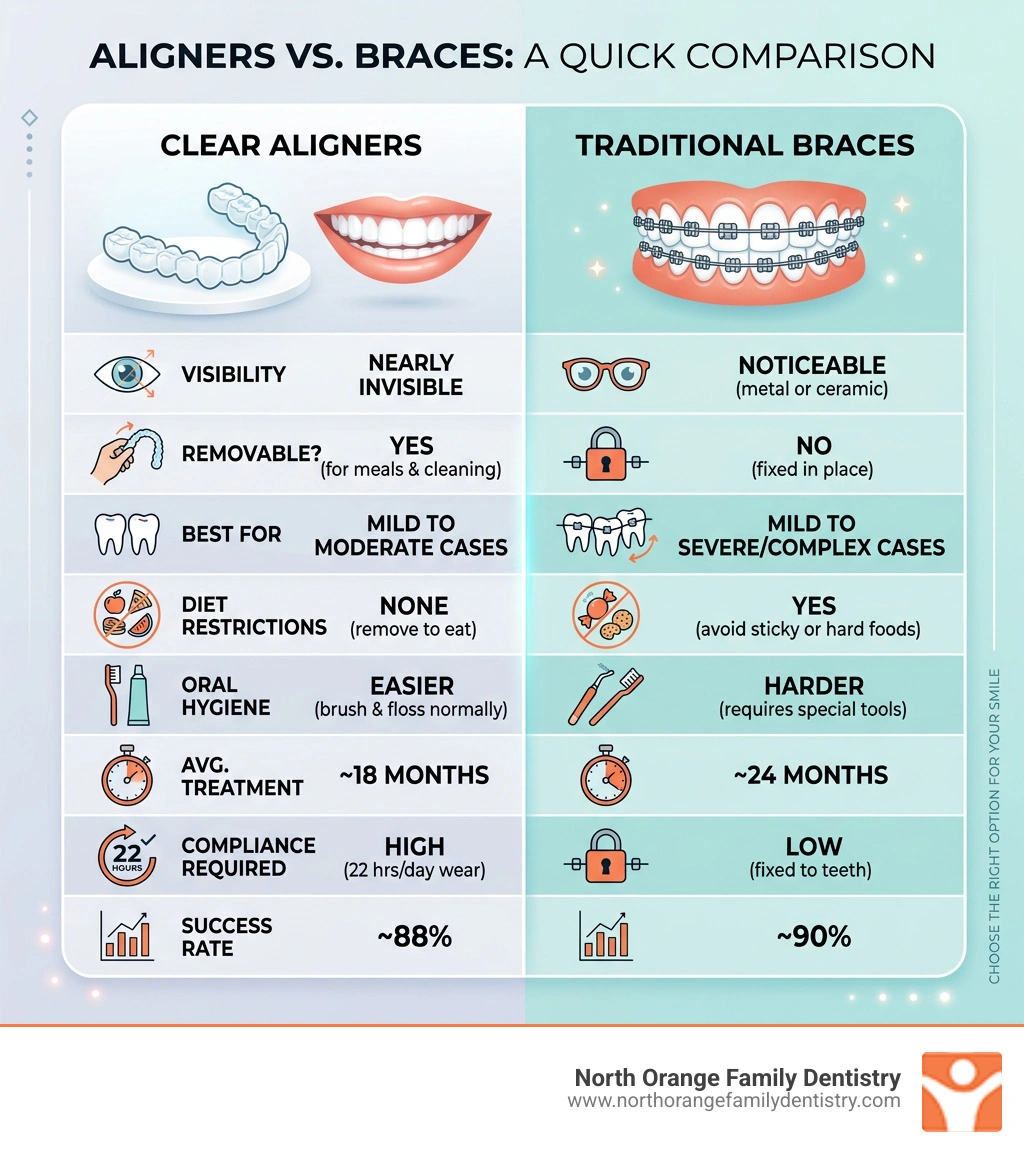
Aligners vs braces basics:
Understanding the Mechanics: Aligners vs Braces
To choose the right path, we first need to look under the hood. While both systems aim for the same finish line — a healthy, straight smile — they use very different engineering to get there.
How Clear Aligners Work
Clear aligners, such as Invisalign, are custom-made trays crafted from a specialized thermoplastic polyurethane. This medical-grade plastic is smooth, thin, and designed to fit snugly over your teeth.
The magic happens through a series of these trays. Each set is slightly different from the last, engineered to apply gentle, controlled pressure to specific teeth. Using 3D digital planning, we can map out your entire "smile journey" before you even put in your first tray. You typically switch to a new set every one to two weeks, gradually nudging your teeth into their ideal positions.

How Traditional Braces Work
Traditional braces are a bit more "heavy-duty." They consist of stainless steel or ceramic brackets glued to each tooth, connected by a flexible archwire. These are held in place by small rubber bands called ligatures.
Unlike the incremental steps of aligners, braces provide a constant, 24/7 force. Every 4 to 8 weeks, we tighten or adjust the wire to keep the teeth moving. This system is incredibly powerful because it allows for high-precision control over every single tooth, including vertical movements and complex rotations. According to scientific research on tooth movement efficacy, this mechanical control is why braces remain the gold standard for complex cases.
If you are interested in a more discreet look, you can learn more about advanced-dentistry/invisalign at our practice.
Aesthetics and Lifestyle: Choosing Your Look
For many of our adult patients in the Delaware and Lewis Center area, aesthetics are the deciding factor. We understand — you have board meetings, weddings, and social lives where you might not want a "metal mouth" look.
The Invisible Edge
Clear aligners win the "hide and seek" contest every time. They are virtually invisible from a distance. However, keep in mind that many treatments require "attachments" — tiny, tooth-colored bumps of composite resin bonded to your teeth to help the aligner grip. While these are discreet, they aren't completely invisible.
The Modern Brace Look
Braces have also had a glow-up! Modern brackets are smaller and more streamlined than the "train tracks" of the past. We also offer ceramic braces, which use clear or tooth-colored brackets to blend in with your enamel. For younger patients, the ability to choose colored bands for their metal brackets is often a fun way to express their personality.
Dietary Freedom with Aligners vs Braces
One of the biggest lifestyle differences involves what you can eat.
With clear-aligners-for-teeth, there are zero dietary restrictions. Why? Because you take them out to eat! You can still enjoy corn on the cob, crunchy apples, and even the occasional sticky treat without fear.
Braces require a bit more sacrifice. To avoid breaking a bracket or bending a wire, you’ll need to steer clear of:
- Sticky candies (caramels, taffy)
- Hard nuts and seeds
- Crunchy snacks like popcorn or hard pretzels
- Biting directly into hard fruits (you'll need to cut those apples into slices!)
For more tips, check out our guide on how-to-care-for-your-teeth-with-braces.
Clinical Effectiveness and Treatment Duration
When comparing aligners vs braces, we have to talk about results. Does one work faster or better than the other?
Treatment Speed
In many mild to moderate cases, aligners can actually be faster. A study published in the Journal of Orthodontics found that Invisalign treatment averaged around 18 months, compared to 24 months for traditional braces. However, this depends entirely on the patient's discipline. If you don't wear your aligners, they don't work!
Complexity of the Case
While technology is catching up, braces are still the champions of complex malocclusions. If you have severe crowding, significant bite issues (like a deep overbite or underbite), or teeth that need to be rotated significantly, braces offer the mechanical leverage needed for a predictable result.
Recent scientific research on treatment duration highlights that while aligners are efficient for simple adjustments, braces provide more stability for large-scale tooth movement. Regardless of which you choose, you can find more information on aligners-for-crooked-teeth to see how we handle these cases.
Cost, Compliance, and Long-Term Value
At North Orange Family Dentistry, we want to make sure your investment in your smile is one that lasts a lifetime.
The Financial Side
Generally, traditional braces are slightly more budget-friendly, typically ranging from $2,500 to $7,000. Clear aligners often range from $3,000 to $8,000. Many insurance plans now cover both options similarly, but it’s always worth checking your specific policy.
To help our Delaware County neighbors, we offer a Dental Wellness Plan. This is a great option for individuals or families without insurance, allowing you to get your necessary yearly care at a discounted price, making your path to a straighter smile more accessible. You can read more about the average-price-of-invisalign to help with your budgeting.
Stability and Success
Success rates for both are high: approximately 88% for aligners and 90% for braces. The small difference usually comes down to "relapse," which happens if a patient doesn't wear their retainers after treatment. Whether you choose aligners-and-retainers or braces, you must wear a retainer to keep your teeth in place. Learn more about night-retainers-after-braces and clear-aligner-retainer options.
Compliance and Responsibility in Aligners vs Braces
This is the "make or break" factor for aligners. You must wear them for at least 22 hours a day. This means they only come out for eating and cleaning. If you think you'll forget to put them back in or lose them at a restaurant, braces might be the safer bet.
Braces are "fixed," meaning they are working 24/7 without you having to think about it. However, they do require more work during your oral hygiene routine. You'll need to use floss threaders or interdental brushes to get around the hardware. Check out our advice on 5-invisalign-mistakes-you-could-be-making---are-you-guilty to see if aligners are a good fit for your personality.
Conclusion
Choosing between aligners vs braces isn't a decision you have to make alone. At North Orange Family Dentistry, Dr. Kyle Bogan and our team of experts use advanced technology to diagnose your specific needs and help you pick the most effective path.
We aren't just here for straightening, either. We offer a full menu of advanced care, including laser treatments for TMJ pain and periodontal disease, which can be a game-changer if you experience jaw discomfort during orthodontic movement. Plus, if you ever have a bracket break or an aligner emergency, we offer same-day emergency dental appointments most of the time.
Ready to see which option is right for you? Visit our page on advanced-dentistry/invisalign to schedule your consultation.
Are aligners suitable for severe bite issues?
Generally, aligners are best for mild to moderate issues. For severe bite corrections, your doctor might recommend braces or even a "hybrid" approach where you start with braces and finish with aligners.
How do hygiene requirements differ?
Aligners are much easier for hygiene because you remove them to brush and floss. Braces require more diligent cleaning with special tools to prevent plaque buildup around the brackets. You can find more details on how-to-floss-with-a-fixed-lingural-ortho-retainer on our blog.
Which option is more comfortable?
Aligners are usually more comfortable as they are made of smooth plastic. Braces can sometimes irritate the cheeks and gums, especially right after an adjustment. However, both will cause some initial pressure as your teeth begin to move!
North Orange Family Dentistry serves families in Lewis Center, Delaware, Powell, and the greater Columbus area. Whether you're looking for straighten-crooked-teeth solutions or clear-retainers-to-straighten-teeth, we're here to provide a five-star experience.
The Real Difference Between Aligners vs Braces (And How to Choose)
Aligners vs braces are both proven ways to straighten teeth — but they work differently, feel different, and suit different situations.
Here's the quick version: clear aligners are nearly invisible, removable, and usually best for mild to moderate cases. Because you take them out to eat, they do not come with the same food restrictions as braces, and brushing and flossing are typically easier. The tradeoff is that aligners require strong daily compliance — usually about 22 hours of wear per day — and treatment averages around 18 months for many cases.
Traditional braces are more noticeable, whether metal or ceramic, but they stay fixed to your teeth and work continuously. They can treat mild cases as well as more severe or complex bite problems, but they usually require avoiding sticky or hard foods and taking extra care with brushing and flossing around brackets and wires. Treatment often averages closer to 24 months, and success rates are high for both options — about 88% for aligners and 90% for braces.
The short answer? Neither option is automatically better. The right choice depends on your specific bite issues, lifestyle, and how disciplined you are about wearing a removable device.
Now here's the longer answer.
Orthodontic treatment has come a long way. A generation ago, metal braces were basically the only option. Today, millions of people — including nearly 1 in 4 orthodontic patients who are adults — are choosing between traditional braces and clear aligners like Invisalign.
It's one of the most common questions patients bring up. And it makes sense. You're committing to months of treatment, real money, and daily habits. You want to get it right.
The good news: both options work. The challenge is knowing which one works for you.
Aligners vs braces basics:
Understanding the Mechanics: Aligners vs Braces
To choose the right path, we first need to look under the hood. While both systems aim for the same finish line — a healthy, straight smile — they use very different engineering to get there.
How Clear Aligners Work
Clear aligners, such as Invisalign, are custom-made trays crafted from a specialized thermoplastic polyurethane. This medical-grade plastic is smooth, thin, and designed to fit snugly over your teeth.
The magic happens through a series of these trays. Each set is slightly different from the last, engineered to apply gentle, controlled pressure to specific teeth. Using 3D digital planning, we can map out your entire "smile journey" before you even put in your first tray. You typically switch to a new set every one to two weeks, gradually nudging your teeth into their ideal positions.
How Traditional Braces Work
Traditional braces are a bit more "heavy-duty." They consist of stainless steel or ceramic brackets glued to each tooth, connected by a flexible archwire. These are held in place by small rubber bands called ligatures.
Unlike the incremental steps of aligners, braces provide a constant, 24/7 force. Every 4 to 8 weeks, we tighten or adjust the wire to keep the teeth moving. This system is incredibly powerful because it allows for high-precision control over every single tooth, including vertical movements and complex rotations. According to scientific research on tooth movement efficacy, this mechanical control is why braces remain the gold standard for complex cases.
If you are interested in a more discreet look, you can learn more about advanced-dentistry/invisalign at our practice.
Aesthetics and Lifestyle: Choosing Your Look
For many of our adult patients in the Delaware and Lewis Center area, aesthetics are the deciding factor. We understand — you have board meetings, weddings, and social lives where you might not want a "metal mouth" look.
The Invisible Edge
Clear aligners win the "hide and seek" contest every time. They are virtually invisible from a distance. However, keep in mind that many treatments require "attachments" — tiny, tooth-colored bumps of composite resin bonded to your teeth to help the aligner grip. While these are discreet, they aren't completely invisible.
The Modern Brace Look
Braces have also had a glow-up! Modern brackets are smaller and more streamlined than the "train tracks" of the past. We also offer ceramic braces, which use clear or tooth-colored brackets to blend in with your enamel. For younger patients, the ability to choose colored bands for their metal brackets is often a fun way to express their personality.
Dietary Freedom with Aligners vs Braces
One of the biggest lifestyle differences involves what you can eat.
With clear-aligners-for-teeth, there are zero dietary restrictions. Why? Because you take them out to eat! You can still enjoy corn on the cob, crunchy apples, and even the occasional sticky treat without fear.
Braces require a bit more sacrifice. To avoid breaking a bracket or bending a wire, you’ll need to steer clear of:
- Sticky candies (caramels, taffy)
- Hard nuts and seeds
- Crunchy snacks like popcorn or hard pretzels
- Biting directly into hard fruits (you'll need to cut those apples into slices!)
For more tips, check out our guide on how-to-care-for-your-teeth-with-braces.
Clinical Effectiveness and Treatment Duration
When comparing aligners vs braces, we have to talk about results. Does one work faster or better than the other?
Treatment Speed
In many mild to moderate cases, aligners can actually be faster. A study published in the Journal of Orthodontics found that Invisalign treatment averaged around 18 months, compared to 24 months for traditional braces. However, this depends entirely on the patient's discipline. If you don't wear your aligners, they don't work!
Complexity of the Case
While technology is catching up, braces are still the champions of complex malocclusions. If you have severe crowding, significant bite issues (like a deep overbite or underbite), or teeth that need to be rotated significantly, braces offer the mechanical leverage needed for a predictable result.
Recent scientific research on treatment duration highlights that while aligners are efficient for simple adjustments, braces provide more stability for large-scale tooth movement. Regardless of which you choose, you can find more information on aligners-for-crooked-teeth to see how we handle these cases.
Cost, Compliance, and Long-Term Value
At North Orange Family Dentistry, we want to make sure your investment in your smile is one that lasts a lifetime.
The Financial Side
Generally, traditional braces are slightly more budget-friendly, typically ranging from $2,500 to $7,000. Clear aligners often range from $3,000 to $8,000. Many insurance plans now cover both options similarly, but it’s always worth checking your specific policy.
To help our Delaware County neighbors, we offer a Dental Wellness Plan. This is a great option for individuals or families without insurance, allowing you to get your necessary yearly care at a discounted price, making your path to a straighter smile more accessible. You can read more about the average-price-of-invisalign to help with your budgeting.
Stability and Success
Success rates for both are high: approximately 88% for aligners and 90% for braces. The small difference usually comes down to "relapse," which happens if a patient doesn't wear their retainers after treatment. Whether you choose aligners-and-retainers or braces, you must wear a retainer to keep your teeth in place. Learn more about night-retainers-after-braces and clear-aligner-retainer options.
Compliance and Responsibility in Aligners vs Braces
This is the "make or break" factor for aligners. You must wear them for at least 22 hours a day. This means they only come out for eating and cleaning. If you think you'll forget to put them back in or lose them at a restaurant, braces might be the safer bet.
Braces are "fixed," meaning they are working 24/7 without you having to think about it. However, they do require more work during your oral hygiene routine. You'll need to use floss threaders or interdental brushes to get around the hardware. Check out our advice on 5-invisalign-mistakes-you-could-be-making---are-you-guilty to see if aligners are a good fit for your personality.
Conclusion
Choosing between aligners vs braces isn't a decision you have to make alone. At North Orange Family Dentistry, Dr. Kyle Bogan and our team of experts use advanced technology to diagnose your specific needs and help you pick the most effective path.
We aren't just here for straightening, either. We offer a full menu of advanced care, including laser treatments for TMJ pain and periodontal disease, which can be a game-changer if you experience jaw discomfort during orthodontic movement. Plus, if you ever have a bracket break or an aligner emergency, we offer same-day emergency dental appointments most of the time.
Ready to see which option is right for you? Visit our page on advanced-dentistry/invisalign to schedule your consultation.
Are aligners suitable for severe bite issues?
Generally, aligners are best for mild to moderate issues. For severe bite corrections, your doctor might recommend braces or even a "hybrid" approach where you start with braces and finish with aligners.
How do hygiene requirements differ?
Aligners are much easier for hygiene because you remove them to brush and floss. Braces require more diligent cleaning with special tools to prevent plaque buildup around the brackets. You can find more details on how-to-floss-with-a-fixed-lingural-ortho-retainer on our blog.
Which option is more comfortable?
Aligners are usually more comfortable as they are made of smooth plastic. Braces can sometimes irritate the cheeks and gums, especially right after an adjustment. However, both will cause some initial pressure as your teeth begin to move!
North Orange Family Dentistry serves families in Lewis Center, Delaware, Powell, and the greater Columbus area. Whether you're looking for straighten-crooked-teeth solutions or clear-retainers-to-straighten-teeth, we're here to provide a five-star experience.
Contact Us
Have any questions? Want to learn more?

