
Don't Mess Up Your Root Canal with These Common Mistakes
Avoid these root canal mistakes: what not to do after a root canal. Eat soft foods, skip smoking & hard foods for smooth recovery!



Why What You Do After a Root Canal Matters More Than You Think
Knowing what not to do after a root canal can be the difference between a smooth recovery and a painful setback. Root canals have a 90–95% success rate — but that success depends heavily on what happens after you leave the dental chair.
Here's a quick overview of the most important things to avoid:
- Don't eat while still numb — you risk biting your cheek or burning your mouth
- Don't chew on the treated tooth — it's vulnerable until permanently restored
- Don't use a straw — suction can disturb healing tissue
- Don't smoke or drink alcohol — both slow healing and raise infection risk
- Don't skip follow-up appointments — your dentist needs to confirm proper healing
- Don't delay your permanent crown — an unprotected tooth can fracture or get reinfected
- Don't ignore severe pain or swelling — these can be signs of complications
- Don't jump back into strenuous exercise — increased blood flow can worsen swelling
Most post-root canal problems aren't caused by the procedure itself. They're caused by aftercare slip-ups in the days and weeks that follow.
Over 15 million root canals are performed in the U.S. every year. Yet about 5.3% of patients still report persistent pain six months later — often linked to avoidable mistakes during recovery.
The good news? With a little care, most people find recovery very manageable. About 95% report that any post-procedure discomfort is handled easily with over-the-counter pain relief.
Read on for a full breakdown of every mistake to avoid — and exactly what to do instead.
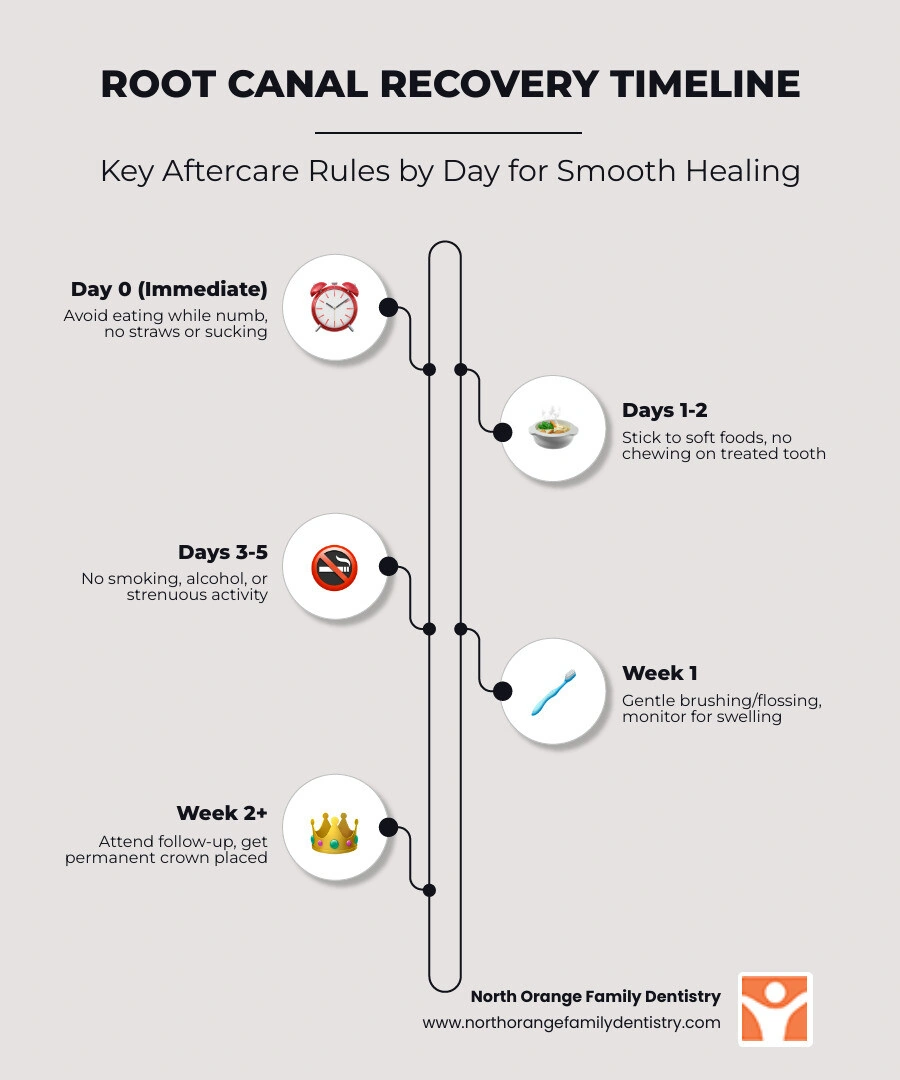
Immediate Post-Op: What Not to Do After a Root Canal
The first few hours after you leave our office are the most critical. Your mouth is likely still numb, and the treated area is beginning its inflammatory response. This is the time when most accidental injuries occur. When considering recovery after root canal care, the goal is to protect the work we just did while keeping you comfortable.
One of the biggest mistakes patients make is thinking they are "in the clear" just because they can't feel any pain yet. The local anesthesia is doing its job, but your tissues are still vulnerable. We always provide a detailed set of aftercare instructions, but the following "don'ts" are the most frequent culprits for post-op calls.
Don't Eat Before the Numbness Wears Off
It usually takes about two to four hours for the local anesthetic to completely wear off. During this window, you have very little control over your lip, cheek, and tongue. We have seen many patients come back with significant soft tissue injuries because they tried to eat a "quick snack" while still numb.
You can easily bite your cheek or tongue hard enough to cause bleeding without even realizing it. Furthermore, because you can't feel temperature correctly, you run a high risk of burning your mouth with hot coffee or soup. If you are wondering how long do root canals take to recover from, the answer starts with waiting those first few hours until your sensation returns.
Avoid Using Straws or Sucking Actions
While it might seem easier to sip a smoothie through a straw when your mouth feels awkward, this is a major "no-no." The suction pressure created by using a straw—or even vigorous spitting—can disturb the healing tissue and the temporary filling we’ve placed.
In some cases, this pressure can even dislodge the blood clots that are essential for the healing of the surrounding gums. Stick to sipping directly from a cup to keep the pressure in your mouth neutralized.
Dietary Restrictions: Foods to Avoid for a Smooth Recovery
Your tooth is in a transitional state. We have removed the infected pulp and sealed the canals, but the tooth structure itself is often more brittle than a healthy tooth. Until it is reinforced with a permanent restoration, it is prone to fractures. Understanding the root canal procedure explained helps you realize that the tooth is currently "hollowed out" and needs gentle care.
Steer Clear of Hard, Crunchy, or Sticky Foods
A temporary filling is exactly what it sounds like—temporary. It is designed to be easily removed when you return for your permanent crown, which also means it isn't strong enough to withstand "the crunch."
- Hard/Crunchy Foods: Avoid nuts, seeds, ice cubes, and hard bread crusts. These can cause the treated tooth to crack or even shatter.
- Sticky Foods: Stay away from taffy, gum, and caramel. These can literally pull the temporary filling right out of your tooth, exposing the sterile canals to bacteria from your saliva.
- Small Seeds: Foods like raspberries or sesame seeds can get lodged in the tiny crevices around a temporary filling, leading to irritation or potential infection.
Why You Shouldn't Chew on the Treated Tooth
Even if you are eating soft foods, try to do all your chewing on the opposite side of your mouth. A root canal involves cleaning out the very center of the tooth, and the ligaments surrounding the root are often inflamed after the procedure.
Every time you bite down on that tooth, you are putting pressure on those inflamed ligaments. This can lead to a "throbbing" sensation and prolong your discomfort. By "resting" the tooth for a few days, you allow the inflammation to subside much faster.
Lifestyle Habits That Can Ruin Your Results
Your body needs resources to heal. Anything that restricts blood flow or increases systemic inflammation is going to make your recovery longer and potentially more painful.
Don't Smoke or Use Tobacco Products after a Root Canal
Smoking is one of the leading causes of dental procedure failure. The chemicals in tobacco smoke cause "vasoconstriction," which is a fancy way of saying they shrink your blood vessels. This reduces the amount of oxygen and nutrients reaching the treated area.
According to Scientific research on smoking and endodontic healing, tobacco use significantly delays the body's ability to regenerate gum and bone tissue. If there was ever a time to try to quit, or at least take a 48-hour break, it’s right after your root canal.
Avoid Alcohol and Strenuous Activity
We know you might want a drink to relax after a dental appointment, but alcohol can interact poorly with any pain medications we may have prescribed or recommended. It can also increase the risk of post-operative bleeding.
Regarding physical activity, we recommend taking it easy for at least 24 to 48 hours. When your heart rate increases during a workout, blood pressure rises throughout your body, including in your mouth. This can lead to increased throbbing and swelling at the treatment site. For more on managing your body's response, you can look at our periodontal scaling and root planning post-op instructions, as many of the same rest principles apply.
Long-Term Mistakes: What Not to Do After a Root Canal Procedure
The root canal itself is often just "Phase 1." Many patients make the mistake of thinking that because the pain is gone, the treatment is finished. This is a dangerous assumption that leads to many avoidable tooth extractions.
Never Skip Your Follow-Up Appointments
We need to see you back to ensure the infection is completely gone and the tooth is healing as expected. Sometimes, we use digital X-rays to verify that the bone is regenerating around the root tips. A root canal specialist or your general dentist uses these visits to catch "silent" issues before they become emergencies. You can find more details on these protocols in the Root Canal Post Treatment Care - Endodontists guidelines.
Don't Delay Getting Your Permanent Crown
This is perhaps the most important point of all. A tooth that has had a dental root canal is essentially a shell. Without the blood supply from the pulp, the tooth becomes brittle over time.
If you delay getting your permanent crown, the tooth is at high risk of "coronal leakage"—where bacteria seep past the temporary filling and reinfect the canals. Even worse, the tooth could fracture in a way that makes it impossible to save, forcing us to extract it. Check out More info about dental crown services to see how we restore the strength and beauty of your smile.
Warning Signs: When to Contact Your Dentist Immediately
While some tenderness is normal, you should never have to suffer through "unbearable" pain. At North Orange Family Dentistry, we pride ourselves on being a modern, full-service facility that handles emergencies with compassion and speed.
Managing Persistent Pain and Swelling
Most post-procedure pain is manageable with over-the-counter medications like Ibuprofen or Acetaminophen. However, you should call us immediately if you experience:
- Visible Swelling: Especially if it is visible on the outside of your face or neck.
- Fever: This could indicate the infection is spreading.
- An Uneven Bite: If the temporary filling feels "high," it can cause intense pain every time you close your mouth.
- A Bad Taste: This could mean the temporary filling has leaked or dislodged.
We offer same-day emergency dental appointments most of the time. We also feature advanced laser treatments that can help with healing and pain management.
Frequently Asked Questions about Root Canal Aftercare
How long should I avoid hard foods?
You should avoid hard, crunchy, or sticky foods on the treated side until your permanent crown or filling is placed. This usually takes about one to two weeks, depending on our laboratory schedule.
Is it safe to brush and floss the treated area?
Yes! In fact, keeping the area clean is vital for preventing infection. However, be very gentle. Use a soft-bristled toothbrush. When flossing, instead of pulling the floss back "up" through the teeth (which can snag the temporary filling), pull it out through the side.
What happens if my temporary filling falls out?
Don't panic, but don't wait. The temporary filling protects the sterile interior of your tooth. If it falls out, bacteria from your mouth can enter the canals. Call us right away so we can replace it and keep your root canal successful.
Conclusion
At North Orange Family Dentistry, Dr. Kyle Bogan and our entire team are dedicated to making your root canal experience as comfortable and successful as possible. We serve families across Delaware, Lewis Center, and the greater Columbus area with a commitment to five-star care.
We understand that dental work can be a significant investment in your health. If you don't have insurance, we offer an in-house Dental Wellness Plan. This plan allows individuals and families to get the yearly preventive care they need—and discounts on restorative work like root canals—for an affordable, transparent price.
Don't let a "hush-hush" infection turn into a lost tooth. If you’re experiencing pain or have been told you need treatment, Schedule a root canal consultation with us today. We’ll get you back to smiling, eating, and living pain-free in no time!
Why What You Do After a Root Canal Matters More Than You Think
Knowing what not to do after a root canal can be the difference between a smooth recovery and a painful setback. Root canals have a 90–95% success rate — but that success depends heavily on what happens after you leave the dental chair.
Here's a quick overview of the most important things to avoid:
- Don't eat while still numb — you risk biting your cheek or burning your mouth
- Don't chew on the treated tooth — it's vulnerable until permanently restored
- Don't use a straw — suction can disturb healing tissue
- Don't smoke or drink alcohol — both slow healing and raise infection risk
- Don't skip follow-up appointments — your dentist needs to confirm proper healing
- Don't delay your permanent crown — an unprotected tooth can fracture or get reinfected
- Don't ignore severe pain or swelling — these can be signs of complications
- Don't jump back into strenuous exercise — increased blood flow can worsen swelling
Most post-root canal problems aren't caused by the procedure itself. They're caused by aftercare slip-ups in the days and weeks that follow.
Over 15 million root canals are performed in the U.S. every year. Yet about 5.3% of patients still report persistent pain six months later — often linked to avoidable mistakes during recovery.
The good news? With a little care, most people find recovery very manageable. About 95% report that any post-procedure discomfort is handled easily with over-the-counter pain relief.
Read on for a full breakdown of every mistake to avoid — and exactly what to do instead.
Immediate Post-Op: What Not to Do After a Root Canal
The first few hours after you leave our office are the most critical. Your mouth is likely still numb, and the treated area is beginning its inflammatory response. This is the time when most accidental injuries occur. When considering recovery after root canal care, the goal is to protect the work we just did while keeping you comfortable.
One of the biggest mistakes patients make is thinking they are "in the clear" just because they can't feel any pain yet. The local anesthesia is doing its job, but your tissues are still vulnerable. We always provide a detailed set of aftercare instructions, but the following "don'ts" are the most frequent culprits for post-op calls.
Don't Eat Before the Numbness Wears Off
It usually takes about two to four hours for the local anesthetic to completely wear off. During this window, you have very little control over your lip, cheek, and tongue. We have seen many patients come back with significant soft tissue injuries because they tried to eat a "quick snack" while still numb.
You can easily bite your cheek or tongue hard enough to cause bleeding without even realizing it. Furthermore, because you can't feel temperature correctly, you run a high risk of burning your mouth with hot coffee or soup. If you are wondering how long do root canals take to recover from, the answer starts with waiting those first few hours until your sensation returns.
Avoid Using Straws or Sucking Actions
While it might seem easier to sip a smoothie through a straw when your mouth feels awkward, this is a major "no-no." The suction pressure created by using a straw—or even vigorous spitting—can disturb the healing tissue and the temporary filling we’ve placed.
In some cases, this pressure can even dislodge the blood clots that are essential for the healing of the surrounding gums. Stick to sipping directly from a cup to keep the pressure in your mouth neutralized.
Dietary Restrictions: Foods to Avoid for a Smooth Recovery
Your tooth is in a transitional state. We have removed the infected pulp and sealed the canals, but the tooth structure itself is often more brittle than a healthy tooth. Until it is reinforced with a permanent restoration, it is prone to fractures. Understanding the root canal procedure explained helps you realize that the tooth is currently "hollowed out" and needs gentle care.
Steer Clear of Hard, Crunchy, or Sticky Foods
A temporary filling is exactly what it sounds like—temporary. It is designed to be easily removed when you return for your permanent crown, which also means it isn't strong enough to withstand "the crunch."
- Hard/Crunchy Foods: Avoid nuts, seeds, ice cubes, and hard bread crusts. These can cause the treated tooth to crack or even shatter.
- Sticky Foods: Stay away from taffy, gum, and caramel. These can literally pull the temporary filling right out of your tooth, exposing the sterile canals to bacteria from your saliva.
- Small Seeds: Foods like raspberries or sesame seeds can get lodged in the tiny crevices around a temporary filling, leading to irritation or potential infection.
Why You Shouldn't Chew on the Treated Tooth
Even if you are eating soft foods, try to do all your chewing on the opposite side of your mouth. A root canal involves cleaning out the very center of the tooth, and the ligaments surrounding the root are often inflamed after the procedure.
Every time you bite down on that tooth, you are putting pressure on those inflamed ligaments. This can lead to a "throbbing" sensation and prolong your discomfort. By "resting" the tooth for a few days, you allow the inflammation to subside much faster.
Lifestyle Habits That Can Ruin Your Results
Your body needs resources to heal. Anything that restricts blood flow or increases systemic inflammation is going to make your recovery longer and potentially more painful.
Don't Smoke or Use Tobacco Products after a Root Canal
Smoking is one of the leading causes of dental procedure failure. The chemicals in tobacco smoke cause "vasoconstriction," which is a fancy way of saying they shrink your blood vessels. This reduces the amount of oxygen and nutrients reaching the treated area.
According to Scientific research on smoking and endodontic healing, tobacco use significantly delays the body's ability to regenerate gum and bone tissue. If there was ever a time to try to quit, or at least take a 48-hour break, it’s right after your root canal.
Avoid Alcohol and Strenuous Activity
We know you might want a drink to relax after a dental appointment, but alcohol can interact poorly with any pain medications we may have prescribed or recommended. It can also increase the risk of post-operative bleeding.
Regarding physical activity, we recommend taking it easy for at least 24 to 48 hours. When your heart rate increases during a workout, blood pressure rises throughout your body, including in your mouth. This can lead to increased throbbing and swelling at the treatment site. For more on managing your body's response, you can look at our periodontal scaling and root planning post-op instructions, as many of the same rest principles apply.
Long-Term Mistakes: What Not to Do After a Root Canal Procedure
The root canal itself is often just "Phase 1." Many patients make the mistake of thinking that because the pain is gone, the treatment is finished. This is a dangerous assumption that leads to many avoidable tooth extractions.
Never Skip Your Follow-Up Appointments
We need to see you back to ensure the infection is completely gone and the tooth is healing as expected. Sometimes, we use digital X-rays to verify that the bone is regenerating around the root tips. A root canal specialist or your general dentist uses these visits to catch "silent" issues before they become emergencies. You can find more details on these protocols in the Root Canal Post Treatment Care - Endodontists guidelines.
Don't Delay Getting Your Permanent Crown
This is perhaps the most important point of all. A tooth that has had a dental root canal is essentially a shell. Without the blood supply from the pulp, the tooth becomes brittle over time.
If you delay getting your permanent crown, the tooth is at high risk of "coronal leakage"—where bacteria seep past the temporary filling and reinfect the canals. Even worse, the tooth could fracture in a way that makes it impossible to save, forcing us to extract it. Check out More info about dental crown services to see how we restore the strength and beauty of your smile.
Warning Signs: When to Contact Your Dentist Immediately
While some tenderness is normal, you should never have to suffer through "unbearable" pain. At North Orange Family Dentistry, we pride ourselves on being a modern, full-service facility that handles emergencies with compassion and speed.
Managing Persistent Pain and Swelling
Most post-procedure pain is manageable with over-the-counter medications like Ibuprofen or Acetaminophen. However, you should call us immediately if you experience:
- Visible Swelling: Especially if it is visible on the outside of your face or neck.
- Fever: This could indicate the infection is spreading.
- An Uneven Bite: If the temporary filling feels "high," it can cause intense pain every time you close your mouth.
- A Bad Taste: This could mean the temporary filling has leaked or dislodged.
We offer same-day emergency dental appointments most of the time. We also feature advanced laser treatments that can help with healing and pain management.
Frequently Asked Questions about Root Canal Aftercare
How long should I avoid hard foods?
You should avoid hard, crunchy, or sticky foods on the treated side until your permanent crown or filling is placed. This usually takes about one to two weeks, depending on our laboratory schedule.
Is it safe to brush and floss the treated area?
Yes! In fact, keeping the area clean is vital for preventing infection. However, be very gentle. Use a soft-bristled toothbrush. When flossing, instead of pulling the floss back "up" through the teeth (which can snag the temporary filling), pull it out through the side.
What happens if my temporary filling falls out?
Don't panic, but don't wait. The temporary filling protects the sterile interior of your tooth. If it falls out, bacteria from your mouth can enter the canals. Call us right away so we can replace it and keep your root canal successful.
Conclusion
At North Orange Family Dentistry, Dr. Kyle Bogan and our entire team are dedicated to making your root canal experience as comfortable and successful as possible. We serve families across Delaware, Lewis Center, and the greater Columbus area with a commitment to five-star care.
We understand that dental work can be a significant investment in your health. If you don't have insurance, we offer an in-house Dental Wellness Plan. This plan allows individuals and families to get the yearly preventive care they need—and discounts on restorative work like root canals—for an affordable, transparent price.
Don't let a "hush-hush" infection turn into a lost tooth. If you’re experiencing pain or have been told you need treatment, Schedule a root canal consultation with us today. We’ll get you back to smiling, eating, and living pain-free in no time!
Contact Us
Have any questions? Want to learn more?

