
Bonding with Your Dentist and How the Procedure Works
Discover how dental bonding works: quick, non-invasive cosmetic procedure for perfect smiles. Procedure, benefits, costs & care guide.


A Simple Answer to How Dental Bonding Works
How dental bonding works is easier to understand than most people expect — and the short version is this:
- Color match — Your dentist picks a composite resin shade that matches your natural tooth color.
- Prep the surface — The tooth is lightly roughened and a conditioning liquid is applied so the resin sticks.
- Apply the resin — The tooth-colored composite is applied, then molded and shaped by hand.
- Cure with light — A special UV or LED light hardens the resin in seconds.
- Polish — The tooth is trimmed and polished until it looks and feels natural.
That's it. One visit. No surgery. Usually no anesthesia.
Dental bonding is one of the most common cosmetic dental procedures — and one of the least invasive. It uses the same tooth-colored composite resin material as modern cavity fillings. In fact, composite resin is used in roughly 72% of all dental restorations today.
It's a go-to solution for chipped teeth, small gaps, discoloration, and minor cracks. The whole process typically takes 30 to 60 minutes per tooth, and most patients walk out the same day with a noticeably improved smile.
If you've been putting off fixing a chip or gap because you assumed it would be complicated or costly, bonding might be the straightforward option you've been looking for.
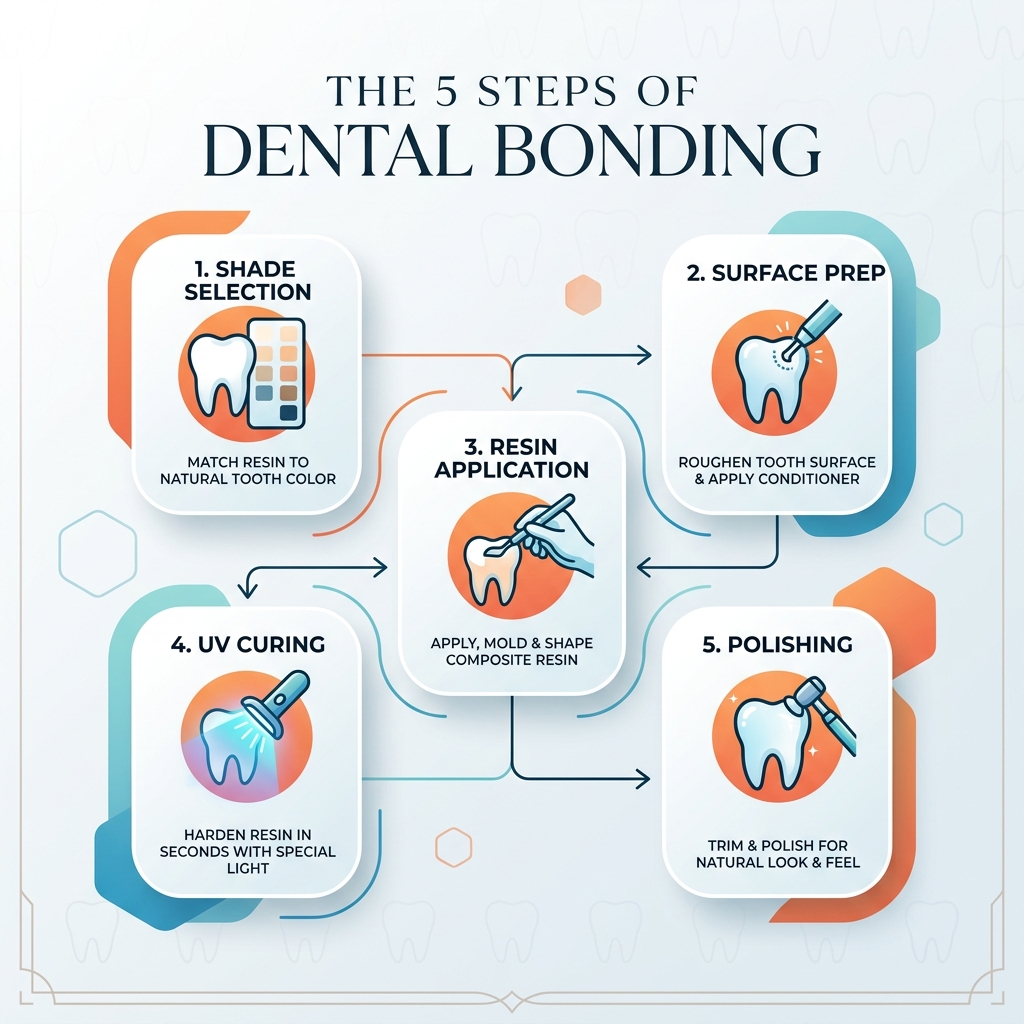
How dental bonding works glossary:
Understanding the Process: How Dental Bonding Works
At its core, dental bonding is a form of adhesive dentistry. Instead of creating a restoration in a lab (like a porcelain veneer or a crown) and then cementing it onto the tooth, we apply a pliable, putty-like restorative material directly to your tooth.
This material is known as composite resin, a durable plastic-based substance that mimics the translucency and strength of natural enamel. Because the material is applied while it is soft, we can sculpt it to the exact shape needed to close a gap or repair a jagged edge.
One of the reasons dental bonding in Ohio is so popular at our Lewis Center and Delaware offices is its versatility. It doesn't just fix chips; it can also:
- Repair decayed teeth (filling cavities with tooth-colored material).
- Protect a portion of the tooth's root that has been exposed due to gum recession.
- Change the shape of teeth to make them appear more uniform.
- Brighten teeth that have stubborn stains that don't respond to traditional whitening.
Our lead dentist, Dr. Kyle Bogan, is a Fellow of the International College of Dentists (FICD), placing him in the top 3% of dentists worldwide. This expertise ensures that when we discuss how dental bonding works, we aren't just slapping resin on a tooth; we are meticulously engineering a bond that is both beautiful and functional.

Step-by-Step: The Procedure from Start to Finish
Many patients feel a bit of "dental anxiety" before any procedure. However, understanding the teeth bonding procedure usually helps calm those nerves. Unlike more intensive treatments, tooth bonding is often described as one of the easiest and least expensive cosmetic dental procedures available.
When you visit us for dentist bonding, here is exactly what you can expect from start to finish.
Preparation and Shade Selection
The first step is all about aesthetics. We use a shade guide to compare various resin colors to your natural teeth. Our goal is best teeth bonding results, which means the resin should be indistinguishable from your natural enamel.
If you are planning to whiten your teeth, we often recommend doing so before the bonding procedure. Composite resin does not respond to whitening gels, so we want to match the resin to your "goal" shade. Once we have the perfect match, we can move forward. You can even look at dental bonding before after photos of previous patients to see how seamless the color matching can be!
The Application: How Dental Bonding Works on the Tooth Surface
Once the color is selected, we prepare the tooth. In most cases, anesthesia isn't even necessary unless we are also filling a cavity near a nerve.
We start by lightly roughening the surface of the tooth. This isn't painful; it’s more like a light "scuffing." We then apply a conditioning liquid, often containing a mild phosphoric acid. This "etches" the tooth on a microscopic level, creating tiny pores that allow the bonding agent to grip the surface.
Next, we apply the gentle dental bonding resin. This is where the artistry happens. We add the resin in layers, molding and smoothing it into the desired shape. This part of the process is truly the smile makeover phase, as we can instantly see the tooth taking on its new, improved form.
Curing and Polishing: Finalizing How Dental Bonding Works
After the resin is perfectly shaped, we use a specialized high-intensity blue LED or UV light. This light triggers a chemical reaction in the resin, causing it to harden (or "cure") in about 20 to 60 seconds.
Once the material is hard, we aren't quite finished. We further trim and shape the bonded area to ensure it doesn't interfere with your bite. Finally, we polish the tooth until its sheen matches the rest of your smile. This is particularly important for front teeth bonding, where the light hits the tooth directly.
Comparing Bonding to Veneers and Crowns
When patients ask us about how dental bonding works, they often want to know how it stacks up against other popular options like veneers or crowns.
The biggest difference between bonding and veneers is the impact on your natural tooth structure. Veneers typically require us to remove about 0.5mm to 1mm of enamel (sometimes up to 30% of the tooth's healthy tissue) to make room for the porcelain shell. Bonding, on the other hand, requires little to no enamel removal.
Another key factor is dental bonding vs veneers cost. Bonding is significantly more affordable and can be completed in a single visit, whereas veneers and crowns require dental impressions and a waiting period while a lab fabricates the restoration. However, it is important to remember that because bonding is less invasive, it is also less "permanent" than its porcelain counterparts.
Benefits, Risks, and Longevity of Bonded Teeth
While bonding is a fantastic "quick fix," it does have its limitations. Most patients can expect a lifespan of 3 to 10 years for their bonded teeth. Eventually, the material may need to be touched up or replaced.
One of the main questions we get is: is dental bonding permanent? The answer is no. Because we don't remove significant enamel, the procedure is actually reversible. If you decide later that you want veneers, the bonding can be removed.
Risks and Limitations
- Staining: Unlike porcelain, composite resin is porous. This means it can stain over time, especially if you are a fan of red wine, coffee, or tobacco.
- Chipping: While durable, resin isn't as strong as natural enamel or porcelain. Biting your fingernails or chewing on ice can cause the bonding to chip or break away.
- Durability: Scientific research suggests that while 72-88% of composite restorations last at least six years, they are generally best suited for low-pressure areas, like the front teeth, rather than the heavy-grinding surfaces of the back molars.
Caring for Your Smile and Managing Costs
Once your bonding is complete, you don't need any "special" tools to take care of it, but you do need to be consistent. We recommend using a soft-bristled toothbrush and non-abrasive fluoride toothpaste.
Pro-Tips for Longevity:
- Floss Horizontally: When flossing a bonded tooth, try pulling the floss out through the side rather than snapping it back up, which can occasionally catch on the edge of the resin.
- Avoid "Teeth as Tools": Never use your teeth to open packages, bite tape, or crack nuts.
- Mouthguards: If you play contact sports or grind your teeth at night (bruxism), we highly recommend a custom mouthguard to protect your investment.
Regarding the cost of dental bonding, prices vary depending on the complexity of the fix. For example, the cosmetic bonding cost for a tiny chip will be lower than the dental bonding gap cost for closing a large space between two teeth.
If you are worried about the cost of dental bonding without insurance, we have a solution. At North Orange Family Dentistry, we offer a Dental Wellness Plan. This plan is designed specifically for our patients in Delaware and Lewis Center who don't have traditional dental insurance. It allows you to get your necessary yearly care and discounts on restorative procedures like bonding for a simple, discounted price. We believe everyone deserves a five-star smile that fits their budget.
You can explore more about composite bonding prices and filling vs bonding costs by chatting with our front desk team.
Frequently Asked Questions about Dental Bonding
Is dental bonding painful?
In the vast majority of cases, the answer is no! Since we are only working on the surface of the enamel, there is no pain involved. Our dental bonding pain guide explains that anesthesia is usually only required if we are treating a deep cavity or an area near the sensitive nerve of the tooth. Some patients might experience very minor, short-term tooth sensitivity to cold or heat immediately following the procedure, but this typically fades within a day or two.
Can dental bonding be used for children?
Absolutely. Dental bonding for kids is a very common treatment in our office. Children are prone to dental trauma — whether it's a fall on the playground or a stray baseball. Because bonding is non-invasive and quick, it is an excellent way to repair a child's chipped tooth without the stress of a more complex procedure.
Can dental bonding be removed?
Yes. One of the greatest advantages of this procedure is that it is reversible. Because we don't have to grind down your natural tooth to apply the resin, the material can be safely removed by a dentist if you decide to upgrade to porcelain veneers or if you simply want to return to your natural tooth shape.
Conclusion
Understanding how dental bonding works reveals why it remains a favorite for both dentists and patients. It is fast, effective, and preserves the natural beauty of your smile. At North Orange Family Dentistry, we take pride in offering this "gentle" approach to cosmetic dentistry.
Led by Dr. Kyle Bogan and our talented team, including Dr. Cindy Ellinger, Dr. Richard Hall, and Dr. Daniel Brumley, we serve families across Lewis Center, Delaware, Powell, and Orange, Ohio. Whether you need a simple tooth bonding session or are interested in our advanced laser treatments for TMJ pain and canker sores, we are here to help.
If you have a dental emergency, don't wait — we are often able to see patients for same-day emergency appointments. Ready to see if bonding is right for you? Check out our dental bonding near me guide or contact us today to schedule your consultation!
A Simple Answer to How Dental Bonding Works
How dental bonding works is easier to understand than most people expect — and the short version is this:
- Color match — Your dentist picks a composite resin shade that matches your natural tooth color.
- Prep the surface — The tooth is lightly roughened and a conditioning liquid is applied so the resin sticks.
- Apply the resin — The tooth-colored composite is applied, then molded and shaped by hand.
- Cure with light — A special UV or LED light hardens the resin in seconds.
- Polish — The tooth is trimmed and polished until it looks and feels natural.
That's it. One visit. No surgery. Usually no anesthesia.
Dental bonding is one of the most common cosmetic dental procedures — and one of the least invasive. It uses the same tooth-colored composite resin material as modern cavity fillings. In fact, composite resin is used in roughly 72% of all dental restorations today.
It's a go-to solution for chipped teeth, small gaps, discoloration, and minor cracks. The whole process typically takes 30 to 60 minutes per tooth, and most patients walk out the same day with a noticeably improved smile.
If you've been putting off fixing a chip or gap because you assumed it would be complicated or costly, bonding might be the straightforward option you've been looking for.
How dental bonding works glossary:
Understanding the Process: How Dental Bonding Works
At its core, dental bonding is a form of adhesive dentistry. Instead of creating a restoration in a lab (like a porcelain veneer or a crown) and then cementing it onto the tooth, we apply a pliable, putty-like restorative material directly to your tooth.
This material is known as composite resin, a durable plastic-based substance that mimics the translucency and strength of natural enamel. Because the material is applied while it is soft, we can sculpt it to the exact shape needed to close a gap or repair a jagged edge.
One of the reasons dental bonding in Ohio is so popular at our Lewis Center and Delaware offices is its versatility. It doesn't just fix chips; it can also:
- Repair decayed teeth (filling cavities with tooth-colored material).
- Protect a portion of the tooth's root that has been exposed due to gum recession.
- Change the shape of teeth to make them appear more uniform.
- Brighten teeth that have stubborn stains that don't respond to traditional whitening.
Our lead dentist, Dr. Kyle Bogan, is a Fellow of the International College of Dentists (FICD), placing him in the top 3% of dentists worldwide. This expertise ensures that when we discuss how dental bonding works, we aren't just slapping resin on a tooth; we are meticulously engineering a bond that is both beautiful and functional.
Step-by-Step: The Procedure from Start to Finish
Many patients feel a bit of "dental anxiety" before any procedure. However, understanding the teeth bonding procedure usually helps calm those nerves. Unlike more intensive treatments, tooth bonding is often described as one of the easiest and least expensive cosmetic dental procedures available.
When you visit us for dentist bonding, here is exactly what you can expect from start to finish.
Preparation and Shade Selection
The first step is all about aesthetics. We use a shade guide to compare various resin colors to your natural teeth. Our goal is best teeth bonding results, which means the resin should be indistinguishable from your natural enamel.
If you are planning to whiten your teeth, we often recommend doing so before the bonding procedure. Composite resin does not respond to whitening gels, so we want to match the resin to your "goal" shade. Once we have the perfect match, we can move forward. You can even look at dental bonding before after photos of previous patients to see how seamless the color matching can be!
The Application: How Dental Bonding Works on the Tooth Surface
Once the color is selected, we prepare the tooth. In most cases, anesthesia isn't even necessary unless we are also filling a cavity near a nerve.
We start by lightly roughening the surface of the tooth. This isn't painful; it’s more like a light "scuffing." We then apply a conditioning liquid, often containing a mild phosphoric acid. This "etches" the tooth on a microscopic level, creating tiny pores that allow the bonding agent to grip the surface.
Next, we apply the gentle dental bonding resin. This is where the artistry happens. We add the resin in layers, molding and smoothing it into the desired shape. This part of the process is truly the smile makeover phase, as we can instantly see the tooth taking on its new, improved form.
Curing and Polishing: Finalizing How Dental Bonding Works
After the resin is perfectly shaped, we use a specialized high-intensity blue LED or UV light. This light triggers a chemical reaction in the resin, causing it to harden (or "cure") in about 20 to 60 seconds.
Once the material is hard, we aren't quite finished. We further trim and shape the bonded area to ensure it doesn't interfere with your bite. Finally, we polish the tooth until its sheen matches the rest of your smile. This is particularly important for front teeth bonding, where the light hits the tooth directly.
Comparing Bonding to Veneers and Crowns
When patients ask us about how dental bonding works, they often want to know how it stacks up against other popular options like veneers or crowns.
The biggest difference between bonding and veneers is the impact on your natural tooth structure. Veneers typically require us to remove about 0.5mm to 1mm of enamel (sometimes up to 30% of the tooth's healthy tissue) to make room for the porcelain shell. Bonding, on the other hand, requires little to no enamel removal.
Another key factor is dental bonding vs veneers cost. Bonding is significantly more affordable and can be completed in a single visit, whereas veneers and crowns require dental impressions and a waiting period while a lab fabricates the restoration. However, it is important to remember that because bonding is less invasive, it is also less "permanent" than its porcelain counterparts.
Benefits, Risks, and Longevity of Bonded Teeth
While bonding is a fantastic "quick fix," it does have its limitations. Most patients can expect a lifespan of 3 to 10 years for their bonded teeth. Eventually, the material may need to be touched up or replaced.
One of the main questions we get is: is dental bonding permanent? The answer is no. Because we don't remove significant enamel, the procedure is actually reversible. If you decide later that you want veneers, the bonding can be removed.
Risks and Limitations
- Staining: Unlike porcelain, composite resin is porous. This means it can stain over time, especially if you are a fan of red wine, coffee, or tobacco.
- Chipping: While durable, resin isn't as strong as natural enamel or porcelain. Biting your fingernails or chewing on ice can cause the bonding to chip or break away.
- Durability: Scientific research suggests that while 72-88% of composite restorations last at least six years, they are generally best suited for low-pressure areas, like the front teeth, rather than the heavy-grinding surfaces of the back molars.
Caring for Your Smile and Managing Costs
Once your bonding is complete, you don't need any "special" tools to take care of it, but you do need to be consistent. We recommend using a soft-bristled toothbrush and non-abrasive fluoride toothpaste.
Pro-Tips for Longevity:
- Floss Horizontally: When flossing a bonded tooth, try pulling the floss out through the side rather than snapping it back up, which can occasionally catch on the edge of the resin.
- Avoid "Teeth as Tools": Never use your teeth to open packages, bite tape, or crack nuts.
- Mouthguards: If you play contact sports or grind your teeth at night (bruxism), we highly recommend a custom mouthguard to protect your investment.
Regarding the cost of dental bonding, prices vary depending on the complexity of the fix. For example, the cosmetic bonding cost for a tiny chip will be lower than the dental bonding gap cost for closing a large space between two teeth.
If you are worried about the cost of dental bonding without insurance, we have a solution. At North Orange Family Dentistry, we offer a Dental Wellness Plan. This plan is designed specifically for our patients in Delaware and Lewis Center who don't have traditional dental insurance. It allows you to get your necessary yearly care and discounts on restorative procedures like bonding for a simple, discounted price. We believe everyone deserves a five-star smile that fits their budget.
You can explore more about composite bonding prices and filling vs bonding costs by chatting with our front desk team.
Frequently Asked Questions about Dental Bonding
Is dental bonding painful?
In the vast majority of cases, the answer is no! Since we are only working on the surface of the enamel, there is no pain involved. Our dental bonding pain guide explains that anesthesia is usually only required if we are treating a deep cavity or an area near the sensitive nerve of the tooth. Some patients might experience very minor, short-term tooth sensitivity to cold or heat immediately following the procedure, but this typically fades within a day or two.
Can dental bonding be used for children?
Absolutely. Dental bonding for kids is a very common treatment in our office. Children are prone to dental trauma — whether it's a fall on the playground or a stray baseball. Because bonding is non-invasive and quick, it is an excellent way to repair a child's chipped tooth without the stress of a more complex procedure.
Can dental bonding be removed?
Yes. One of the greatest advantages of this procedure is that it is reversible. Because we don't have to grind down your natural tooth to apply the resin, the material can be safely removed by a dentist if you decide to upgrade to porcelain veneers or if you simply want to return to your natural tooth shape.
Conclusion
Understanding how dental bonding works reveals why it remains a favorite for both dentists and patients. It is fast, effective, and preserves the natural beauty of your smile. At North Orange Family Dentistry, we take pride in offering this "gentle" approach to cosmetic dentistry.
Led by Dr. Kyle Bogan and our talented team, including Dr. Cindy Ellinger, Dr. Richard Hall, and Dr. Daniel Brumley, we serve families across Lewis Center, Delaware, Powell, and Orange, Ohio. Whether you need a simple tooth bonding session or are interested in our advanced laser treatments for TMJ pain and canker sores, we are here to help.
If you have a dental emergency, don't wait — we are often able to see patients for same-day emergency appointments. Ready to see if bonding is right for you? Check out our dental bonding near me guide or contact us today to schedule your consultation!
Contact Us
Have any questions? Want to learn more?

