
How to Choose the Best Teeth Bonding for Your Smile
Discover how to choose the best teeth bonding for your smile. Fix chips, gaps, and imperfections easily for a stunning look.


What Is the Best Teeth Bonding — and Is It Right for You?
Best teeth bonding is a quick, affordable cosmetic dental procedure that uses tooth-colored composite resin to repair chips, cracks, gaps, stains, and other minor imperfections — often in a single visit with no anesthesia required.
Quick answer: Here's what makes dental bonding the right choice for most people:
- ✅ Fast — most treatments are done in one appointment (10–60 minutes per tooth)
- ✅ Painless — little to no enamel removal means no anesthesia in most cases
- ✅ Affordable — costs significantly less than veneers or crowns
- ✅ Natural-looking — resin is color-matched to blend with your real teeth
- ✅ Versatile — fixes chips, cracks, gaps, discoloration, and exposed roots
- ⚠️ Not permanent — lasts 3–10 years depending on location and care
- ⚠️ Not ideal for severe decay, large gaps, or heavy bite-force areas
Maybe you chipped a tooth on something hard. Maybe you've had a gap or a stain you've wanted to fix for years but kept putting off. Either way, you're not alone — and the fix might be simpler than you think.
Dental bonding is one of the most accessible cosmetic dental treatments available today. It doesn't require surgery, multiple appointments, or a long recovery. For many patients at North Orange Family Dentistry, it's the first step toward finally feeling confident about their smile.
This guide walks you through everything you need to know — from how bonding works, to who it's best for, to how it compares to veneers and crowns — so you can make a clear, confident decision.
Understanding Dental Bonding: How It Works
At its core, Dental Bonding is an artistic process. Think of us as sculptors for your smile. Instead of clay, we use a high-quality composite resin—a durable, enamel-like material that starts as a soft, tooth-colored putty.
So, What is Dental Bonding exactly? It is a technique where we apply this resin directly to your tooth. Because the material is so pliable, we can shape it to fill in a chip, close a gap, or even change the entire contour of a tooth. Once we have achieved the perfect look, we use a specialized high-intensity light to "bond" or harden the material to your natural enamel.
The result is a restoration that looks and feels like your real tooth. Because the resin comes in a wide variety of shades, we can match it so precisely that even you might forget which tooth was bonded!
Identifying the Ideal Candidates for Treatment
Not every smile issue requires a major overhaul. In fact, many of the patients we see in our Lewis Center office are looking for "tweakments"—minor adjustments that make a major difference.
Common reasons for Tooth Bonding include:
- Repairing a tooth that has been chipped or cracked (perhaps from an accidental blow or a piece of hard candy).
- Closing small gaps (diastemas) between teeth without needing braces.
- Improving the appearance of discolored teeth that don't respond to traditional whitening.
- Changing the shape of teeth to make them look longer or more symmetrical.
- Protecting a portion of the tooth's root that has been exposed due to receding gums.
Who are the candidates for the best teeth bonding?
The best teeth bonding candidates are usually those with minor cosmetic issues and healthy underlying teeth. If you have a small chip on a front tooth or a slight misalignment that bothers you when you look in the mirror, bonding is likely a fantastic fit.
However, it is important to note that bonding is generally best suited for "low-pressure" areas. This means it works wonders on front teeth but might not be the primary recommendation for the chewing surfaces of your back molars, where the biting force is much higher.
We also find that Dental Bonding for Kids is an excellent solution. Children are prone to playground accidents and chipped teeth, and bonding provides a non-invasive way to restore their smile while they are still growing.
Benefits of Choosing the best teeth bonding for Minor Repairs
When we sit down with families in Delaware and Powell, the conversation often turns to convenience and comfort. Dental bonding shines in both categories.
Here are the primary benefits:
- Minimally Invasive: Unlike crowns or veneers, which require us to remove a significant amount of your natural tooth enamel, bonding requires almost no preparation. We keep your natural tooth structure intact.
- Virtually Painless: Because we aren't drilling into the sensitive parts of the tooth, most patients don't even need local anesthesia. You can read our Dental Bonding Pain Guide for more reassurance, but rest assured, it’s a very comfortable process.
- Speed: We can usually complete the entire process in a single appointment. In fact, bonding one tooth typically takes between 30 to 60 minutes.
- Cost-Effective: It is one of the most affordable cosmetic procedures available, making it a great entry point for smile enhancement.
Comparison: Bonding vs. Veneers vs. Crowns
FeatureDental BondingPorcelain VeneersDental CrownsPrimary UseMinor repairs/gapsMajor cosmetic changesStructural damage/decayAppointments1 (Same day)2–32AnesthesiaUsually noneOften requiredRequiredDurability3–10 years10–20 years15+ yearsReversibilityYesNoNo
The Procedure: What to Expect During Your Visit
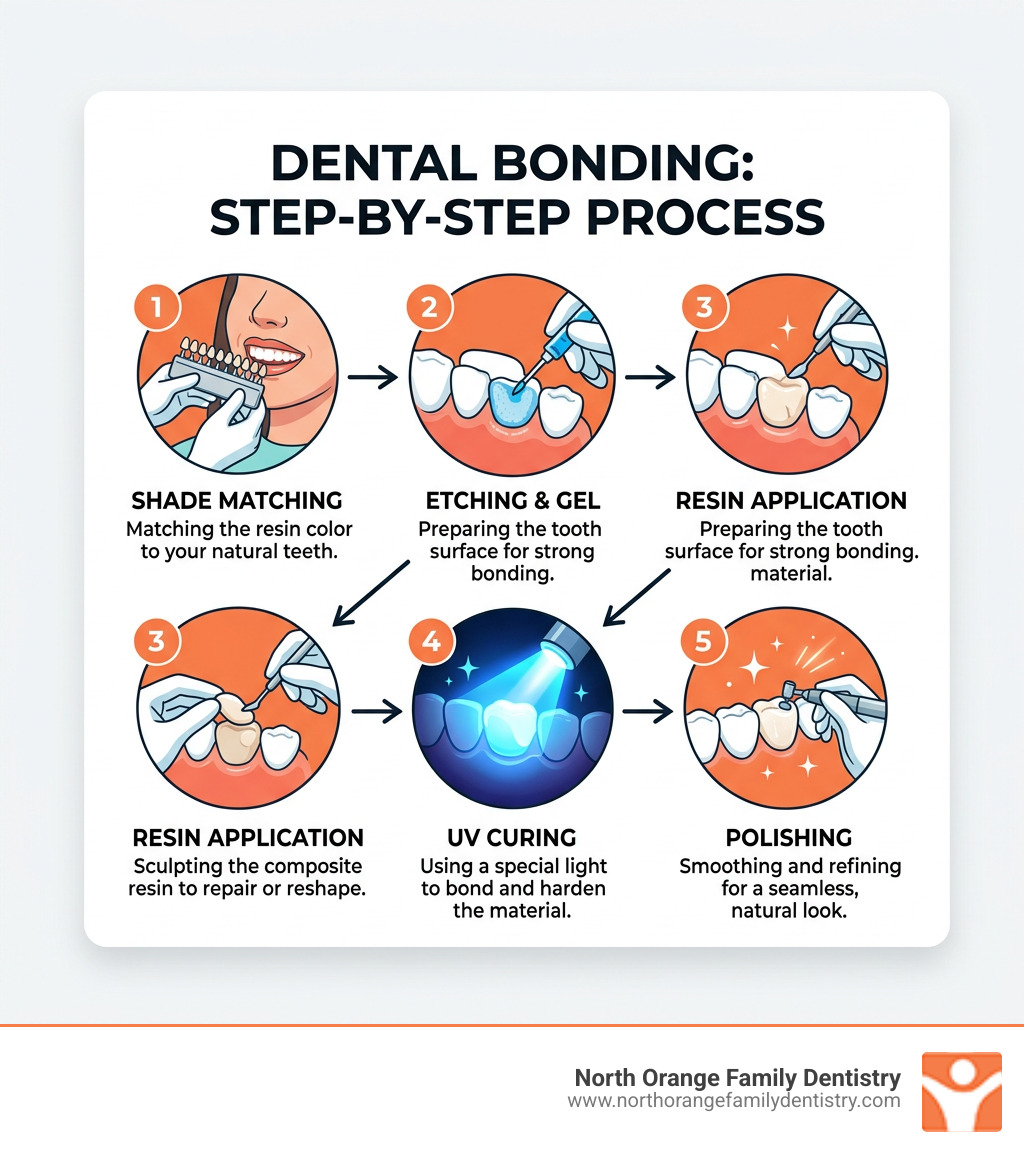
We want your visit to North Orange Family Dentistry to be the best part of your day. When you come in for the best teeth bonding experience, here is exactly what happens:
- The Shade Match: We use a shade guide to compare various resin colors against your natural teeth. Our goal is a seamless blend.
- Preparation: We lightly roughen the surface of the tooth and apply a conditioning liquid. This isn't painful; it simply helps the bonding adhesive stick firmly to the tooth.
- Application: We apply the putty-like resin. This is where the artistry happens! We mold and smooth it until it reaches the desired shape.
- Curing: We use a special UV light or laser to harden the material in seconds.
- Polishing: Once hardened, we further trim and shape the material, then polish it to match the sheen of the rest of your teeth.
Maintaining the best teeth bonding results
Once your smile is restored, you’ll want to keep it looking sharp. While the resin material is strong, it isn't quite as hard as natural enamel or porcelain.
To ensure your results last, we recommend:
- Good Oral Hygiene: Brush twice daily with a non-abrasive toothpaste and floss every day.
- Avoid Staining Agents: Coffee, tea, and red wine can stain resin over time. Rinsing with water after consuming these can help.
- Don't Chew Hard Objects: Avoid biting your fingernails, chewing on pens, or crunching on ice. These habits can chip the bonding.
- Regular Check-ups: See us every six months for a wellness check and professional cleaning.
Curious about the timeline? You can read more about How Long Do Dental Bonding Last to see how lifestyle choices impact your investment.
Comparing Bonding to Veneers and Crowns
A common question we hear is: "Should I get bonding or veneers?"
The answer depends on your goals. Bonding is the most conservative option. There is ongoing research into composite materials to make them even more stain-resistant and durable, but currently, porcelain veneers still lead the way for long-term "Hollywood" transformations.
Veneers are thin shells of porcelain that cover the entire front of the tooth. They are more resistant to stains and last longer, but they require the removal of some enamel, making the process permanent. Crowns, on the other hand, cover the entire tooth and are used when there is significant decay or structural damage.
For a deeper dive into the pros and cons of each, check out our guide on Veneers vs Dental Bonding: What's the Difference.
Cost and Longevity of Dental Bonding in Delaware, Ohio
At North Orange Family Dentistry, we believe that a five-star dental experience should fit into your family's budget. The Dental Bonding Cost Ohio is generally much lower than other cosmetic options.
While costs can vary based on the complexity of the tooth repair, bonding is often partially covered by dental insurance if it is deemed "restorative" (for example, fixing a chip caused by an accident). If the procedure is purely cosmetic, insurance may not cover it.
For our neighbors in the Lewis Center area who do not have dental insurance, we offer a Dental Wellness Plan. This is an in-house plan designed for individuals and families to help them get the care they need at a discounted price. It’s a great way to manage the Cost of Dental Bonding Without Insurance while maintaining your overall oral health.
Frequently Asked Questions about Dental Bonding
Is the dental bonding procedure painful?
Not at all! Because the procedure is non-invasive and we rarely have to remove enamel, anesthesia is usually unnecessary. Most of our patients find the process quite relaxing. If you’re feeling nervous, just let us know—we’re experts at making patients feel at ease. You can learn more in our Dental Bonding Pain Guide.
How long does dental bonding typically last?
The average lifespan is between 3 to 10 years. The longevity depends on where the bonding is located and how well you care for it. For example, bonding on the very edge of a front tooth might be more prone to chipping than bonding used to fill a small gap. For more details, see How Long Do Dental Bonding Last.
Can bonded teeth be whitened?
This is a very important point: composite resin does not respond to whitening gels. If you are considering Teeth Whitening, we strongly recommend doing it before your bonding procedure. This allows us to match the resin to your new, brighter shade for a perfectly uniform smile.
Conclusion
Your smile is often the first thing people notice about you. If a small chip or a gap is holding you back from smiling with confidence, the best teeth bonding might be the simple, effective solution you've been searching for.
At North Orange Family Dentistry, Dr. Kyle Bogan and our experienced team are dedicated to providing comfortable, personalized, and advanced care for the whole family. Whether you are in Lewis Center, Delaware, or Powell, we invite you to experience the difference that a five-star dental team can make.
Ready to see what bonding can do for you? Schedule your consultation for Tooth Bonding today and let us help you achieve the smile you deserve!
What Is the Best Teeth Bonding — and Is It Right for You?
Best teeth bonding is a quick, affordable cosmetic dental procedure that uses tooth-colored composite resin to repair chips, cracks, gaps, stains, and other minor imperfections — often in a single visit with no anesthesia required.
Quick answer: Here's what makes dental bonding the right choice for most people:
- ✅ Fast — most treatments are done in one appointment (10–60 minutes per tooth)
- ✅ Painless — little to no enamel removal means no anesthesia in most cases
- ✅ Affordable — costs significantly less than veneers or crowns
- ✅ Natural-looking — resin is color-matched to blend with your real teeth
- ✅ Versatile — fixes chips, cracks, gaps, discoloration, and exposed roots
- ⚠️ Not permanent — lasts 3–10 years depending on location and care
- ⚠️ Not ideal for severe decay, large gaps, or heavy bite-force areas
Maybe you chipped a tooth on something hard. Maybe you've had a gap or a stain you've wanted to fix for years but kept putting off. Either way, you're not alone — and the fix might be simpler than you think.
Dental bonding is one of the most accessible cosmetic dental treatments available today. It doesn't require surgery, multiple appointments, or a long recovery. For many patients at North Orange Family Dentistry, it's the first step toward finally feeling confident about their smile.
This guide walks you through everything you need to know — from how bonding works, to who it's best for, to how it compares to veneers and crowns — so you can make a clear, confident decision.
Understanding Dental Bonding: How It Works
At its core, Dental Bonding is an artistic process. Think of us as sculptors for your smile. Instead of clay, we use a high-quality composite resin—a durable, enamel-like material that starts as a soft, tooth-colored putty.
So, What is Dental Bonding exactly? It is a technique where we apply this resin directly to your tooth. Because the material is so pliable, we can shape it to fill in a chip, close a gap, or even change the entire contour of a tooth. Once we have achieved the perfect look, we use a specialized high-intensity light to "bond" or harden the material to your natural enamel.
The result is a restoration that looks and feels like your real tooth. Because the resin comes in a wide variety of shades, we can match it so precisely that even you might forget which tooth was bonded!
Identifying the Ideal Candidates for Treatment
Not every smile issue requires a major overhaul. In fact, many of the patients we see in our Lewis Center office are looking for "tweakments"—minor adjustments that make a major difference.
Common reasons for Tooth Bonding include:
- Repairing a tooth that has been chipped or cracked (perhaps from an accidental blow or a piece of hard candy).
- Closing small gaps (diastemas) between teeth without needing braces.
- Improving the appearance of discolored teeth that don't respond to traditional whitening.
- Changing the shape of teeth to make them look longer or more symmetrical.
- Protecting a portion of the tooth's root that has been exposed due to receding gums.
Who are the candidates for the best teeth bonding?
The best teeth bonding candidates are usually those with minor cosmetic issues and healthy underlying teeth. If you have a small chip on a front tooth or a slight misalignment that bothers you when you look in the mirror, bonding is likely a fantastic fit.
However, it is important to note that bonding is generally best suited for "low-pressure" areas. This means it works wonders on front teeth but might not be the primary recommendation for the chewing surfaces of your back molars, where the biting force is much higher.
We also find that Dental Bonding for Kids is an excellent solution. Children are prone to playground accidents and chipped teeth, and bonding provides a non-invasive way to restore their smile while they are still growing.
Benefits of Choosing the best teeth bonding for Minor Repairs
When we sit down with families in Delaware and Powell, the conversation often turns to convenience and comfort. Dental bonding shines in both categories.
Here are the primary benefits:
- Minimally Invasive: Unlike crowns or veneers, which require us to remove a significant amount of your natural tooth enamel, bonding requires almost no preparation. We keep your natural tooth structure intact.
- Virtually Painless: Because we aren't drilling into the sensitive parts of the tooth, most patients don't even need local anesthesia. You can read our Dental Bonding Pain Guide for more reassurance, but rest assured, it’s a very comfortable process.
- Speed: We can usually complete the entire process in a single appointment. In fact, bonding one tooth typically takes between 30 to 60 minutes.
- Cost-Effective: It is one of the most affordable cosmetic procedures available, making it a great entry point for smile enhancement.
Comparison: Bonding vs. Veneers vs. Crowns
FeatureDental BondingPorcelain VeneersDental CrownsPrimary UseMinor repairs/gapsMajor cosmetic changesStructural damage/decayAppointments1 (Same day)2–32AnesthesiaUsually noneOften requiredRequiredDurability3–10 years10–20 years15+ yearsReversibilityYesNoNo
The Procedure: What to Expect During Your Visit
We want your visit to North Orange Family Dentistry to be the best part of your day. When you come in for the best teeth bonding experience, here is exactly what happens:
- The Shade Match: We use a shade guide to compare various resin colors against your natural teeth. Our goal is a seamless blend.
- Preparation: We lightly roughen the surface of the tooth and apply a conditioning liquid. This isn't painful; it simply helps the bonding adhesive stick firmly to the tooth.
- Application: We apply the putty-like resin. This is where the artistry happens! We mold and smooth it until it reaches the desired shape.
- Curing: We use a special UV light or laser to harden the material in seconds.
- Polishing: Once hardened, we further trim and shape the material, then polish it to match the sheen of the rest of your teeth.
Maintaining the best teeth bonding results
Once your smile is restored, you’ll want to keep it looking sharp. While the resin material is strong, it isn't quite as hard as natural enamel or porcelain.
To ensure your results last, we recommend:
- Good Oral Hygiene: Brush twice daily with a non-abrasive toothpaste and floss every day.
- Avoid Staining Agents: Coffee, tea, and red wine can stain resin over time. Rinsing with water after consuming these can help.
- Don't Chew Hard Objects: Avoid biting your fingernails, chewing on pens, or crunching on ice. These habits can chip the bonding.
- Regular Check-ups: See us every six months for a wellness check and professional cleaning.
Curious about the timeline? You can read more about How Long Do Dental Bonding Last to see how lifestyle choices impact your investment.
Comparing Bonding to Veneers and Crowns
A common question we hear is: "Should I get bonding or veneers?"
The answer depends on your goals. Bonding is the most conservative option. There is ongoing research into composite materials to make them even more stain-resistant and durable, but currently, porcelain veneers still lead the way for long-term "Hollywood" transformations.
Veneers are thin shells of porcelain that cover the entire front of the tooth. They are more resistant to stains and last longer, but they require the removal of some enamel, making the process permanent. Crowns, on the other hand, cover the entire tooth and are used when there is significant decay or structural damage.
For a deeper dive into the pros and cons of each, check out our guide on Veneers vs Dental Bonding: What's the Difference.
Cost and Longevity of Dental Bonding in Delaware, Ohio
At North Orange Family Dentistry, we believe that a five-star dental experience should fit into your family's budget. The Dental Bonding Cost Ohio is generally much lower than other cosmetic options.
While costs can vary based on the complexity of the tooth repair, bonding is often partially covered by dental insurance if it is deemed "restorative" (for example, fixing a chip caused by an accident). If the procedure is purely cosmetic, insurance may not cover it.
For our neighbors in the Lewis Center area who do not have dental insurance, we offer a Dental Wellness Plan. This is an in-house plan designed for individuals and families to help them get the care they need at a discounted price. It’s a great way to manage the Cost of Dental Bonding Without Insurance while maintaining your overall oral health.
Frequently Asked Questions about Dental Bonding
Is the dental bonding procedure painful?
Not at all! Because the procedure is non-invasive and we rarely have to remove enamel, anesthesia is usually unnecessary. Most of our patients find the process quite relaxing. If you’re feeling nervous, just let us know—we’re experts at making patients feel at ease. You can learn more in our Dental Bonding Pain Guide.
How long does dental bonding typically last?
The average lifespan is between 3 to 10 years. The longevity depends on where the bonding is located and how well you care for it. For example, bonding on the very edge of a front tooth might be more prone to chipping than bonding used to fill a small gap. For more details, see How Long Do Dental Bonding Last.
Can bonded teeth be whitened?
This is a very important point: composite resin does not respond to whitening gels. If you are considering Teeth Whitening, we strongly recommend doing it before your bonding procedure. This allows us to match the resin to your new, brighter shade for a perfectly uniform smile.
Conclusion
Your smile is often the first thing people notice about you. If a small chip or a gap is holding you back from smiling with confidence, the best teeth bonding might be the simple, effective solution you've been searching for.
At North Orange Family Dentistry, Dr. Kyle Bogan and our experienced team are dedicated to providing comfortable, personalized, and advanced care for the whole family. Whether you are in Lewis Center, Delaware, or Powell, we invite you to experience the difference that a five-star dental team can make.
Ready to see what bonding can do for you? Schedule your consultation for Tooth Bonding today and let us help you achieve the smile you deserve!
Contact Us
Have any questions? Want to learn more?

