
Fix Your Underbite Using Modern Aligners
Learn how clear aligners for underbite correction work, from mild to moderate cases. Discover treatment steps, benefits, and schedule a consultation.


Can Clear Aligners Fix an Underbite?
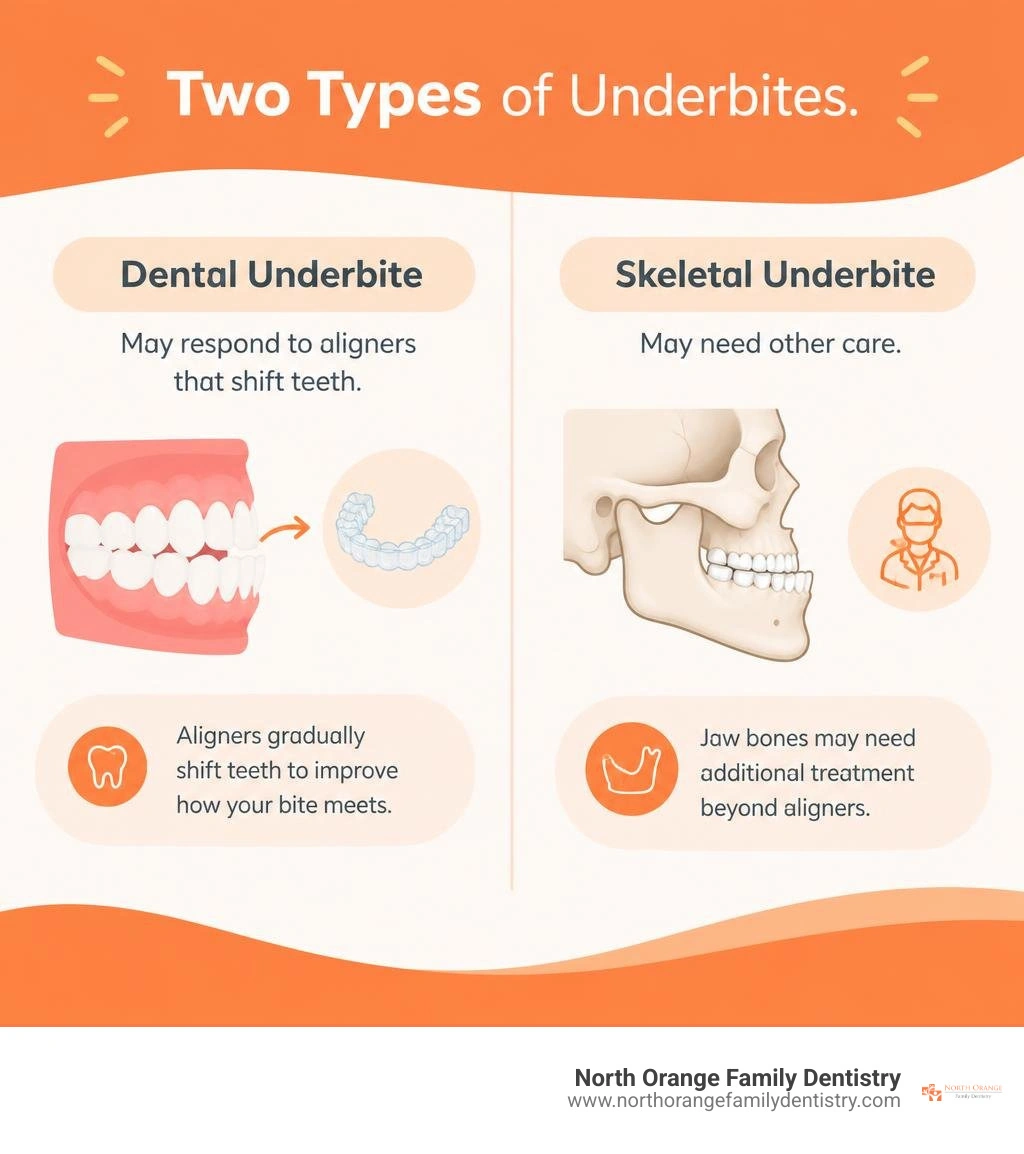
Yes, clear aligners for an underbite can often help when the problem comes from tooth position. Invisalign gradually shifts teeth to improve how the upper and lower teeth meet. But if the jaw bones cause the underbite, aligners alone may not correct it. A dental exam can tell you which type you have.
At North Orange Family Dentistry in the Lewis Center area, we can assess your bite and explain whether Invisalign is a good fit. The key question is simple: Do the teeth need to move, or is the jaw position the main issue? Clear aligner technology has advanced rapidly, allowing dental professionals to correct complex occlusal misalignments without relying solely on traditional metal brackets and archwires.
Explore related reading on modern orthodontics:
- Learn how modern clear aligners work for bite correction.
- Compare treatment methods in our breakdown of aligners vs braces.
- Discover the mechanics behind advanced clear aligner braces.
Understanding Underbites: Dental vs. Skeletal Class III Issues
In orthodontic terms, an underbite is classified as a Class III malocclusion. This occurs when the lower dental arch extends noticeably forward past the upper arch, causing the lower front teeth to overlap the upper front teeth when you close your mouth. Just as patients frequently ask can clear aligners fix an overbite, many wonder whether the reverse problem can be treated without traditional metal appliances.
Underbites generally fall into two distinct anatomical categories:
- Dental Underbite: The underlying jaw bones are properly proportioned and positioned relative to the skull, but individual teeth are tilted incorrectly. The lower incisors flare outward, or the upper incisors tip inward toward the palate, creating the visual appearance and functional challenge of an underbite.
- Skeletal Underbite: The discrepancy stems from the facial skeleton itself. Either the lower jaw (mandible) has overgrown, the upper jaw (maxilla) is underdeveloped, or a combination of both structural factors exists.
Childhood habits like prolonged pacifier use, extended bottle feeding past age three, and persistent thumb-sucking can influence dental positioning during early development. However, genetics primarily dictate skeletal growth patterns. If an underbite is left unaddressed, the unnatural tooth contact can place severe strain on the temporomandibular joints (TMJ), cause premature enamel wear, chip incisal edges, and lead to chronic jaw fatigue and headaches. A clinical bite assessment can determine which classification applies to your smile and guide the most appropriate treatment pathway.
Can Clear Aligners for an Underbite Deliver Real Results?

Modern orthodontic technology has expanded what dentists can achieve using invisible orthodontic aligners. Through advanced biomechanical engineering, custom plastic trays apply continuous, calibrated force to guide teeth into balanced positions. Clear aligners achieve predictable results for dental underbites by repositioning the teeth within the existing jaw structure. While clear trays are discreet enough that even your pets will not notice you are wearing them, they are powerful medical devices capable of complex three-dimensional movements.
How Clear Aligners for Underbite Correction Shift Teeth
Correcting an underbite with aligners involves coordinated tooth movements across both dental arches:
- Upper Arch Expansion and Proclination: Aligners apply outward pressure to the upper front teeth, gently tipping them forward so they can clear the lower arch and establish proper overlap.
- Lower Arch Retroclination and Distalization: Aligners exert backward pressure on the lower front teeth, tilting them inward and nudging them back to sit safely behind the upper teeth.
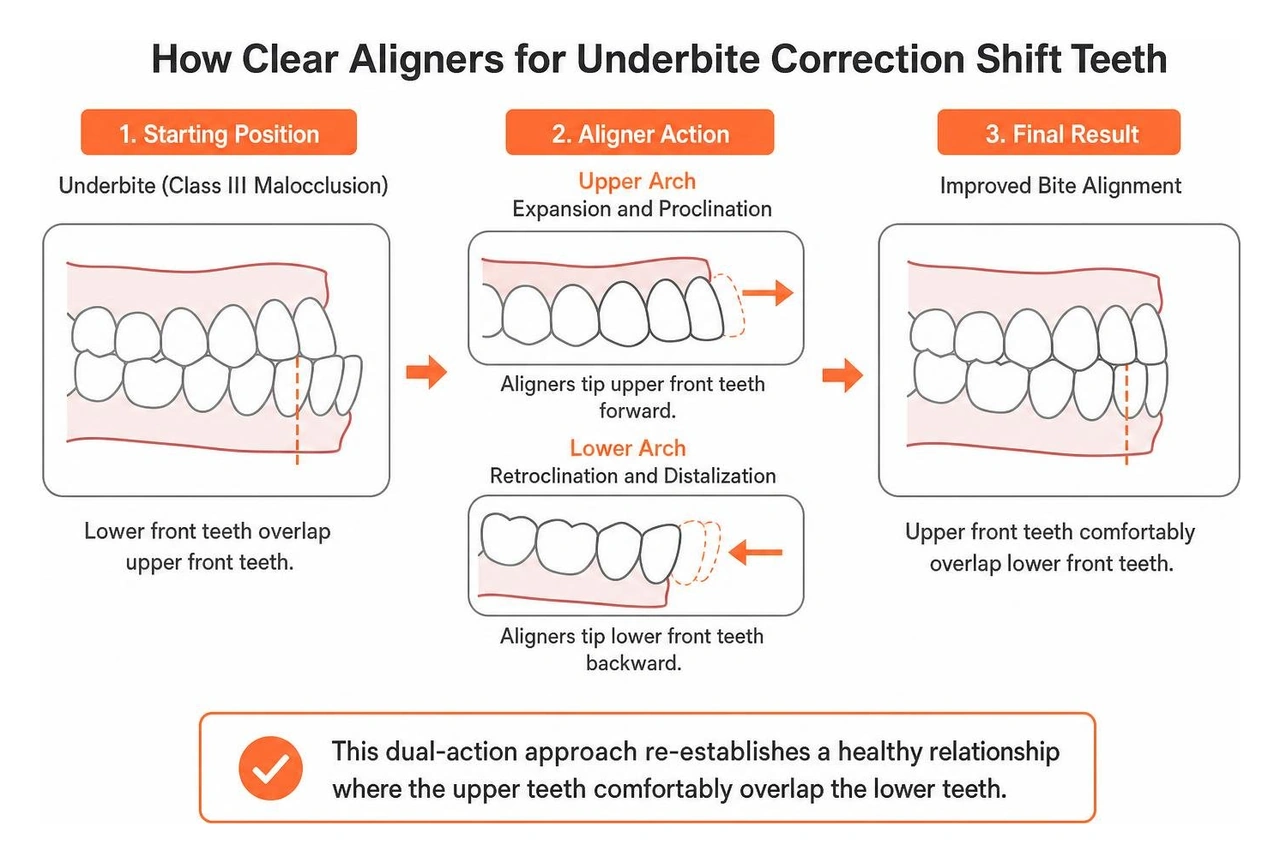
This dual-action approach re-establishes a healthy relationship where the upper teeth comfortably overlap the lower teeth.
Candidate Evaluation: Clear Aligners for Underbite Severity Levels
Bite severity determines whether clear aligners will deliver optimal results:
- Mild Dental Underbites: Excellent candidates. Typically involve minor tooth tipping and can be addressed efficiently using invisalign for mild cases.
- Moderate Underbites: Strong candidates when managed by experienced providers who utilize adjuncts like elastics and composite attachments.
- Severe Skeletal Underbites: Limited candidacy for aligners alone. Severe jaw discrepancies often require combined orthodontic care and corrective orthognathic surgery to realign the underlying bone structure.
Step-by-Step Clear Aligner Treatment Process and Timelines
Understanding the treatment roadmap helps patients stay motivated throughout their bite correction journey. As detailed in our invisalign complete guide 2026, the process follows several structured stages:
- Digital Consultation and 3D Imaging: We capture high-resolution digital scans of your teeth and jaw joints to evaluate your bite mechanics, root positions, and soft tissues while mapping out each precise tooth movement.
- Custom Treatment Simulation: Specialized software projects your tooth movement week by week, allowing you to preview your final smile before aligner manufacturing begins.
- Aligner Delivery and Placement: You receive your initial series of custom trays along with any small attachments needed to provide traction for stubborn teeth.
- Active Progression: You advance to a fresh set of trays every one to two weeks, checking in with our team periodically so we can confirm your teeth are tracking as planned.
- Retention: Once the active realignment phase concludes, you switch to retainers to lock your new bite in place permanently.
Role of Attachments, Elastics, and Precision Cuts
Moving teeth against opposing occlusal forces requires strategic mechanical leverage:
- SmartForce Attachments: Tiny, tooth-colored composite dots placed on specific teeth act as anchor points for the aligner trays, directing forces down through the tooth root.
- Precision Cuts and Intermaxillary Elastics: Tiny cutouts engineered into the aligners allow you to hook small orthodontic rubber bands between the upper back teeth and lower front teeth. These elastics provide continuous pull to shift the lower dental arch backward and the upper dental arch forward.
Treatment Duration, Success Rates, and Retention
Treatment timelines depend on the extent of tooth movement needed:
- Mild cases: Typically take 6 to 12 months (with some minor alignments finishing in as few as 3 to 6 months).
- Moderate cases: Usually require 12 to 18 months of consistent aligner wear and elastic compliance.
- Complex cases: Requiring extensive movement or combined therapies can take 18 to 24+ months.
High compliance is essential: aligners must be worn 20 to 22 hours per day to achieve these milestones. Once your bite is corrected, wearing a clear aligner retainer at night preserves your results and prevents natural relapse.
Key Benefits of Choosing Removable Aligners
Patients exploring comparisons such as clear aligners vs invisalign frequently favor clear trays over fixed braces for several distinct advantages:
- Discreet Appearance: Clear, medical-grade plastic allows you to align your smile without noticeable metal brackets or dark wires.
- Uncompromised Oral Hygiene: Because trays are completely removable, you can brush and floss normally without navigating around hardware, lowering your risk of plaque buildup, gingivitis, and decalcification marks.
- No Dietary Restrictions: You remove your aligners during meals, so you can continue enjoying crisp apples, popcorn, nuts, and chewy foods without fear of breaking brackets.
- Comfortable Design: Smooth plastic edges protect delicate cheek and lip tissues from friction and painful sores.
- Fewer Office Visits: Clear aligner therapy requires fewer emergency appointments for broken wires or loose orthodontic bands.
Frequently Asked Questions About Underbite Correction
Can clear aligners correct an underbite?
Yes, clear aligners effectively correct mild to moderate dental underbites by shifting the upper teeth forward and the lower teeth backward into proper alignment. Severe skeletal underbites caused by significant jaw discrepancies typically require orthognathic jaw surgery combined with orthodontic treatment.
How many hours per day must you wear aligners for bite correction?
Aligners must be worn for 20 to 22 hours every single day. They should only be removed for eating meals, drinking anything other than cool, plain water, and performing your daily brushing and flossing routines.
What oral health problems happen if an underbite remains untreated?
Leaving an underbite untreated can cause uneven tooth wear, chipped enamel, chronic jaw tension, speech changes, and chewing difficulties. In addition to orthodontic care, we provide specialized therapies such as advanced laser treatments for TMJ pain, canker sore healing, and periodontal disease treatment to manage surrounding soft tissue and joint health.
Conclusion
Correcting an underbite does more than enhance your facial profile; it preserves your natural teeth, restores proper chewing mechanics, and protects your jaw joints for the future.
At North Orange Family Dentistry in Delaware, Ohio (serving our neighbors throughout Lewis Center, Powell, and Orange), we deliver personalized orthodontic and comprehensive dental care for patients of all ages. In addition to aligners, our restorative offerings include high-quality endosteal dental implants, which average about $4,500 per tooth. For individuals and families without dental insurance, our Dental Wellness Plan offers essential preventive care and discounts on dental treatments to keep healthy smiles within reach without relying on complex third-party financing. Our office accommodates busy schedules with our last appointment of the day at 3pm, and we provide same-day emergency dental appointments most of the time.
Ready to see what clear aligners can do for your smile? Schedule an Invisalign consultation with Dr. Kyle Bogan and our team today.
Can Clear Aligners Fix an Underbite?
Yes, clear aligners for an underbite can often help when the problem comes from tooth position. Invisalign gradually shifts teeth to improve how the upper and lower teeth meet. But if the jaw bones cause the underbite, aligners alone may not correct it. A dental exam can tell you which type you have.
At North Orange Family Dentistry in the Lewis Center area, we can assess your bite and explain whether Invisalign is a good fit. The key question is simple: Do the teeth need to move, or is the jaw position the main issue? Clear aligner technology has advanced rapidly, allowing dental professionals to correct complex occlusal misalignments without relying solely on traditional metal brackets and archwires.
Explore related reading on modern orthodontics:
- Learn how modern clear aligners work for bite correction.
- Compare treatment methods in our breakdown of aligners vs braces.
- Discover the mechanics behind advanced clear aligner braces.
Understanding Underbites: Dental vs. Skeletal Class III Issues
In orthodontic terms, an underbite is classified as a Class III malocclusion. This occurs when the lower dental arch extends noticeably forward past the upper arch, causing the lower front teeth to overlap the upper front teeth when you close your mouth. Just as patients frequently ask can clear aligners fix an overbite, many wonder whether the reverse problem can be treated without traditional metal appliances.
Underbites generally fall into two distinct anatomical categories:
- Dental Underbite: The underlying jaw bones are properly proportioned and positioned relative to the skull, but individual teeth are tilted incorrectly. The lower incisors flare outward, or the upper incisors tip inward toward the palate, creating the visual appearance and functional challenge of an underbite.
- Skeletal Underbite: The discrepancy stems from the facial skeleton itself. Either the lower jaw (mandible) has overgrown, the upper jaw (maxilla) is underdeveloped, or a combination of both structural factors exists.
Childhood habits like prolonged pacifier use, extended bottle feeding past age three, and persistent thumb-sucking can influence dental positioning during early development. However, genetics primarily dictate skeletal growth patterns. If an underbite is left unaddressed, the unnatural tooth contact can place severe strain on the temporomandibular joints (TMJ), cause premature enamel wear, chip incisal edges, and lead to chronic jaw fatigue and headaches. A clinical bite assessment can determine which classification applies to your smile and guide the most appropriate treatment pathway.
Can Clear Aligners for an Underbite Deliver Real Results?
Modern orthodontic technology has expanded what dentists can achieve using invisible orthodontic aligners. Through advanced biomechanical engineering, custom plastic trays apply continuous, calibrated force to guide teeth into balanced positions. Clear aligners achieve predictable results for dental underbites by repositioning the teeth within the existing jaw structure. While clear trays are discreet enough that even your pets will not notice you are wearing them, they are powerful medical devices capable of complex three-dimensional movements.
How Clear Aligners for Underbite Correction Shift Teeth
Correcting an underbite with aligners involves coordinated tooth movements across both dental arches:
- Upper Arch Expansion and Proclination: Aligners apply outward pressure to the upper front teeth, gently tipping them forward so they can clear the lower arch and establish proper overlap.
- Lower Arch Retroclination and Distalization: Aligners exert backward pressure on the lower front teeth, tilting them inward and nudging them back to sit safely behind the upper teeth.
This dual-action approach re-establishes a healthy relationship where the upper teeth comfortably overlap the lower teeth.
Candidate Evaluation: Clear Aligners for Underbite Severity Levels
Bite severity determines whether clear aligners will deliver optimal results:
- Mild Dental Underbites: Excellent candidates. Typically involve minor tooth tipping and can be addressed efficiently using invisalign for mild cases.
- Moderate Underbites: Strong candidates when managed by experienced providers who utilize adjuncts like elastics and composite attachments.
- Severe Skeletal Underbites: Limited candidacy for aligners alone. Severe jaw discrepancies often require combined orthodontic care and corrective orthognathic surgery to realign the underlying bone structure.
Step-by-Step Clear Aligner Treatment Process and Timelines
Understanding the treatment roadmap helps patients stay motivated throughout their bite correction journey. As detailed in our invisalign complete guide 2026, the process follows several structured stages:
- Digital Consultation and 3D Imaging: We capture high-resolution digital scans of your teeth and jaw joints to evaluate your bite mechanics, root positions, and soft tissues while mapping out each precise tooth movement.
- Custom Treatment Simulation: Specialized software projects your tooth movement week by week, allowing you to preview your final smile before aligner manufacturing begins.
- Aligner Delivery and Placement: You receive your initial series of custom trays along with any small attachments needed to provide traction for stubborn teeth.
- Active Progression: You advance to a fresh set of trays every one to two weeks, checking in with our team periodically so we can confirm your teeth are tracking as planned.
- Retention: Once the active realignment phase concludes, you switch to retainers to lock your new bite in place permanently.
Role of Attachments, Elastics, and Precision Cuts
Moving teeth against opposing occlusal forces requires strategic mechanical leverage:
- SmartForce Attachments: Tiny, tooth-colored composite dots placed on specific teeth act as anchor points for the aligner trays, directing forces down through the tooth root.
- Precision Cuts and Intermaxillary Elastics: Tiny cutouts engineered into the aligners allow you to hook small orthodontic rubber bands between the upper back teeth and lower front teeth. These elastics provide continuous pull to shift the lower dental arch backward and the upper dental arch forward.
Treatment Duration, Success Rates, and Retention
Treatment timelines depend on the extent of tooth movement needed:
- Mild cases: Typically take 6 to 12 months (with some minor alignments finishing in as few as 3 to 6 months).
- Moderate cases: Usually require 12 to 18 months of consistent aligner wear and elastic compliance.
- Complex cases: Requiring extensive movement or combined therapies can take 18 to 24+ months.
High compliance is essential: aligners must be worn 20 to 22 hours per day to achieve these milestones. Once your bite is corrected, wearing a clear aligner retainer at night preserves your results and prevents natural relapse.
Key Benefits of Choosing Removable Aligners
Patients exploring comparisons such as clear aligners vs invisalign frequently favor clear trays over fixed braces for several distinct advantages:
- Discreet Appearance: Clear, medical-grade plastic allows you to align your smile without noticeable metal brackets or dark wires.
- Uncompromised Oral Hygiene: Because trays are completely removable, you can brush and floss normally without navigating around hardware, lowering your risk of plaque buildup, gingivitis, and decalcification marks.
- No Dietary Restrictions: You remove your aligners during meals, so you can continue enjoying crisp apples, popcorn, nuts, and chewy foods without fear of breaking brackets.
- Comfortable Design: Smooth plastic edges protect delicate cheek and lip tissues from friction and painful sores.
- Fewer Office Visits: Clear aligner therapy requires fewer emergency appointments for broken wires or loose orthodontic bands.
Frequently Asked Questions About Underbite Correction
Can clear aligners correct an underbite?
Yes, clear aligners effectively correct mild to moderate dental underbites by shifting the upper teeth forward and the lower teeth backward into proper alignment. Severe skeletal underbites caused by significant jaw discrepancies typically require orthognathic jaw surgery combined with orthodontic treatment.
How many hours per day must you wear aligners for bite correction?
Aligners must be worn for 20 to 22 hours every single day. They should only be removed for eating meals, drinking anything other than cool, plain water, and performing your daily brushing and flossing routines.
What oral health problems happen if an underbite remains untreated?
Leaving an underbite untreated can cause uneven tooth wear, chipped enamel, chronic jaw tension, speech changes, and chewing difficulties. In addition to orthodontic care, we provide specialized therapies such as advanced laser treatments for TMJ pain, canker sore healing, and periodontal disease treatment to manage surrounding soft tissue and joint health.
Conclusion
Correcting an underbite does more than enhance your facial profile; it preserves your natural teeth, restores proper chewing mechanics, and protects your jaw joints for the future.
At North Orange Family Dentistry in Delaware, Ohio (serving our neighbors throughout Lewis Center, Powell, and Orange), we deliver personalized orthodontic and comprehensive dental care for patients of all ages. In addition to aligners, our restorative offerings include high-quality endosteal dental implants, which average about $4,500 per tooth. For individuals and families without dental insurance, our Dental Wellness Plan offers essential preventive care and discounts on dental treatments to keep healthy smiles within reach without relying on complex third-party financing. Our office accommodates busy schedules with our last appointment of the day at 3pm, and we provide same-day emergency dental appointments most of the time.
Ready to see what clear aligners can do for your smile? Schedule an Invisalign consultation with Dr. Kyle Bogan and our team today.
Contact Us
Have any questions? Want to learn more?

