
How to Fix a Chipped Tooth
Learn chipped tooth repair: first aid, bonding, veneers, crowns, root canals & costs. Fix it fast in Delaware, OH!


What You Need to Know About Chipped Tooth Repair
Chipped tooth repair is more common than you might think — in fact, chipped teeth are the single most common dental injury. Whether it happened biting into a piece of hard candy, taking an elbow during a pickup game, or waking up one morning with a jagged edge you can't stop running your tongue over, the good news is this: it's fixable.
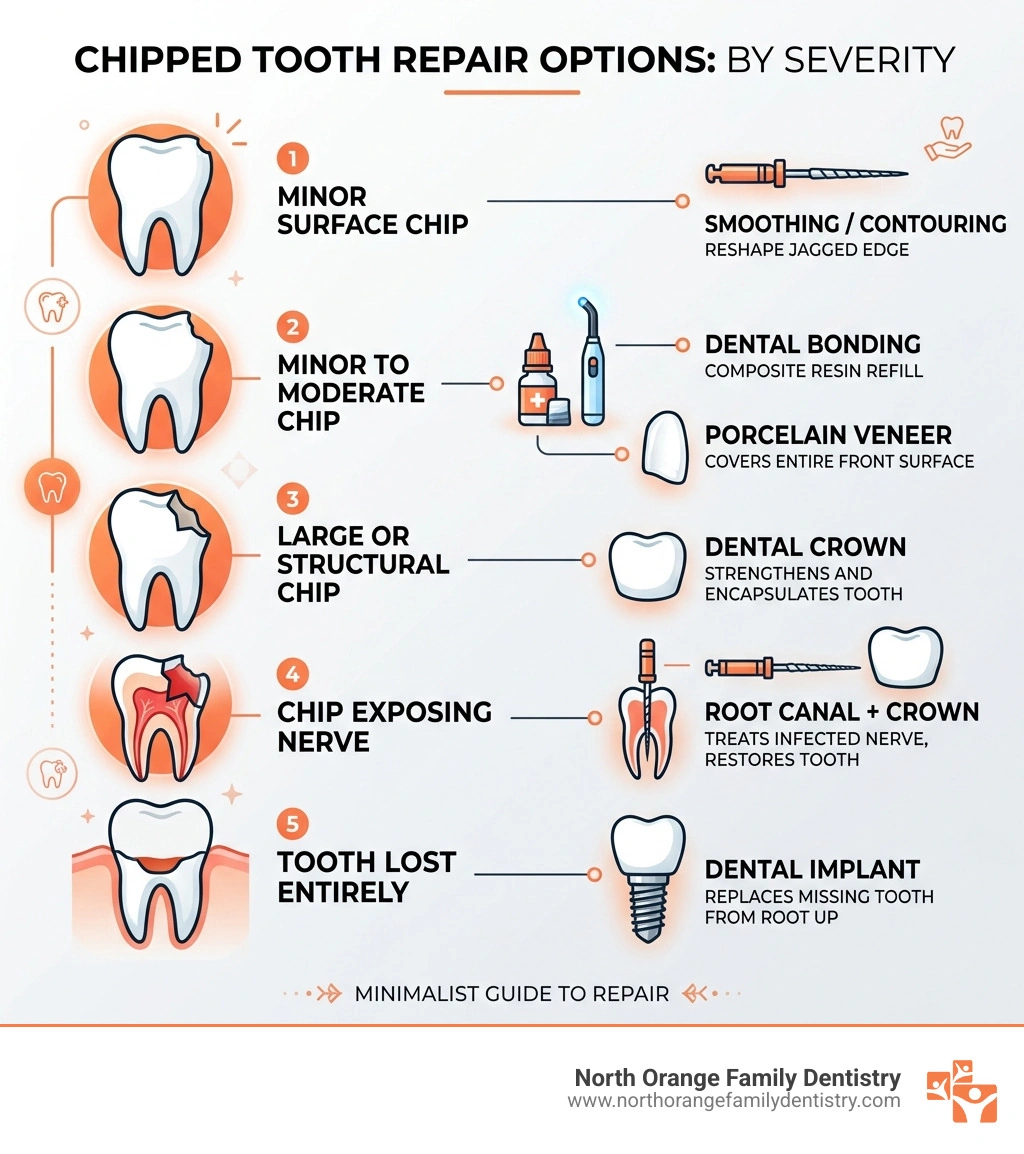
Here's a quick look at your main repair options:
| Severity | Likely Treatment |
|---|---|
| Tiny surface chip | Smoothing/contouring or dental bonding |
| Minor to moderate chip | Dental bonding or porcelain veneer |
| Large or structural chip | Dental crown |
| Chip exposing nerve | Root canal + crown |
| Tooth lost entirely | Dental implant |
A few things worth knowing upfront:
- Not every chip is an emergency — but every chip deserves professional attention.
- Even a painless chip can let bacteria in, leading to decay or infection over time.
- The sooner you act, the simpler (and less costly) the fix tends to be.
- Your risk of chipping a tooth increases after age 50, as enamel naturally wears down.
At North Orange Family Dentistry, we see chipped teeth regularly — and most of the time, we can get you in the same day. Whether you're dealing with a tiny cosmetic nick or something more serious, this guide walks you through everything: what to do right now, what your treatment options look like, and how to make sure it doesn't happen again.
Handy chipped tooth repair terms:
Understanding the Severity of Your Injury
Not all chips are created equal. To understand how we approach chipped tooth repair, it helps to know exactly what happened to the anatomy of your tooth. Tooth enamel is the hardest substance in the human body, but it is also brittle, much like a porcelain mug. When it meets enough force, it can fracture in several ways.
According to the Cleveland Clinic, dental injuries range from superficial aesthetic issues to deep structural failures. Here are the most common types:
- Craze Lines: These are tiny, superficial cracks that only affect the outer enamel. They are like a small chip in a windshield — they might not hurt now, but they can eventually expand.
- Fractured Cusp: This usually happens on the chewing surfaces of your molars. It doesn't typically damage the pulp (the nerve center), but it makes chewing uncomfortable.
- Split Tooth: This is the end-stage of an untreated crack. The tooth is literally split into two distinct pieces, which often requires more extensive intervention.
- Enamel Erosion: While not a "chip" from a single impact, acid reflux or GERD can weaken enamel over time, making your teeth much more likely to chip during normal meals.
Identifying Symptoms and Causes
How do you know if you've actually chipped a tooth? Sometimes it’s obvious, but other times you might just feel a "sharpness" or a strange sensation with your tongue. Common symptoms include:
- Tooth Sensitivity: Sharp pain when consuming hot or cold drinks.
- Jagged Edges: Irritation to your tongue or cheek from a rough surface.
- Pain on Release: Feeling a "zing" only when you let go of a bite (a classic sign of a cracked tooth).
The causes are equally varied. While facial trauma from sports or accidents is a major factor, many patients chip teeth due to bruxism (chronic teeth grinding) or simply biting down on hard objects like unpopped popcorn kernels, ice, or metal forks.
Immediate First Aid for Chipped Tooth Repair
If you just felt that sickening "crunch" that wasn't part of your meal, don't panic. Taking the right steps in the first 30 minutes can significantly improve the outcome of your chipped tooth repair.

- Rinse Immediately: Use warm saltwater to clear away debris and reduce the risk of infection.
- Save the Fragment: If you can find the piece of the tooth that broke off, save it! Store it in a small container of whole milk. In some cases, we may be able to reattach the original fragment.
- Protect Your Mouth: If the remaining tooth has a sharp edge, cover it with a piece of sugarless gum or dental wax to keep it from cutting your tongue.
- Manage Swelling: Apply a cold compress to the outside of your cheek for 15-minute intervals.
For a deeper dive into these steps, check out our Broken Tooth Repair Complete Guide.
When to Seek Emergency Care
While a small chip might feel like a cosmetic nuisance, certain situations require an immediate visit to our Lewis Center office. You should treat your situation as a dental emergency if:
- The "pulp" (the pinkish soft tissue inside the tooth) is visible or bleeding.
- You are in severe, throbbing pain that doesn't stop.
- There is significant swelling in the gums or face.
At North Orange Family Dentistry, we offer same-day emergency appointments most of the time because we know that a broken tooth after filling or a sudden trauma can't always wait until next Tuesday.
Professional Solutions for Chipped Tooth Repair
Once you arrive at our office, our team — led by Dr. Kyle Bogan and our experienced associates — will evaluate the damage. Our goal is always to preserve as much of your natural tooth as possible while restoring your smile's strength and beauty.
Minor Fixes: Dental Bonding and Smoothing
For small chips, especially on the front teeth, tooth bonding is often the gold standard. It is fast, minimally invasive, and usually doesn't even require numbing.
We use a tooth-colored composite resin that we shade-match to your natural enamel. After "etching" the surface of the tooth, we apply the resin, mold it to the perfect shape, and harden it instantly with a specialized UV curing light. This process is often completed in a single visit. You can learn more about our tooth bonding services and see how it differs from a standard broken tooth composite filling.
Moderate Repairs: Veneers and Crowns
If the chip is too large for bonding or if you're looking for a more permanent cosmetic upgrade, we may recommend veneers or crowns.
- Veneers: These are thin, porcelain shells that cover the front of the tooth. They are incredibly durable and stain-resistant. This is a popular choice for chipped tooth veneers when the damage is on a "smile-zone" tooth. Learn more about our dental veneers.
- Crowns: If a large portion of the tooth is missing, a crown (or "cap") is used to engulf the entire visible portion of the tooth. This protects the structure from further breaking. Explore our options for dental crowns.
Advanced Chipped Tooth Repair: Root Canals and Implants
In more severe cases, the damage goes beneath the surface.
- Root Canals: If the chip exposes the pulp, bacteria can cause an infection (pulpitis). A root canal allows us to clear out the infection and save the natural tooth root before sealing it with a crown. It’s a common misconception that these are painful; with modern technology, they are often no more uncomfortable than getting a filling. See our root canal services.
- Dental Implants: If the tooth is split to the root or lost entirely, an endosteal dental implant is the best long-term solution. It replaces both the root and the crown. At North Orange Family Dentistry, the average cost for a single-tooth implant is approximately $4,500. This investment provides a result designed to last a lifetime. Read about our affordable dental implants.
Costs, Insurance, and Affordability
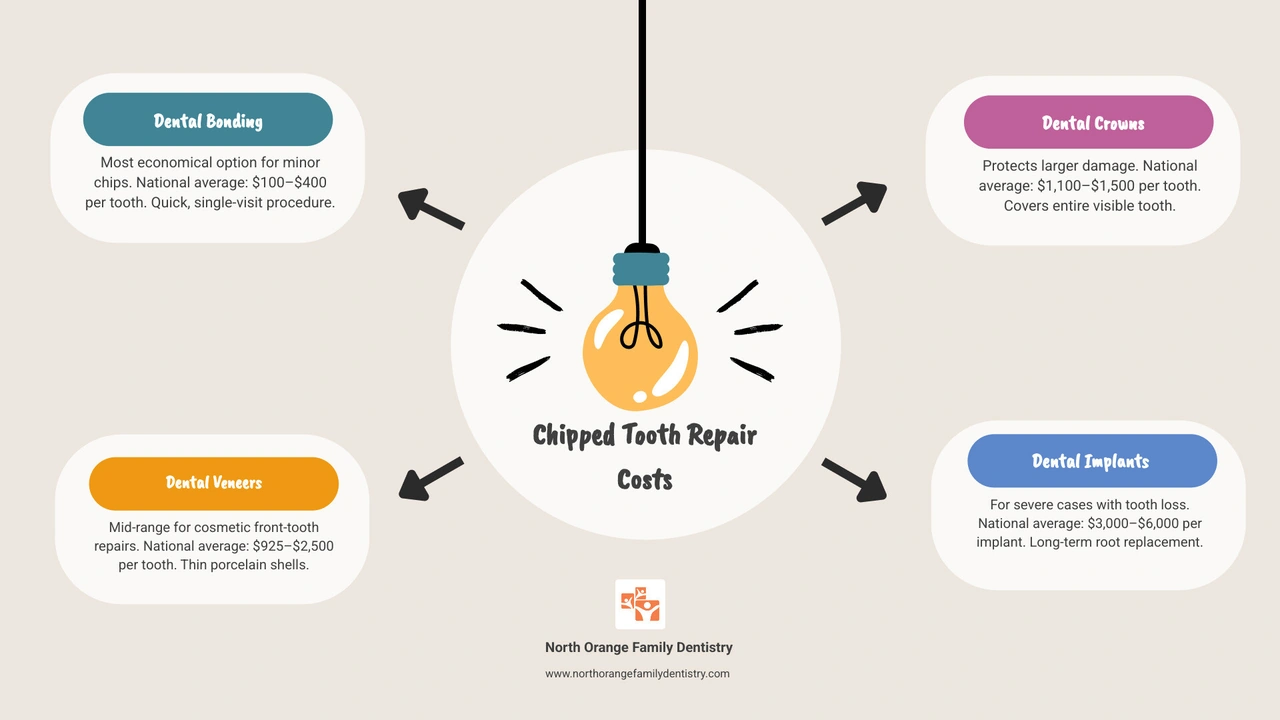
The cost of chipped tooth repair varies based on the treatment needed. Generally, bonding is the most economical, while crowns and veneers fall into a mid-range, and implants represent a more significant investment.
Most dental insurance plans cover restorative procedures like fillings and crowns, though cosmetic-only repairs (like veneers for a tiny nick) may not be fully covered. For a detailed breakdown, visit our resource on Broken Tooth Repair Cost.
Making Care Accessible with the Dental Wellness Plan
We believe everyone in Delaware County deserves a five-star smile, regardless of insurance status. If you don't have dental insurance, we offer an in-house Dental Wellness Plan. This is not a complex financing scheme; it’s a simple plan for individuals and families that provides discounted yearly care and preventive maintenance for a transparent price. It’s our way of making high-quality family dentistry accessible to our neighbors in Lewis Center and Powell.
Prevention and Long-Term Maintenance
Once your tooth is repaired, you’ll want to keep it that way. Maintenance for bonded or crowned teeth is simple: brush twice a day, floss once, and avoid using your teeth as tools (no opening packages with your incisors!).
We also offer advanced preventative technologies that set us apart in the Delaware area:
- Laser Treatments: We use specialized lasers for TMJ pain relief (which reduces the grinding that causes chips) and for faster canker sore healing.
- Mouthguards: If you play sports or grind your teeth at night, a custom-fitted guard is your best defense.
- Periodontal Health: Treatments like Perio Protect help keep the foundations of your teeth strong.
For more prevention tips, WebMD offers excellent advice on dietary habits to protect your enamel.
Frequently Asked Questions about Chipped Teeth
Is a chipped tooth considered a dental emergency?
It depends on the symptoms. If you have severe pain, bleeding, or the inner pulp is exposed, yes — it is an emergency. If it is a tiny chip with no pain, it is less urgent but still needs to be evaluated soon to prevent decay.
What happens if I leave a chipped tooth untreated?
Even a small chip can act as a gateway for bacteria. Over time, this can lead to a cavity in the dentin, a painful abscess, or a fracture that eventually requires a root canal or extraction.
How does a chipped tooth differ from a cracked tooth?
A chip is usually a piece of enamel breaking away from the edge. A crack is a fracture line that can run vertically toward the root. Cracks are often more serious because they can compromise the entire structural integrity of the tooth.
Conclusion
A chipped tooth can be a shock, but it doesn't have to be a disaster. At North Orange Family Dentistry, Dr. Kyle Bogan and our team are dedicated to providing a comfortable, five-star experience for every member of your family. Whether you need a quick bonding session or a more advanced restoration, we use the latest technology to get you back to smiling confidently.
If you’ve experienced a dental injury or just want to strengthen your smile, we’re here to help. We proudly serve patients across Delaware, Lewis Center, Orange, and Powell, Ohio.
Schedule your visit with North Orange Family Dentistry today, or call us for a same-day emergency evaluation.
What You Need to Know About Chipped Tooth Repair
Chipped tooth repair is more common than you might think — in fact, chipped teeth are the single most common dental injury. Whether it happened biting into a piece of hard candy, taking an elbow during a pickup game, or waking up one morning with a jagged edge you can't stop running your tongue over, the good news is this: it's fixable.
Here's a quick look at your main repair options:
| Severity | Likely Treatment |
|---|---|
| Tiny surface chip | Smoothing/contouring or dental bonding |
| Minor to moderate chip | Dental bonding or porcelain veneer |
| Large or structural chip | Dental crown |
| Chip exposing nerve | Root canal + crown |
| Tooth lost entirely | Dental implant |
A few things worth knowing upfront:
- Not every chip is an emergency — but every chip deserves professional attention.
- Even a painless chip can let bacteria in, leading to decay or infection over time.
- The sooner you act, the simpler (and less costly) the fix tends to be.
- Your risk of chipping a tooth increases after age 50, as enamel naturally wears down.
At North Orange Family Dentistry, we see chipped teeth regularly — and most of the time, we can get you in the same day. Whether you're dealing with a tiny cosmetic nick or something more serious, this guide walks you through everything: what to do right now, what your treatment options look like, and how to make sure it doesn't happen again.
Handy chipped tooth repair terms:
Understanding the Severity of Your Injury
Not all chips are created equal. To understand how we approach chipped tooth repair, it helps to know exactly what happened to the anatomy of your tooth. Tooth enamel is the hardest substance in the human body, but it is also brittle, much like a porcelain mug. When it meets enough force, it can fracture in several ways.
According to the Cleveland Clinic, dental injuries range from superficial aesthetic issues to deep structural failures. Here are the most common types:
- Craze Lines: These are tiny, superficial cracks that only affect the outer enamel. They are like a small chip in a windshield — they might not hurt now, but they can eventually expand.
- Fractured Cusp: This usually happens on the chewing surfaces of your molars. It doesn't typically damage the pulp (the nerve center), but it makes chewing uncomfortable.
- Split Tooth: This is the end-stage of an untreated crack. The tooth is literally split into two distinct pieces, which often requires more extensive intervention.
- Enamel Erosion: While not a "chip" from a single impact, acid reflux or GERD can weaken enamel over time, making your teeth much more likely to chip during normal meals.
Identifying Symptoms and Causes
How do you know if you've actually chipped a tooth? Sometimes it’s obvious, but other times you might just feel a "sharpness" or a strange sensation with your tongue. Common symptoms include:
- Tooth Sensitivity: Sharp pain when consuming hot or cold drinks.
- Jagged Edges: Irritation to your tongue or cheek from a rough surface.
- Pain on Release: Feeling a "zing" only when you let go of a bite (a classic sign of a cracked tooth).
The causes are equally varied. While facial trauma from sports or accidents is a major factor, many patients chip teeth due to bruxism (chronic teeth grinding) or simply biting down on hard objects like unpopped popcorn kernels, ice, or metal forks.
Immediate First Aid for Chipped Tooth Repair
If you just felt that sickening "crunch" that wasn't part of your meal, don't panic. Taking the right steps in the first 30 minutes can significantly improve the outcome of your chipped tooth repair.
- Rinse Immediately: Use warm saltwater to clear away debris and reduce the risk of infection.
- Save the Fragment: If you can find the piece of the tooth that broke off, save it! Store it in a small container of whole milk. In some cases, we may be able to reattach the original fragment.
- Protect Your Mouth: If the remaining tooth has a sharp edge, cover it with a piece of sugarless gum or dental wax to keep it from cutting your tongue.
- Manage Swelling: Apply a cold compress to the outside of your cheek for 15-minute intervals.
For a deeper dive into these steps, check out our Broken Tooth Repair Complete Guide.
When to Seek Emergency Care
While a small chip might feel like a cosmetic nuisance, certain situations require an immediate visit to our Lewis Center office. You should treat your situation as a dental emergency if:
- The "pulp" (the pinkish soft tissue inside the tooth) is visible or bleeding.
- You are in severe, throbbing pain that doesn't stop.
- There is significant swelling in the gums or face.
At North Orange Family Dentistry, we offer same-day emergency appointments most of the time because we know that a broken tooth after filling or a sudden trauma can't always wait until next Tuesday.
Professional Solutions for Chipped Tooth Repair
Once you arrive at our office, our team — led by Dr. Kyle Bogan and our experienced associates — will evaluate the damage. Our goal is always to preserve as much of your natural tooth as possible while restoring your smile's strength and beauty.
Minor Fixes: Dental Bonding and Smoothing
For small chips, especially on the front teeth, tooth bonding is often the gold standard. It is fast, minimally invasive, and usually doesn't even require numbing.
We use a tooth-colored composite resin that we shade-match to your natural enamel. After "etching" the surface of the tooth, we apply the resin, mold it to the perfect shape, and harden it instantly with a specialized UV curing light. This process is often completed in a single visit. You can learn more about our tooth bonding services and see how it differs from a standard broken tooth composite filling.
Moderate Repairs: Veneers and Crowns
If the chip is too large for bonding or if you're looking for a more permanent cosmetic upgrade, we may recommend veneers or crowns.
- Veneers: These are thin, porcelain shells that cover the front of the tooth. They are incredibly durable and stain-resistant. This is a popular choice for chipped tooth veneers when the damage is on a "smile-zone" tooth. Learn more about our dental veneers.
- Crowns: If a large portion of the tooth is missing, a crown (or "cap") is used to engulf the entire visible portion of the tooth. This protects the structure from further breaking. Explore our options for dental crowns.
Advanced Chipped Tooth Repair: Root Canals and Implants
In more severe cases, the damage goes beneath the surface.
- Root Canals: If the chip exposes the pulp, bacteria can cause an infection (pulpitis). A root canal allows us to clear out the infection and save the natural tooth root before sealing it with a crown. It’s a common misconception that these are painful; with modern technology, they are often no more uncomfortable than getting a filling. See our root canal services.
- Dental Implants: If the tooth is split to the root or lost entirely, an endosteal dental implant is the best long-term solution. It replaces both the root and the crown. At North Orange Family Dentistry, the average cost for a single-tooth implant is approximately $4,500. This investment provides a result designed to last a lifetime. Read about our affordable dental implants.
Costs, Insurance, and Affordability
The cost of chipped tooth repair varies based on the treatment needed. Generally, bonding is the most economical, while crowns and veneers fall into a mid-range, and implants represent a more significant investment.
Most dental insurance plans cover restorative procedures like fillings and crowns, though cosmetic-only repairs (like veneers for a tiny nick) may not be fully covered. For a detailed breakdown, visit our resource on Broken Tooth Repair Cost.
Making Care Accessible with the Dental Wellness Plan
We believe everyone in Delaware County deserves a five-star smile, regardless of insurance status. If you don't have dental insurance, we offer an in-house Dental Wellness Plan. This is not a complex financing scheme; it’s a simple plan for individuals and families that provides discounted yearly care and preventive maintenance for a transparent price. It’s our way of making high-quality family dentistry accessible to our neighbors in Lewis Center and Powell.
Prevention and Long-Term Maintenance
Once your tooth is repaired, you’ll want to keep it that way. Maintenance for bonded or crowned teeth is simple: brush twice a day, floss once, and avoid using your teeth as tools (no opening packages with your incisors!).
We also offer advanced preventative technologies that set us apart in the Delaware area:
- Laser Treatments: We use specialized lasers for TMJ pain relief (which reduces the grinding that causes chips) and for faster canker sore healing.
- Mouthguards: If you play sports or grind your teeth at night, a custom-fitted guard is your best defense.
- Periodontal Health: Treatments like Perio Protect help keep the foundations of your teeth strong.
For more prevention tips, WebMD offers excellent advice on dietary habits to protect your enamel.
Frequently Asked Questions about Chipped Teeth
Is a chipped tooth considered a dental emergency?
It depends on the symptoms. If you have severe pain, bleeding, or the inner pulp is exposed, yes — it is an emergency. If it is a tiny chip with no pain, it is less urgent but still needs to be evaluated soon to prevent decay.
What happens if I leave a chipped tooth untreated?
Even a small chip can act as a gateway for bacteria. Over time, this can lead to a cavity in the dentin, a painful abscess, or a fracture that eventually requires a root canal or extraction.
How does a chipped tooth differ from a cracked tooth?
A chip is usually a piece of enamel breaking away from the edge. A crack is a fracture line that can run vertically toward the root. Cracks are often more serious because they can compromise the entire structural integrity of the tooth.
Conclusion
A chipped tooth can be a shock, but it doesn't have to be a disaster. At North Orange Family Dentistry, Dr. Kyle Bogan and our team are dedicated to providing a comfortable, five-star experience for every member of your family. Whether you need a quick bonding session or a more advanced restoration, we use the latest technology to get you back to smiling confidently.
If you’ve experienced a dental injury or just want to strengthen your smile, we’re here to help. We proudly serve patients across Delaware, Lewis Center, Orange, and Powell, Ohio.
Schedule your visit with North Orange Family Dentistry today, or call us for a same-day emergency evaluation.
Contact Us
Have any questions? Want to learn more?

