
A Comprehensive Guide to Broken Tooth Repair Options
Get expert broken tooth repair options. Learn first steps, treatments, costs, and prevention from North Orange Family Dentistry.


Why Addressing a Broken Tooth Quickly Matters
Broken tooth repair is a critical dental service that addresses damage from minor chips to severe fractures. Depending on the injury's extent, treatments can include bonding, fillings, crowns, veneers, root canals, or dental implants.
Quick answers for broken tooth repair:
- Minor chips and cracks: Dental bonding or tooth-colored fillings
- Moderate damage: Dental crowns or veneers
- Severe breaks exposing pulp: Root canal therapy followed by a crown
- Fractures below the gum line: Extraction and replacement with a dental implant or bridge
- Emergency steps: Rinse with warm water, save the broken piece, apply a cold compress, and call your dentist immediately
Whether you've bitten down on something hard or had an accident, a broken tooth is a serious issue that won't heal on its own. Even if the pain subsides, the underlying damage can lead to infection, increased sensitivity, further breakage, and even tooth loss if left untreated.
Fortunately, modern dentistry offers reliable solutions for every type of tooth injury. The severity of the break determines the best treatment. A small chip might only need simple bonding, while a deeper fracture could require a root canal and a crown. In the most severe cases, extraction and replacement may be necessary.
Time matters. The sooner you see a dentist, the more options you'll have to save your tooth and prevent complications. Even a painless chip needs professional evaluation to avoid future decay or damage.
I'm Dr. Kyle Bogan, founder of North Orange Family Dentistry and a Fellow in both the International College of Dentists and the Academy of General Dentistry. With years of experience in restorative dentistry, I've helped hundreds of patients in the Delaware and Lewis Center area restore their smiles. In this guide, I'll explain everything you need to know about broken tooth repair, from immediate first aid to long-term solutions.
First Steps and Types of Tooth Injuries
A broken tooth can be alarming, but knowing what to do can significantly improve the outcome. Here’s how to handle the situation and understand the different types of injuries.
What to Do Immediately After Breaking a Tooth
Quick, calm action can save your tooth and reduce discomfort. Follow these steps immediately:
- Rinse Your Mouth: Gently rinse with warm salt water to clean and soothe the area.
- Save the Broken Piece: If you can find the fragment, save it in a small container of milk or saliva. We may be able to reattach it.
- Apply a Cold Compress: Place an ice pack on your cheek to reduce swelling and pain.
- Cover Sharp Edges: Use sugar-free gum or dental wax to cover any jagged edges irritating your tongue or cheek.
- Use Pain Relief: Take over-the-counter pain relievers like acetaminophen or ibuprofen as needed.
- Call Us Immediately: This is the most critical step. Contact our office at North Orange Family Dentistry right away. We offer emergency dental care in Lewis Center and often see patients the same day. Prompt action can prevent infection and more extensive repairs. For more tips, see what to do with a broken tooth.
If you have severe pain, bleeding, or a visible nerve, it's a dental emergency. A minor, painless chip may be less urgent, but it's always best to call us for guidance, as a broken tooth will not heal on its own.
Understanding the Severity: Chipped vs. Cracked vs. Fractured Teeth
Not all broken teeth are the same. The injury type dictates the treatment.
- Common Causes: Tooth breaks often result from trauma, biting hard foods, teeth grinding (bruxism), or weakened tooth structure due to decay or large fillings.
- Types of Tooth Injuries:
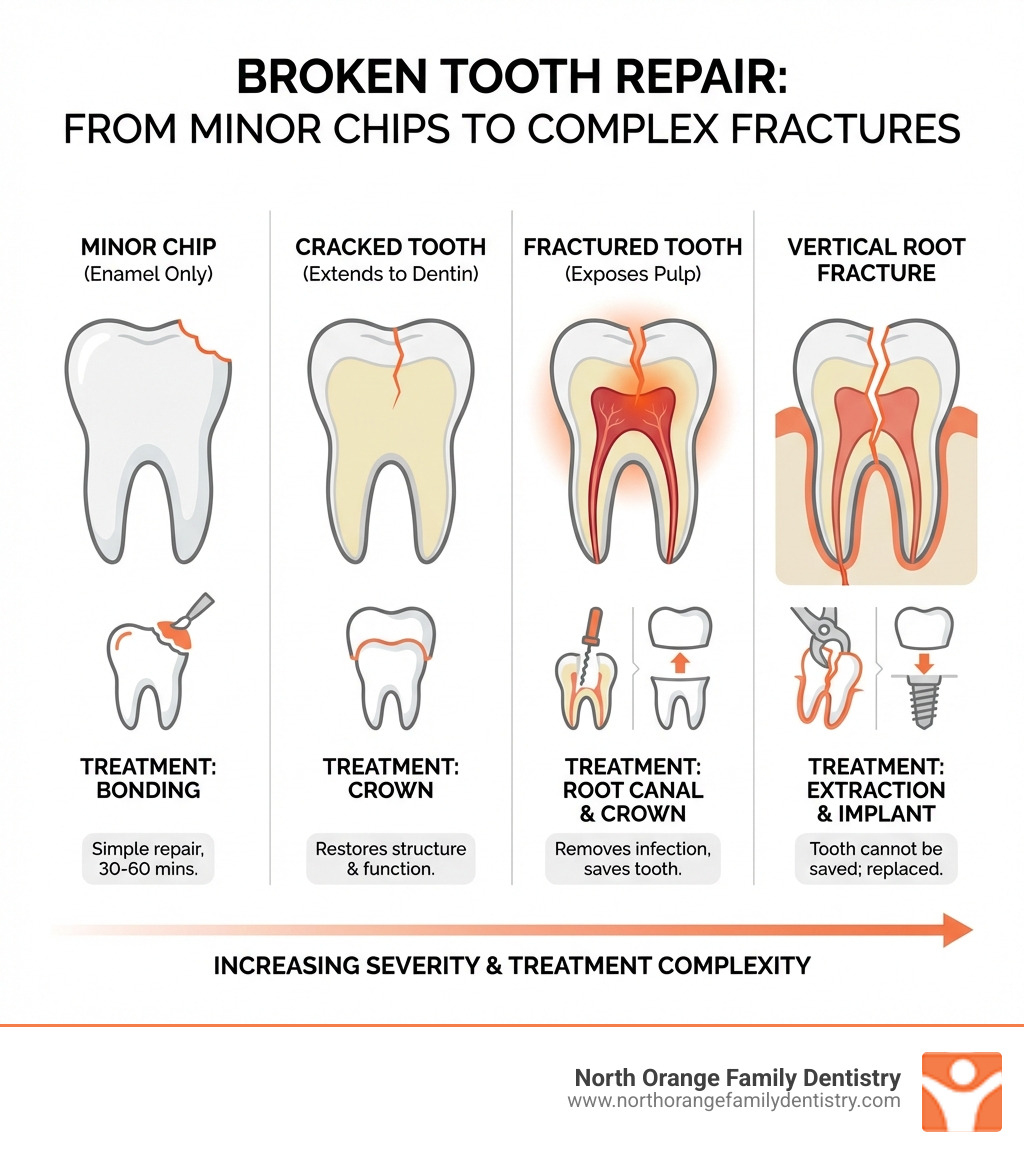
- Minor Chips and Craze Lines: These are small breaks or superficial cracks in the enamel. They may not cause pain but can have sharp edges.
- Cracked Tooth: A crack extends from the chewing surface toward the root. It can go deep enough to affect the inner dentin and pulp, causing pain.
- Fractured Cusp: This is a break in a pointed chewing surface, often around a filling.
- Severe Break/Fractured Tooth: A significant break that may expose the inner dentin and pulp, causing pain and sensitivity. If the pulp (nerve) is exposed, the pain can be severe.
- Split Tooth or Vertical Root Fracture: These are the most severe fractures, where the tooth splits into segments or a crack starts at the root. They are often painful and may require extraction.
- Diagnosis: We diagnose the extent of the damage through a visual exam, probing, and dental X-rays, which help us see if the root or pulp is affected.
A Closer Look at Broken Tooth Repair Options
After assessing the damage with a thorough exam and digital X-rays, we'll create a personalized treatment plan to restore your tooth's health and function. You can learn more about general restorations from this Restorative Dentistry guide.

Restoring Minor Damage with Dental Bonding and Fillings
For smaller chips or cracks, dental bonding or tooth-colored fillings are effective, conservative options.
- Dental Bonding: Ideal for minor chips on front teeth, dental bonding uses a composite resin to restore your tooth's shape. The process is typically completed in one visit. We prepare the tooth, apply the tooth-colored resin, sculpt it to match, and harden it with a special light. Bonding is fast, affordable, and minimally invasive, but it may not be as durable or stain-resistant as other options.
- Tooth-Colored Fillings: Similar to bonding, these fillings repair small breaks, especially those associated with decay. If a broken tooth occurs around an old filling, we can replace it to restore the tooth's integrity. Learn more about this scenario at Broken Tooth After Filling.
Advanced Solutions for Broken Tooth Repair: Crowns and Veneers
For more significant damage or cosmetic concerns, crowns and veneers offer durable, aesthetic solutions.
- Dental Crowns (Caps): A crown is a custom-made cap that covers the entire tooth, restoring its shape, strength, and appearance. We recommend crowns for a broken tooth with a large fracture, extensive decay, or after a root canal. The process typically takes two visits. Read our guide to learn Everything You Need to Know About Dental Crowns: Protect and Enhance Your Teeth.
- Dental Veneers: Veneers are thin porcelain shells that cover the front surface of teeth. While primarily cosmetic, they are excellent for repairing chips on front teeth and creating a uniform, natural-looking smile. Explore how chipped tooth veneers can restore your confidence.
Here's a quick comparison of these popular repair options:
FeatureDental BondingDental VeneersDental CrownsDamage TypeMinor chips, cracks, gapsMinor chips, cracks, discoloration, uneven teethLarge breaks, severe decay, after root canalTooth PrepMinimal or no enamel removalLight enamel reduction (0.3-1.2mm)Significant tooth shapingMaterialComposite resinPorcelain or composite resinPorcelain, zirconia, porcelain-fused-to-metalAestheticsGood, color-matchedExcellent, natural-looking, stain-resistantExcellent, natural-looking, strongDurability5-10 years10-20 years10-30 yearsCostGenerally lowerModerate to higherHigherProcedure TimeSingle visit (1-2 hours)2 visits2 visits
When a Tooth Can't Be Saved: Root Canals, Extractions, and Implants
Sometimes, a broken tooth is too damaged for the repairs above. In these cases, we focus on treating infection and providing a lasting replacement.
- Root Canal Therapy: If a fracture exposes the inner pulp (nerve), bacteria can cause a painful infection. A root canal saves the tooth by removing the infected pulp, cleaning the inner chamber, and sealing it. Afterward, we almost always place a dental crown to protect the now-brittle tooth. If you're in pain, learn about Tooth Pain Relief options.
- Tooth Extraction: In severe cases, such as a tooth fractured below the gum line, extraction may be the only option. If so, we will discuss the best ways to replace the missing tooth.
- Dental Implants: The gold standard for tooth replacement is a dental implant. We surgically place a titanium post (an endosteal implant) into the jawbone to act as a new root. A custom crown is then attached to it. Implants are a durable, long-term solution that doesn't affect adjacent teeth. The average cost for a single tooth implant at our practice is about $4500.
- Dental Bridges: A bridge is another replacement option that uses crowns on adjacent teeth to support an artificial tooth in the gap. However, this requires altering healthy teeth, which is why implants are often preferred.
Your Smile's Future: Aftercare, Costs, and Prevention
After your broken tooth is repaired, proper care is essential for maintaining your oral health and ensuring the longevity of the restoration.
The Cost and Longevity of Broken Tooth Repair
The lifespan of your repair depends on the treatment type and your oral habits.
- Longevity of Repairs:
- Bonding: Can last 5-10 years.
- Veneers: Typically last 10-20 years.
- Crowns: Very durable, often lasting 10-30 years or more.
- Implants: Can last a lifetime with proper care.
- Aftercare and Prevention: To protect your repaired tooth and prevent future breaks, maintain excellent oral hygiene by brushing and flossing daily. Avoid chewing on extremely hard items like ice or hard candy. If you grind your teeth (bruxism), we may recommend a custom nightguard. Regular checkups allow us to monitor your restoration and overall oral health. Learn more about the importance of preventative dental care.
- Cost and Affordability: The cost of broken tooth repair varies based on the treatment needed. While bonding is less expensive, implants are a more significant investment. We are committed to making quality care accessible. For patients without dental insurance, our Dental Wellness Plan Ohio offers a way to receive discounted yearly dental care at an affordable price.
- Dangers of an Untreated Broken Tooth: Ignoring a broken tooth can lead to serious issues, including infection, abscess, severe pain, and eventual tooth loss. Early treatment is the best way to avoid these complications.
Why Choose North Orange Family Dentistry for Broken Tooth Repair?
At North Orange Family Dentistry, we understand that a broken tooth can be painful and stressful. We are dedicated to providing compassionate, effective, and timely care to our community in Lewis Center, Delaware, and throughout Ohio.
- Same-Day Emergency Dental Care: We prioritize your comfort and can often see patients the same day for emergency dental treatments.
- Experienced, Awarded Team: Dr. Kyle Bogan leads our experienced team, which is committed to delivering five-star patient experiences with a warm, friendly approach.
- Advanced Technology: We use cutting-edge technology for precise diagnoses and effective treatments, including innovative laser therapies for TMJ pain, canker sores, and periodontal disease.
- Comprehensive Services: Beyond broken tooth repair, we offer a full spectrum of dental services to meet all your family's needs, including:
- Invisalign
- TMJ Pain Relief
- Teeth Whitening
- Dental Implants
- Tooth Bonding
- Veneers
- Crowns
- Root Canal Therapy
- Oral Hygiene & Wellness Checkups
- Botox
- Digital Dentures
- Personalized Care: We believe in a personalized approach to dentistry. We take the time to understand your unique needs and concerns, crafting treatment plans that are right for you and your family.
- Convenient Location: Located in Lewis Center, Ohio, we are easily accessible for patients from Delaware and surrounding areas, making it convenient to receive top-quality dental care.
Don't let a broken tooth compromise your smile or your health. We're here to help you restore your confidence and comfort. If you have a broken tooth, or to learn more about our services, please don't hesitate to reach out. We look forward to welcoming you to our dental family. To schedule an appointment for a dental crown or any other service, you can visit our website or give us a call. We're ready to help you smile brightly again.
Why Addressing a Broken Tooth Quickly Matters
Broken tooth repair is a critical dental service that addresses damage from minor chips to severe fractures. Depending on the injury's extent, treatments can include bonding, fillings, crowns, veneers, root canals, or dental implants.
Quick answers for broken tooth repair:
- Minor chips and cracks: Dental bonding or tooth-colored fillings
- Moderate damage: Dental crowns or veneers
- Severe breaks exposing pulp: Root canal therapy followed by a crown
- Fractures below the gum line: Extraction and replacement with a dental implant or bridge
- Emergency steps: Rinse with warm water, save the broken piece, apply a cold compress, and call your dentist immediately
Whether you've bitten down on something hard or had an accident, a broken tooth is a serious issue that won't heal on its own. Even if the pain subsides, the underlying damage can lead to infection, increased sensitivity, further breakage, and even tooth loss if left untreated.
Fortunately, modern dentistry offers reliable solutions for every type of tooth injury. The severity of the break determines the best treatment. A small chip might only need simple bonding, while a deeper fracture could require a root canal and a crown. In the most severe cases, extraction and replacement may be necessary.
Time matters. The sooner you see a dentist, the more options you'll have to save your tooth and prevent complications. Even a painless chip needs professional evaluation to avoid future decay or damage.
I'm Dr. Kyle Bogan, founder of North Orange Family Dentistry and a Fellow in both the International College of Dentists and the Academy of General Dentistry. With years of experience in restorative dentistry, I've helped hundreds of patients in the Delaware and Lewis Center area restore their smiles. In this guide, I'll explain everything you need to know about broken tooth repair, from immediate first aid to long-term solutions.
First Steps and Types of Tooth Injuries
A broken tooth can be alarming, but knowing what to do can significantly improve the outcome. Here’s how to handle the situation and understand the different types of injuries.
What to Do Immediately After Breaking a Tooth
Quick, calm action can save your tooth and reduce discomfort. Follow these steps immediately:
- Rinse Your Mouth: Gently rinse with warm salt water to clean and soothe the area.
- Save the Broken Piece: If you can find the fragment, save it in a small container of milk or saliva. We may be able to reattach it.
- Apply a Cold Compress: Place an ice pack on your cheek to reduce swelling and pain.
- Cover Sharp Edges: Use sugar-free gum or dental wax to cover any jagged edges irritating your tongue or cheek.
- Use Pain Relief: Take over-the-counter pain relievers like acetaminophen or ibuprofen as needed.
- Call Us Immediately: This is the most critical step. Contact our office at North Orange Family Dentistry right away. We offer emergency dental care in Lewis Center and often see patients the same day. Prompt action can prevent infection and more extensive repairs. For more tips, see what to do with a broken tooth.
If you have severe pain, bleeding, or a visible nerve, it's a dental emergency. A minor, painless chip may be less urgent, but it's always best to call us for guidance, as a broken tooth will not heal on its own.
Understanding the Severity: Chipped vs. Cracked vs. Fractured Teeth
Not all broken teeth are the same. The injury type dictates the treatment.
- Common Causes: Tooth breaks often result from trauma, biting hard foods, teeth grinding (bruxism), or weakened tooth structure due to decay or large fillings.
- Types of Tooth Injuries:
- Minor Chips and Craze Lines: These are small breaks or superficial cracks in the enamel. They may not cause pain but can have sharp edges.
- Cracked Tooth: A crack extends from the chewing surface toward the root. It can go deep enough to affect the inner dentin and pulp, causing pain.
- Fractured Cusp: This is a break in a pointed chewing surface, often around a filling.
- Severe Break/Fractured Tooth: A significant break that may expose the inner dentin and pulp, causing pain and sensitivity. If the pulp (nerve) is exposed, the pain can be severe.
- Split Tooth or Vertical Root Fracture: These are the most severe fractures, where the tooth splits into segments or a crack starts at the root. They are often painful and may require extraction.
- Diagnosis: We diagnose the extent of the damage through a visual exam, probing, and dental X-rays, which help us see if the root or pulp is affected.
A Closer Look at Broken Tooth Repair Options
After assessing the damage with a thorough exam and digital X-rays, we'll create a personalized treatment plan to restore your tooth's health and function. You can learn more about general restorations from this Restorative Dentistry guide.
Restoring Minor Damage with Dental Bonding and Fillings
For smaller chips or cracks, dental bonding or tooth-colored fillings are effective, conservative options.
- Dental Bonding: Ideal for minor chips on front teeth, dental bonding uses a composite resin to restore your tooth's shape. The process is typically completed in one visit. We prepare the tooth, apply the tooth-colored resin, sculpt it to match, and harden it with a special light. Bonding is fast, affordable, and minimally invasive, but it may not be as durable or stain-resistant as other options.
- Tooth-Colored Fillings: Similar to bonding, these fillings repair small breaks, especially those associated with decay. If a broken tooth occurs around an old filling, we can replace it to restore the tooth's integrity. Learn more about this scenario at Broken Tooth After Filling.
Advanced Solutions for Broken Tooth Repair: Crowns and Veneers
For more significant damage or cosmetic concerns, crowns and veneers offer durable, aesthetic solutions.
- Dental Crowns (Caps): A crown is a custom-made cap that covers the entire tooth, restoring its shape, strength, and appearance. We recommend crowns for a broken tooth with a large fracture, extensive decay, or after a root canal. The process typically takes two visits. Read our guide to learn Everything You Need to Know About Dental Crowns: Protect and Enhance Your Teeth.
- Dental Veneers: Veneers are thin porcelain shells that cover the front surface of teeth. While primarily cosmetic, they are excellent for repairing chips on front teeth and creating a uniform, natural-looking smile. Explore how chipped tooth veneers can restore your confidence.
Here's a quick comparison of these popular repair options:
FeatureDental BondingDental VeneersDental CrownsDamage TypeMinor chips, cracks, gapsMinor chips, cracks, discoloration, uneven teethLarge breaks, severe decay, after root canalTooth PrepMinimal or no enamel removalLight enamel reduction (0.3-1.2mm)Significant tooth shapingMaterialComposite resinPorcelain or composite resinPorcelain, zirconia, porcelain-fused-to-metalAestheticsGood, color-matchedExcellent, natural-looking, stain-resistantExcellent, natural-looking, strongDurability5-10 years10-20 years10-30 yearsCostGenerally lowerModerate to higherHigherProcedure TimeSingle visit (1-2 hours)2 visits2 visits
When a Tooth Can't Be Saved: Root Canals, Extractions, and Implants
Sometimes, a broken tooth is too damaged for the repairs above. In these cases, we focus on treating infection and providing a lasting replacement.
- Root Canal Therapy: If a fracture exposes the inner pulp (nerve), bacteria can cause a painful infection. A root canal saves the tooth by removing the infected pulp, cleaning the inner chamber, and sealing it. Afterward, we almost always place a dental crown to protect the now-brittle tooth. If you're in pain, learn about Tooth Pain Relief options.
- Tooth Extraction: In severe cases, such as a tooth fractured below the gum line, extraction may be the only option. If so, we will discuss the best ways to replace the missing tooth.
- Dental Implants: The gold standard for tooth replacement is a dental implant. We surgically place a titanium post (an endosteal implant) into the jawbone to act as a new root. A custom crown is then attached to it. Implants are a durable, long-term solution that doesn't affect adjacent teeth. The average cost for a single tooth implant at our practice is about $4500.
- Dental Bridges: A bridge is another replacement option that uses crowns on adjacent teeth to support an artificial tooth in the gap. However, this requires altering healthy teeth, which is why implants are often preferred.
Your Smile's Future: Aftercare, Costs, and Prevention
After your broken tooth is repaired, proper care is essential for maintaining your oral health and ensuring the longevity of the restoration.
The Cost and Longevity of Broken Tooth Repair
The lifespan of your repair depends on the treatment type and your oral habits.
- Longevity of Repairs:
- Bonding: Can last 5-10 years.
- Veneers: Typically last 10-20 years.
- Crowns: Very durable, often lasting 10-30 years or more.
- Implants: Can last a lifetime with proper care.
- Aftercare and Prevention: To protect your repaired tooth and prevent future breaks, maintain excellent oral hygiene by brushing and flossing daily. Avoid chewing on extremely hard items like ice or hard candy. If you grind your teeth (bruxism), we may recommend a custom nightguard. Regular checkups allow us to monitor your restoration and overall oral health. Learn more about the importance of preventative dental care.
- Cost and Affordability: The cost of broken tooth repair varies based on the treatment needed. While bonding is less expensive, implants are a more significant investment. We are committed to making quality care accessible. For patients without dental insurance, our Dental Wellness Plan Ohio offers a way to receive discounted yearly dental care at an affordable price.
- Dangers of an Untreated Broken Tooth: Ignoring a broken tooth can lead to serious issues, including infection, abscess, severe pain, and eventual tooth loss. Early treatment is the best way to avoid these complications.
Why Choose North Orange Family Dentistry for Broken Tooth Repair?
At North Orange Family Dentistry, we understand that a broken tooth can be painful and stressful. We are dedicated to providing compassionate, effective, and timely care to our community in Lewis Center, Delaware, and throughout Ohio.
- Same-Day Emergency Dental Care: We prioritize your comfort and can often see patients the same day for emergency dental treatments.
- Experienced, Awarded Team: Dr. Kyle Bogan leads our experienced team, which is committed to delivering five-star patient experiences with a warm, friendly approach.
- Advanced Technology: We use cutting-edge technology for precise diagnoses and effective treatments, including innovative laser therapies for TMJ pain, canker sores, and periodontal disease.
- Comprehensive Services: Beyond broken tooth repair, we offer a full spectrum of dental services to meet all your family's needs, including:
- Invisalign
- TMJ Pain Relief
- Teeth Whitening
- Dental Implants
- Tooth Bonding
- Veneers
- Crowns
- Root Canal Therapy
- Oral Hygiene & Wellness Checkups
- Botox
- Digital Dentures
- Personalized Care: We believe in a personalized approach to dentistry. We take the time to understand your unique needs and concerns, crafting treatment plans that are right for you and your family.
- Convenient Location: Located in Lewis Center, Ohio, we are easily accessible for patients from Delaware and surrounding areas, making it convenient to receive top-quality dental care.
Don't let a broken tooth compromise your smile or your health. We're here to help you restore your confidence and comfort. If you have a broken tooth, or to learn more about our services, please don't hesitate to reach out. We look forward to welcoming you to our dental family. To schedule an appointment for a dental crown or any other service, you can visit our website or give us a call. We're ready to help you smile brightly again.
Contact Us
Have any questions? Want to learn more?

