
A Practical Guide to Modern Invisible Orthodontic Aligners
Learn how invisible orthodontic aligners discreetly straighten teeth. Explore the process, benefits, and candidacy at North Orange Family Dentistry.


How Invisible Orthodontic Aligners Straighten Teeth
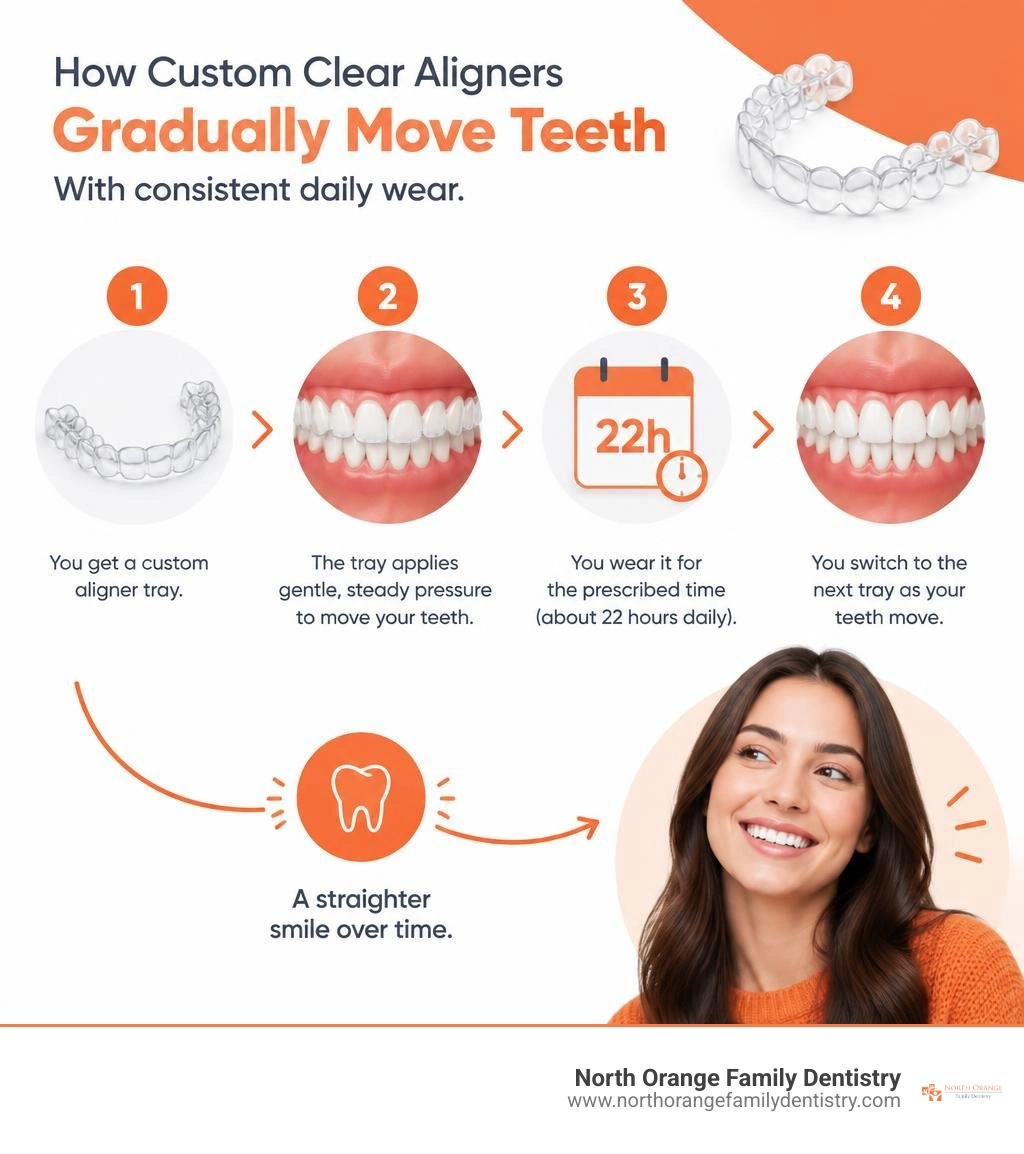
Invisible orthodontic aligners are clear, removable trays that gently shift teeth. Each custom tray makes a small change. You wear it for the prescribed time, then switch to the next tray as your teeth move. Most plans call for about 22 hours of wear each day.
Aligners can help with crowded or gapped teeth and some bite problems, but they are not right for every case. A comprehensive dental exam, including a review of orthodontic treatment options, is the best way to find out whether clear aligners could work for your smile. During that exam, your dentist will evaluate your tooth alignment, bite relationship, and gum health to determine whether clear aligner therapy is a safe and predictable option for your specific needs, concluding with a custom clear aligner retainer to maintain your results.
How Invisible Orthodontic Aligners Work and What They Treat
Modern orthodontic trays rely on medical-grade thermoplastic polyurethane to exert calibrated, continuous pressure against specific teeth. Aligners gently push teeth into planned positions through snug, custom-formed plastic envelopes.
When patients want to straighten crooked teeth, clear aligners offer a way to guide arch development and resolve misalignment without altering daily dietary habits or drawing attention to their smile.
The Science of Clear Aligners and Mechanical Tooth Movement
Clear aligner biomechanics operate across two primary systems: displacement-driven and force-driven mechanics. Displacement-driven movement occurs when the aligner's physical shape slightly differs from the tooth's current position, nudging it toward the tray's contours. Force-driven systems use targeted shape modifications and tooth-colored composite buttons known as attachments to deliver specific vectors of force.
These composite attachments serve as handles for the plastic, facilitating complex three-dimensional movements such as root uprighting and premolar derotation. When mild crowding requires minute spacing, providers may perform interproximal reduction (IPR), gently polishing away fractions of a millimeter of enamel to ensure proper tooth movement velocity without extractions (İ et al., 2019).
Clinical Candidacy for Invisible Orthodontic Aligners
Clear aligner therapy effectively treats a wide range of common orthodontic concerns:
- Dental Crowding: Overlapping teeth that are difficult to brush and floss.
- Diastema: Gaps and unwanted spaces across the dental arch.
- Overbite and Deep Bite: Upper front teeth overlapping the lower arch excessively.
- Crossbite: Upper teeth biting inside the lower teeth.
- Open Bite: Front teeth failing to meet when back teeth touch.
While clear aligners excel at non-extraction alignment, severe skeletal malocclusions or heavily impacted teeth may require specialized interdisciplinary care. Consistent compliance—wearing trays at least 22 hours daily—remains the fundamental requirement for successful clinical outcomes.
The Step-by-Step Treatment Process and Digital Fabrication
Getting started with clear aligners begins with a thorough clinical examination and digital intraoral scanning. We capture high-resolution 3D models of your dental arches, eliminating messy traditional impressions. This digital approach also allows you to preview your projected final smile before committing to treatment, which helps many patients feel confident about their decision.
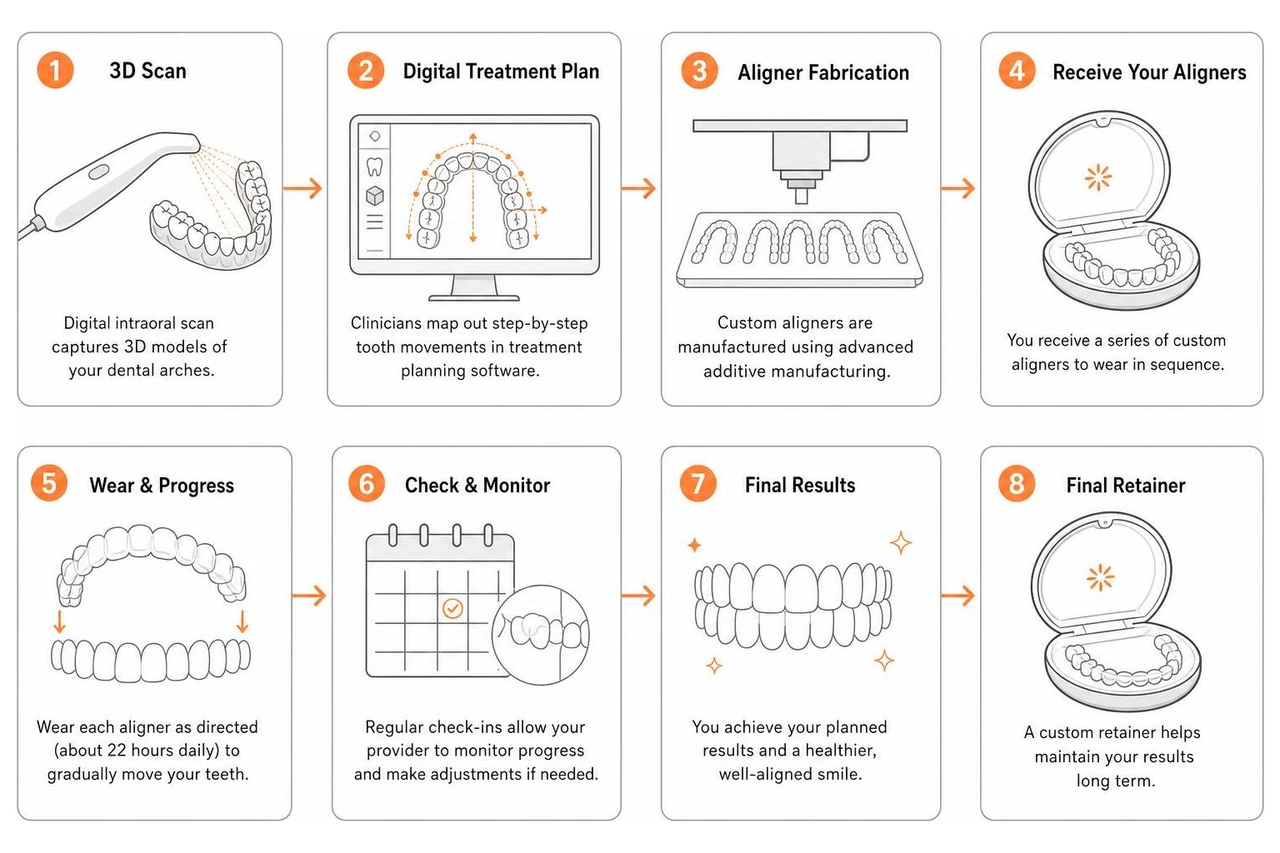
Using these digital scans, our clinicians map out step-by-step tooth movements in proprietary treatment planning software before manufacturing ever begins. Biomechanical research on 3D-printed models and polymeric clear aligners shows how digital workflows ensure high accuracy from initial software staging to the physical appliance.
The Digital Workflow Behind Invisible Orthodontic Aligners
The physical fabrication of modern aligners involves advanced additive manufacturing:
- Digital Staging: The clinical software divides the treatment into incremental stages, typically moving teeth no more than 0.25 mm per step.
- 3D Printing: High-resolution photopolymer printers cure liquid resin into durable, patient-specific dental models for every movement stage (Yu et al., 2022).
- Thermoforming: Medical-grade thermoplastic sheets are heated and pressure-formed over the 3D-printed models.
- Precision Trimming: Automated lasers cut the aligners along the gingival margin for a comfortable, customized fit.
Daily Wear Schedules, Attachments, and Treatment Duration
Clear aligner treatment typically lasts around 12 months, though mild cases can wrap up in as few as six months. To keep your treatment on schedule:
- Wear your aligners 20 to 22 hours every single day.
- Remove trays only for meals, hot beverages, and oral hygiene.
- Switch to your next tray sequence every 7 to 14 days as directed by your dentist.
- Clean trays with cool water and a soft-bristled toothbrush daily.
- Keep your previous set of trays in a safe case as a backup.
Regular progress checks at our Delaware, Ohio office allow Dr. Bogan and our clinical team to confirm that your teeth are tracking as planned and to make any necessary adjustments to your treatment timeline.
Benefits and Limitations of Clear Aligner Treatment
Choosing clear aligners gives patients a discreet way to achieve a balanced smile without visible hardware. While you might notice a very slight lisp during the first day or two of wear, your tongue adapts rapidly. Most patients report that friends, family members, and coworkers never even notice they are undergoing orthodontic treatment.
Comfort, Hygiene, and Dietary Freedom
Because clear aligners are completely removable, you never have to avoid crunchy vegetables, popcorn, or sticky foods. You simply take your trays out before eating, enjoy your meal, brush your teeth, and click the aligners back into place. This dietary freedom is one of the most frequently cited advantages of clear aligner therapy.
Maintaining gum health is equally simple; you can brush and floss normally without needing specialized threaders or interdental brushes. Furthermore, smooth polymer edges eliminate soft tissue irritation and painful abrasions inside the mouth.
Treatment Efficacy and Biomechanical Considerations
Scientific literature highlights clear aligners as exceptionally efficient for mild to moderate crowding, often reducing overall treatment duration in non-extraction cases.
However, clear aligners have distinct mechanical limits. Severe rotations of rounded teeth (like canines) and pure vertical extrusion can be challenging to achieve with plastic alone. In complex cases, your dentist may incorporate elastics or auxiliary buttons to ensure complete control over tooth roots and arch symmetry (İ et al., 2019).
Managing Oral Health, Side Effects, and Long-Term Stability
Periodontal Benefits and Monitoring Root Health
From a periodontal perspective, clear aligners can support daily oral hygiene because they are removable. Patients develop significantly fewer white-spot lesions (enamel demineralization) and experience less plaque-induced gingivitis because daily hygiene remains unhindered.
Mild apical root resorption is a recognized risk across all forms of orthodontic movement. Studies demonstrate that clear aligners apply gentle, intermittent forces that generally carry a lower severity of root remodeling compared to heavy continuous archwire forces, making them a safe choice when monitored by an experienced clinician (İ et al., 2019).
Post-Treatment Retention Protocols to Prevent Relapse
Once active tooth movement concludes, the surrounding bone and periodontal ligaments require time to remodel and stabilize. Without proper retention, teeth naturally drift back toward their original positions. Wearing a dedicated clear aligner retainer every night protects your investment and preserves your straight smile for life.
Navigating Treatment Costs and Insurance Coverage
Many dental insurance policies include orthodontic benefits that provide coverage for clear aligner therapy. Reviewing a comprehensive Invisalign insurance guide can help clarify lifetime orthodontic maximums and out-of-pocket estimates.
For our uninsured patients and families in Delaware County and Lewis Center, North Orange Family Dentistry offers an in-house Dental Wellness Plan. This plan provides routine yearly preventive dental care and generous discounts on treatments, making comprehensive dental care and smile alignment accessible without traditional insurance barriers. Our team is happy to walk you through your coverage details and provide a clear estimate before you begin treatment, so there are no surprises along the way.
Frequently Asked Questions About Clear Aligners
How painful is wearing clear aligners?
Most patients describe the sensation as mild pressure rather than pain. When you switch to a fresh set of trays, your teeth may feel slightly tender for the first 24 to 48 hours as the new movement begins. This temporary discomfort indicates that the aligners are actively working and can easily be managed with over-the-counter pain relievers if necessary.
Can you wear clear aligners only at night?
No, standard aligners require 20 to 22 hours of daily wear to shift teeth effectively. Wearing aligners only at night disrupts the biological remodeling process, keeping your teeth in a constant state of traumatic relapse and inflammation that delays progress and risks root damage.
What happens if an aligner tray breaks or gets lost?
If you lose or crack an aligner, contact our dental office immediately. Depending on where you are in your current wear cycle, we may advise you to step back into your previous tray or move forward to the next stage early. Having your dentist manage any timeline adjustments helps you avoid unexpected delays and keeps Invisalign replacement costs to a minimum.
Conclusion
Modern clear aligners combine advanced digital scanning, predictive 3D modeling, and comfortable materials to deliver predictable, discreet orthodontic results for both teens and adults. Achieving your ideal smile starts with an individualized clinical assessment.
At North Orange Family Dentistry, Dr. Kyle Bogan and our experienced clinical team provide complete smile care for patients of all ages across Delaware, Lewis Center, and the greater Columbus area. Beyond aligner therapy, our practice delivers cutting-edge laser treatments for TMJ pain, canker sore healing, and periodontal disease, as well as same-day emergency appointments for unexpected dental needs. Whether you have insurance or choose our in-house Dental Wellness Plan, we are here to support your oral health goals.
Ready to transform your smile? Schedule an Invisalign clear aligner consultation with North Orange Family Dentistry today.
References
Tamer İ, Öztaş E, Marşan G. "Orthodontic Treatment with Clear Aligners and The Scientific Reality Behind Their Marketing: A Literature Review.." Turkish journal of orthodontics, 2019. PMCID PMC7018497.Yu X, Li G, Zheng Y, Gao J, Fu Y, Wang Q, Huang L, Pan X, Ding J. "'Invisible' orthodontics by polymeric 'clear' aligners molded on 3D-printed personalized dental models.." Regenerative biomaterials, 2022. PMCID PMC8992363.
How Invisible Orthodontic Aligners Straighten Teeth
Invisible orthodontic aligners are clear, removable trays that gently shift teeth. Each custom tray makes a small change. You wear it for the prescribed time, then switch to the next tray as your teeth move. Most plans call for about 22 hours of wear each day.
Aligners can help with crowded or gapped teeth and some bite problems, but they are not right for every case. A comprehensive dental exam, including a review of orthodontic treatment options, is the best way to find out whether clear aligners could work for your smile. During that exam, your dentist will evaluate your tooth alignment, bite relationship, and gum health to determine whether clear aligner therapy is a safe and predictable option for your specific needs, concluding with a custom clear aligner retainer to maintain your results.
How Invisible Orthodontic Aligners Work and What They Treat
Modern orthodontic trays rely on medical-grade thermoplastic polyurethane to exert calibrated, continuous pressure against specific teeth. Aligners gently push teeth into planned positions through snug, custom-formed plastic envelopes.
When patients want to straighten crooked teeth, clear aligners offer a way to guide arch development and resolve misalignment without altering daily dietary habits or drawing attention to their smile.
The Science of Clear Aligners and Mechanical Tooth Movement
Clear aligner biomechanics operate across two primary systems: displacement-driven and force-driven mechanics. Displacement-driven movement occurs when the aligner's physical shape slightly differs from the tooth's current position, nudging it toward the tray's contours. Force-driven systems use targeted shape modifications and tooth-colored composite buttons known as attachments to deliver specific vectors of force.
These composite attachments serve as handles for the plastic, facilitating complex three-dimensional movements such as root uprighting and premolar derotation. When mild crowding requires minute spacing, providers may perform interproximal reduction (IPR), gently polishing away fractions of a millimeter of enamel to ensure proper tooth movement velocity without extractions (İ et al., 2019).
Clinical Candidacy for Invisible Orthodontic Aligners
Clear aligner therapy effectively treats a wide range of common orthodontic concerns:
- Dental Crowding: Overlapping teeth that are difficult to brush and floss.
- Diastema: Gaps and unwanted spaces across the dental arch.
- Overbite and Deep Bite: Upper front teeth overlapping the lower arch excessively.
- Crossbite: Upper teeth biting inside the lower teeth.
- Open Bite: Front teeth failing to meet when back teeth touch.
While clear aligners excel at non-extraction alignment, severe skeletal malocclusions or heavily impacted teeth may require specialized interdisciplinary care. Consistent compliance—wearing trays at least 22 hours daily—remains the fundamental requirement for successful clinical outcomes.
The Step-by-Step Treatment Process and Digital Fabrication
Getting started with clear aligners begins with a thorough clinical examination and digital intraoral scanning. We capture high-resolution 3D models of your dental arches, eliminating messy traditional impressions. This digital approach also allows you to preview your projected final smile before committing to treatment, which helps many patients feel confident about their decision.
Using these digital scans, our clinicians map out step-by-step tooth movements in proprietary treatment planning software before manufacturing ever begins. Biomechanical research on 3D-printed models and polymeric clear aligners shows how digital workflows ensure high accuracy from initial software staging to the physical appliance.
The Digital Workflow Behind Invisible Orthodontic Aligners
The physical fabrication of modern aligners involves advanced additive manufacturing:
- Digital Staging: The clinical software divides the treatment into incremental stages, typically moving teeth no more than 0.25 mm per step.
- 3D Printing: High-resolution photopolymer printers cure liquid resin into durable, patient-specific dental models for every movement stage (Yu et al., 2022).
- Thermoforming: Medical-grade thermoplastic sheets are heated and pressure-formed over the 3D-printed models.
- Precision Trimming: Automated lasers cut the aligners along the gingival margin for a comfortable, customized fit.
Daily Wear Schedules, Attachments, and Treatment Duration
Clear aligner treatment typically lasts around 12 months, though mild cases can wrap up in as few as six months. To keep your treatment on schedule:
- Wear your aligners 20 to 22 hours every single day.
- Remove trays only for meals, hot beverages, and oral hygiene.
- Switch to your next tray sequence every 7 to 14 days as directed by your dentist.
- Clean trays with cool water and a soft-bristled toothbrush daily.
- Keep your previous set of trays in a safe case as a backup.
Regular progress checks at our Delaware, Ohio office allow Dr. Bogan and our clinical team to confirm that your teeth are tracking as planned and to make any necessary adjustments to your treatment timeline.
Benefits and Limitations of Clear Aligner Treatment
Choosing clear aligners gives patients a discreet way to achieve a balanced smile without visible hardware. While you might notice a very slight lisp during the first day or two of wear, your tongue adapts rapidly. Most patients report that friends, family members, and coworkers never even notice they are undergoing orthodontic treatment.
Comfort, Hygiene, and Dietary Freedom
Because clear aligners are completely removable, you never have to avoid crunchy vegetables, popcorn, or sticky foods. You simply take your trays out before eating, enjoy your meal, brush your teeth, and click the aligners back into place. This dietary freedom is one of the most frequently cited advantages of clear aligner therapy.
Maintaining gum health is equally simple; you can brush and floss normally without needing specialized threaders or interdental brushes. Furthermore, smooth polymer edges eliminate soft tissue irritation and painful abrasions inside the mouth.
Treatment Efficacy and Biomechanical Considerations
Scientific literature highlights clear aligners as exceptionally efficient for mild to moderate crowding, often reducing overall treatment duration in non-extraction cases.
However, clear aligners have distinct mechanical limits. Severe rotations of rounded teeth (like canines) and pure vertical extrusion can be challenging to achieve with plastic alone. In complex cases, your dentist may incorporate elastics or auxiliary buttons to ensure complete control over tooth roots and arch symmetry (İ et al., 2019).
Managing Oral Health, Side Effects, and Long-Term Stability
Periodontal Benefits and Monitoring Root Health
From a periodontal perspective, clear aligners can support daily oral hygiene because they are removable. Patients develop significantly fewer white-spot lesions (enamel demineralization) and experience less plaque-induced gingivitis because daily hygiene remains unhindered.
Mild apical root resorption is a recognized risk across all forms of orthodontic movement. Studies demonstrate that clear aligners apply gentle, intermittent forces that generally carry a lower severity of root remodeling compared to heavy continuous archwire forces, making them a safe choice when monitored by an experienced clinician (İ et al., 2019).
Post-Treatment Retention Protocols to Prevent Relapse
Once active tooth movement concludes, the surrounding bone and periodontal ligaments require time to remodel and stabilize. Without proper retention, teeth naturally drift back toward their original positions. Wearing a dedicated clear aligner retainer every night protects your investment and preserves your straight smile for life.
Navigating Treatment Costs and Insurance Coverage
Many dental insurance policies include orthodontic benefits that provide coverage for clear aligner therapy. Reviewing a comprehensive Invisalign insurance guide can help clarify lifetime orthodontic maximums and out-of-pocket estimates.
For our uninsured patients and families in Delaware County and Lewis Center, North Orange Family Dentistry offers an in-house Dental Wellness Plan. This plan provides routine yearly preventive dental care and generous discounts on treatments, making comprehensive dental care and smile alignment accessible without traditional insurance barriers. Our team is happy to walk you through your coverage details and provide a clear estimate before you begin treatment, so there are no surprises along the way.
Frequently Asked Questions About Clear Aligners
How painful is wearing clear aligners?
Most patients describe the sensation as mild pressure rather than pain. When you switch to a fresh set of trays, your teeth may feel slightly tender for the first 24 to 48 hours as the new movement begins. This temporary discomfort indicates that the aligners are actively working and can easily be managed with over-the-counter pain relievers if necessary.
Can you wear clear aligners only at night?
No, standard aligners require 20 to 22 hours of daily wear to shift teeth effectively. Wearing aligners only at night disrupts the biological remodeling process, keeping your teeth in a constant state of traumatic relapse and inflammation that delays progress and risks root damage.
What happens if an aligner tray breaks or gets lost?
If you lose or crack an aligner, contact our dental office immediately. Depending on where you are in your current wear cycle, we may advise you to step back into your previous tray or move forward to the next stage early. Having your dentist manage any timeline adjustments helps you avoid unexpected delays and keeps Invisalign replacement costs to a minimum.
Conclusion
Modern clear aligners combine advanced digital scanning, predictive 3D modeling, and comfortable materials to deliver predictable, discreet orthodontic results for both teens and adults. Achieving your ideal smile starts with an individualized clinical assessment.
At North Orange Family Dentistry, Dr. Kyle Bogan and our experienced clinical team provide complete smile care for patients of all ages across Delaware, Lewis Center, and the greater Columbus area. Beyond aligner therapy, our practice delivers cutting-edge laser treatments for TMJ pain, canker sore healing, and periodontal disease, as well as same-day emergency appointments for unexpected dental needs. Whether you have insurance or choose our in-house Dental Wellness Plan, we are here to support your oral health goals.
Ready to transform your smile? Schedule an Invisalign clear aligner consultation with North Orange Family Dentistry today.
References
Tamer İ, Öztaş E, Marşan G. "Orthodontic Treatment with Clear Aligners and The Scientific Reality Behind Their Marketing: A Literature Review.." Turkish journal of orthodontics, 2019. PMCID PMC7018497.Yu X, Li G, Zheng Y, Gao J, Fu Y, Wang Q, Huang L, Pan X, Ding J. "'Invisible' orthodontics by polymeric 'clear' aligners molded on 3D-printed personalized dental models.." Regenerative biomaterials, 2022. PMCID PMC8992363.
Contact Us
Have any questions? Want to learn more?

