
Best Endodontist Near Me: Top 10 Expert Reviews
Find the best endodontist near you for expert root canal care and tooth-saving treatments at North Orange Family Dentistry.


Why Finding the Right Endodontist Can Save Your Tooth — and Your Peace of Mind
An endodontist is a dental specialist who focuses on diagnosing and treating problems inside the tooth — most commonly through root canal therapy. If you're in pain and need help fast, here's what you need to know right now:
Quick Answer: What Does an Endodontist Do?
- Treats infected, inflamed, or damaged tooth pulp
- Performs root canal treatments and endodontic surgery
- Diagnoses complex or hard-to-find tooth and jaw pain
- Works to save your natural tooth rather than extract it
- Completes 2-3 years of advanced training beyond dental school
Tooth pain that wakes you up at night, sharp sensitivity to hot or cold, or a swollen jaw — these are signs that something is going wrong deep inside your tooth. And that's exactly where an endodontist comes in.
Here's a surprising fact: less than 3% of all dentists are endodontists. They are rare specialists, and for good reason. The space inside a root canal is incredibly small — smaller than the ear on a dime — and treating it takes precision, advanced tools, and years of focused training.
The good news? Modern endodontic care is far more comfortable than most people expect. With today's anesthesia and technology, most patients are genuinely surprised by how painless the process is.
At North Orange Family Dentistry, we offer root canal services as part of our full range of dental care for families in Delaware, Lewis Center, and Powell, Ohio — and we're able to see emergency patients the same day in most cases.
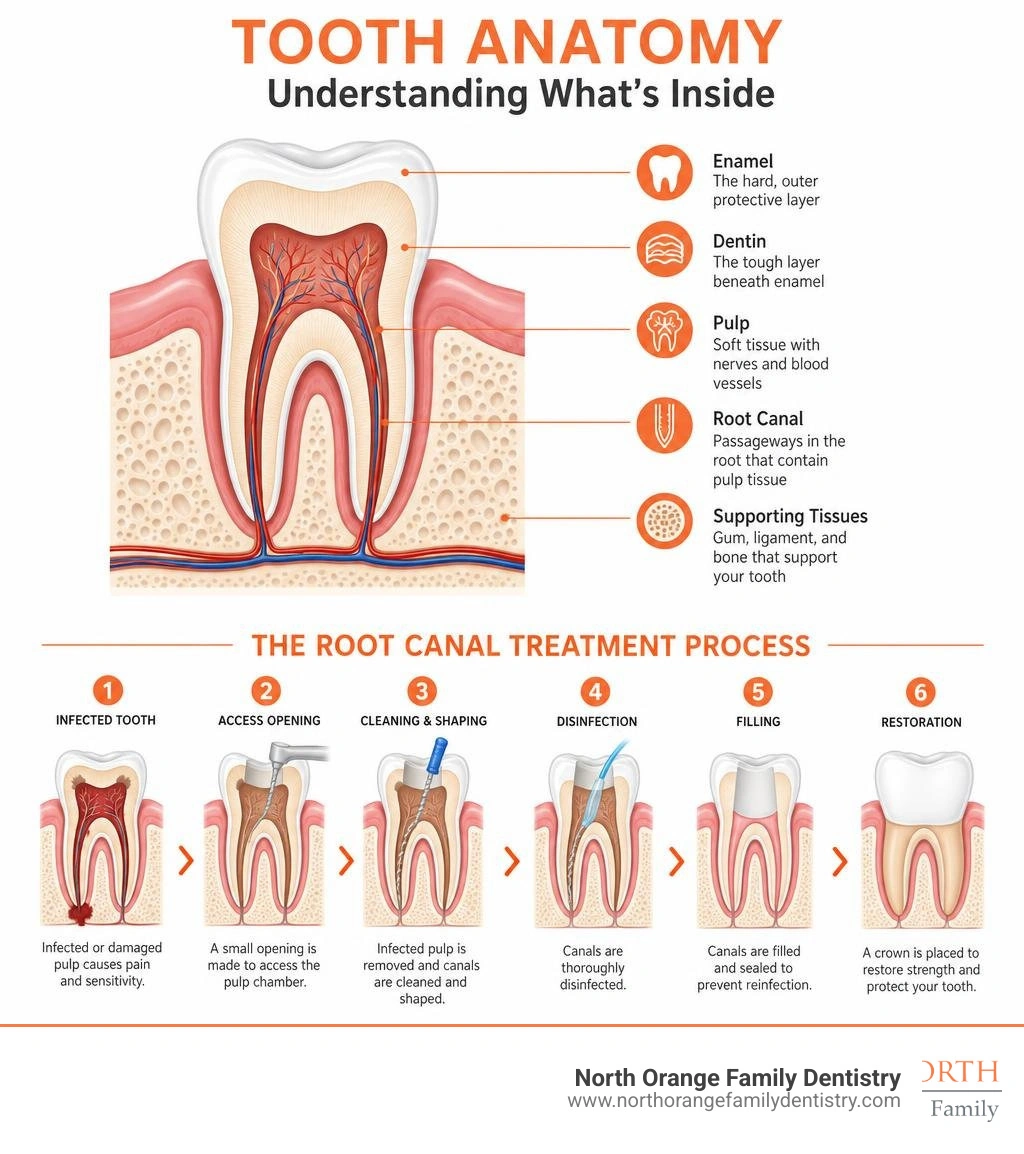
Endodontist word roundup:
What is an Endodontist and How Do They Differ From a Dentist?
While every endodontist is a dentist, not all dentists are endodontists. The easiest way to think about the difference is to compare a general practitioner doctor to a cardiologist. Your general dentist is the coordinator of your overall oral health, handling cleanings, fillings, crowns, and preventive care.
An endodontist, however, is a specialist who focuses on the internal anatomy of the tooth. They treat diseases and injuries affecting the dental pulp (the soft tissue inside your tooth containing nerves and blood vessels) and the surrounding root tissues. The American Association of Endodontists also describes endodontists as specialists in saving teeth through advanced diagnosis and treatment of tooth pain.
Because of this hyper-focused scope of practice, endodontists possess immense diagnostic expertise. They are uniquely skilled at identifying the source of complex, hard-to-explain oral and facial pain that might baffle a general practitioner.
The Specialized Training of an Endodontist
To earn their title, endodontists must complete four years of dental school followed by an additional two to three years in an accredited advanced specialty program in endodontics. This residency program provides rigorous clinical experience and deep academic training in root canal biology, pain management, and microsurgical techniques.
This specialized focus translates to a massive difference in clinical volume:
- General Dentists: Typically perform about two root canal treatments per week.
- Endodontists: Complete an average of 25 to 35 root canal treatments per week.
This high volume means they have seen almost every root shape, calcified canal, and structural anomaly imaginable. By limiting their scope entirely to these procedures, specialists ensure the highest level of precision and care for every patient.
When to See a Root Canal Specialist: Symptoms and Referrals

You might find yourself needing a Root Canal Specialist if a deep cavity, cracked tooth, or physical trauma has allowed bacteria to enter the inner chamber of your tooth. When this happens, the pulp becomes inflamed or infected, leading to a dental abscess if left untreated.
In many cases, your general dentist will recommend a referral to an endodontist if they detect a highly complex root system, severe calcification, or a persistent infection that requires advanced microscopic intervention. However, patients can also reach out to specialists directly when experiencing emergency symptoms.
Key Symptoms That Require an Endodontist
If you experience any of the following symptoms, it is time to have your tooth evaluated:
- Persistent Pain: Deep, throbbing pain in your tooth or jaw that does not go away.
- Temperature Sensitivity: Sharp pain when consuming hot or cold foods that lingers long after the stimulus is gone.
- Gum Tenderness and Swelling: Tenderness, redness, or a visible pimple-like bump on the gums near the painful tooth.
- Tooth Discoloration: A noticeable darkening or graying of a single tooth, indicating internal nerve damage.
- Facial Swelling: Swelling in your face, cheek, or jaw, which can indicate a spreading infection that requires immediate emergency dental care.
Common Procedures: Nonsurgical Root Canals vs. Endodontic Surgery
When treating the interior of a tooth, endodontists have a variety of procedures at their disposal, ranging from standard therapies to advanced microsurgery. The primary goal of a Dental Root Canal is always to remove infected tissue and seal the tooth to prevent future reinfection.
- Nonsurgical Root Canal Therapy: This is the standard procedure. The specialist creates a small access opening in the crown of the tooth, removes the diseased pulp, cleans and shapes the microscopic canals, fills the space with a biocompatible material, and seals the opening.
- Endodontic Retreatment: If a previous root canal fails to heal properly—which can happen due to narrow or curved canals that were missed during the first treatment—the old filling material is removed, the canals are cleaned again, and the tooth is resealed.
- Endodontic Surgery (Apicoectomy): When a nonsurgical root canal cannot save the tooth, surgery may be necessary. The most common surgical procedure is an apicoectomy (or root-end surgery). The specialist opens the gum tissue, removes the infected tissue at the very tip of the root, trims the root end, and places a small filling to seal the canal from the bottom.
- Pulpotomy and Pulpectomy: Often performed in pediatric or emergency cases, a pulpotomy removes only the diseased portion of the pulp to save the healthy nerve, while a pulpectomy removes the entire pulp chamber as the first step of a complete root canal.
Advanced Technology and Pain Management in Endodontics
The fear of root canals is a relic of the past. Modern endodontics relies on cutting-edge technology to make procedures fast, highly successful, and completely pain-free.
First and foremost is pain management. Endodontists are experts in administering local anesthesia, utilizing advanced numbing techniques to ensure "profound anesthesia" before any work begins. Many specialist offices also offer sedation dentistry to help highly anxious patients relax completely.
To achieve successful outcomes, specialists use several key technologies:
- 3D Imaging and CBCT Scans: Cone-beam computed tomography provides a highly detailed, three-dimensional view of the tooth, roots, and surrounding jawbone, exposing tiny structural details that traditional 2D X-rays miss.
- Dental Operating Microscopes: Because root canals are incredibly narrow, high-powered mounted microscopes allow the specialist to see deep inside the tooth to locate hidden canals and structural fractures.
- Dental Dams: A protective latex or non-latex sheet is placed around the tooth to isolate it from the rest of the mouth, keeping the treatment area sterile and dry.
Experienced specialists emphasize these microscopic tools to minimize chair time and maximize patient comfort. For an in-depth breakdown of what to expect, read our guide on the Root Canal Procedure Explained.
Saving Your Natural Teeth vs. Extraction and Implants
When faced with a severely damaged tooth, you generally have two choices: save the tooth with endodontic treatment or extract it and replace it. Dental professionals agree that preserving your natural tooth is always the preferred option.
Nothing functions, feels, or looks exactly like your natural tooth. Saving it avoids the risk of neighboring teeth shifting, preserves your natural bite force, and prevents jawbone resorption (the gradual loss of bone structure that occurs when a tooth root is missing).
However, if a tooth is fractured below the gumline or lacks sufficient bone support, extraction becomes necessary. In these cases, replacing the tooth is vital. At North Orange Family Dentistry, we offer high-quality endosteal dental implants. The average cost for a single-tooth implant is about $4,500, which includes the surgical placement and the custom crown. While implants are an incredible and durable modern solution, saving your natural tooth through a root canal is usually more cost-effective and conservative.
For more insights on why saving your tooth is safe and beneficial, explore our article: Are Root Canals Bad for You.
Frequently Asked Questions About Endodontic Care
How Long Do Root Canals Take and What is the Recovery Like?
Most standard root canal treatments are completed in a single visit lasting between 45 and 90 minutes. However, complex cases or teeth with severe infections may require two appointments to ensure the tooth is fully sanitized before sealing.
Recovery is typically mild. You can expect some tenderness or a bruised sensation around the treated tooth for a few days, which is easily managed with over-the-counter pain relievers like ibuprofen. For more details, see our resources on How Long Do Root Canals Take and Recovery After Root Canal.
What Should I Avoid Doing After My Procedure?
To protect your tooth and ensure proper healing, keep these best practices in mind:
- Do not chew on the treated tooth until your general dentist has placed the permanent crown. Temporary fillings can leak or wear down under heavy pressure.
- Avoid hard, sticky, or crunchy foods that could crack the weakened tooth structure.
- Maintain gentle oral hygiene care by brushing and flossing carefully around the treated area.
For a complete list of recovery tips, read What Not to Do After a Root Canal.
What is the Success Rate of Endodontic Treatments?
Nonsurgical root canals boast an impressive success rate of over 95%. The long-term outcome depends heavily on how quickly you return to your general dentist for the placement of a permanent crown. A permanent crown restores the tooth's structural integrity and seals out bacteria, ensuring the tooth can survive for a lifetime.
Conclusion
When you are dealing with severe tooth pain, you want expert care in a comfortable environment. At North Orange Family Dentistry, led by Dr. Kyle Bogan in Delaware, Ohio, we are dedicated to helping our patients preserve their natural smiles. Our practice is proud of our consistent 5-star rating and over 900 Google reviews, reflecting our commitment to clinical excellence and compassionate care.
We understand that dental emergencies don't wait. That is why we offer same-day emergency dental appointments to get you out of pain fast. For patients without dental insurance, we offer an in-house Dental Wellness Plan, which helps individuals and families receive the yearly preventive care they need at a discounted price.
In addition to root canal therapy, our modern facility features advanced laser treatments for TMJ pain, rapid canker sore healing, and non-surgical periodontal disease therapy. Whether you live in Delaware, Lewis Center, Orange, or Powell, Ohio, we are here to provide top-tier care for your entire family.
If you are experiencing tooth pain or want to learn more, check out More info about root canal services or contact us today to schedule your visit!
Why Finding the Right Endodontist Can Save Your Tooth — and Your Peace of Mind
An endodontist is a dental specialist who focuses on diagnosing and treating problems inside the tooth — most commonly through root canal therapy. If you're in pain and need help fast, here's what you need to know right now:
Quick Answer: What Does an Endodontist Do?
- Treats infected, inflamed, or damaged tooth pulp
- Performs root canal treatments and endodontic surgery
- Diagnoses complex or hard-to-find tooth and jaw pain
- Works to save your natural tooth rather than extract it
- Completes 2-3 years of advanced training beyond dental school
Tooth pain that wakes you up at night, sharp sensitivity to hot or cold, or a swollen jaw — these are signs that something is going wrong deep inside your tooth. And that's exactly where an endodontist comes in.
Here's a surprising fact: less than 3% of all dentists are endodontists. They are rare specialists, and for good reason. The space inside a root canal is incredibly small — smaller than the ear on a dime — and treating it takes precision, advanced tools, and years of focused training.
The good news? Modern endodontic care is far more comfortable than most people expect. With today's anesthesia and technology, most patients are genuinely surprised by how painless the process is.
At North Orange Family Dentistry, we offer root canal services as part of our full range of dental care for families in Delaware, Lewis Center, and Powell, Ohio — and we're able to see emergency patients the same day in most cases.
Endodontist word roundup:
What is an Endodontist and How Do They Differ From a Dentist?
While every endodontist is a dentist, not all dentists are endodontists. The easiest way to think about the difference is to compare a general practitioner doctor to a cardiologist. Your general dentist is the coordinator of your overall oral health, handling cleanings, fillings, crowns, and preventive care.
An endodontist, however, is a specialist who focuses on the internal anatomy of the tooth. They treat diseases and injuries affecting the dental pulp (the soft tissue inside your tooth containing nerves and blood vessels) and the surrounding root tissues. The American Association of Endodontists also describes endodontists as specialists in saving teeth through advanced diagnosis and treatment of tooth pain.
Because of this hyper-focused scope of practice, endodontists possess immense diagnostic expertise. They are uniquely skilled at identifying the source of complex, hard-to-explain oral and facial pain that might baffle a general practitioner.
The Specialized Training of an Endodontist
To earn their title, endodontists must complete four years of dental school followed by an additional two to three years in an accredited advanced specialty program in endodontics. This residency program provides rigorous clinical experience and deep academic training in root canal biology, pain management, and microsurgical techniques.
This specialized focus translates to a massive difference in clinical volume:
- General Dentists: Typically perform about two root canal treatments per week.
- Endodontists: Complete an average of 25 to 35 root canal treatments per week.
This high volume means they have seen almost every root shape, calcified canal, and structural anomaly imaginable. By limiting their scope entirely to these procedures, specialists ensure the highest level of precision and care for every patient.
When to See a Root Canal Specialist: Symptoms and Referrals
You might find yourself needing a Root Canal Specialist if a deep cavity, cracked tooth, or physical trauma has allowed bacteria to enter the inner chamber of your tooth. When this happens, the pulp becomes inflamed or infected, leading to a dental abscess if left untreated.
In many cases, your general dentist will recommend a referral to an endodontist if they detect a highly complex root system, severe calcification, or a persistent infection that requires advanced microscopic intervention. However, patients can also reach out to specialists directly when experiencing emergency symptoms.
Key Symptoms That Require an Endodontist
If you experience any of the following symptoms, it is time to have your tooth evaluated:
- Persistent Pain: Deep, throbbing pain in your tooth or jaw that does not go away.
- Temperature Sensitivity: Sharp pain when consuming hot or cold foods that lingers long after the stimulus is gone.
- Gum Tenderness and Swelling: Tenderness, redness, or a visible pimple-like bump on the gums near the painful tooth.
- Tooth Discoloration: A noticeable darkening or graying of a single tooth, indicating internal nerve damage.
- Facial Swelling: Swelling in your face, cheek, or jaw, which can indicate a spreading infection that requires immediate emergency dental care.
Common Procedures: Nonsurgical Root Canals vs. Endodontic Surgery
When treating the interior of a tooth, endodontists have a variety of procedures at their disposal, ranging from standard therapies to advanced microsurgery. The primary goal of a Dental Root Canal is always to remove infected tissue and seal the tooth to prevent future reinfection.
- Nonsurgical Root Canal Therapy: This is the standard procedure. The specialist creates a small access opening in the crown of the tooth, removes the diseased pulp, cleans and shapes the microscopic canals, fills the space with a biocompatible material, and seals the opening.
- Endodontic Retreatment: If a previous root canal fails to heal properly—which can happen due to narrow or curved canals that were missed during the first treatment—the old filling material is removed, the canals are cleaned again, and the tooth is resealed.
- Endodontic Surgery (Apicoectomy): When a nonsurgical root canal cannot save the tooth, surgery may be necessary. The most common surgical procedure is an apicoectomy (or root-end surgery). The specialist opens the gum tissue, removes the infected tissue at the very tip of the root, trims the root end, and places a small filling to seal the canal from the bottom.
- Pulpotomy and Pulpectomy: Often performed in pediatric or emergency cases, a pulpotomy removes only the diseased portion of the pulp to save the healthy nerve, while a pulpectomy removes the entire pulp chamber as the first step of a complete root canal.
Advanced Technology and Pain Management in Endodontics
The fear of root canals is a relic of the past. Modern endodontics relies on cutting-edge technology to make procedures fast, highly successful, and completely pain-free.
First and foremost is pain management. Endodontists are experts in administering local anesthesia, utilizing advanced numbing techniques to ensure "profound anesthesia" before any work begins. Many specialist offices also offer sedation dentistry to help highly anxious patients relax completely.
To achieve successful outcomes, specialists use several key technologies:
- 3D Imaging and CBCT Scans: Cone-beam computed tomography provides a highly detailed, three-dimensional view of the tooth, roots, and surrounding jawbone, exposing tiny structural details that traditional 2D X-rays miss.
- Dental Operating Microscopes: Because root canals are incredibly narrow, high-powered mounted microscopes allow the specialist to see deep inside the tooth to locate hidden canals and structural fractures.
- Dental Dams: A protective latex or non-latex sheet is placed around the tooth to isolate it from the rest of the mouth, keeping the treatment area sterile and dry.
Experienced specialists emphasize these microscopic tools to minimize chair time and maximize patient comfort. For an in-depth breakdown of what to expect, read our guide on the Root Canal Procedure Explained.
Saving Your Natural Teeth vs. Extraction and Implants
When faced with a severely damaged tooth, you generally have two choices: save the tooth with endodontic treatment or extract it and replace it. Dental professionals agree that preserving your natural tooth is always the preferred option.
Nothing functions, feels, or looks exactly like your natural tooth. Saving it avoids the risk of neighboring teeth shifting, preserves your natural bite force, and prevents jawbone resorption (the gradual loss of bone structure that occurs when a tooth root is missing).
However, if a tooth is fractured below the gumline or lacks sufficient bone support, extraction becomes necessary. In these cases, replacing the tooth is vital. At North Orange Family Dentistry, we offer high-quality endosteal dental implants. The average cost for a single-tooth implant is about $4,500, which includes the surgical placement and the custom crown. While implants are an incredible and durable modern solution, saving your natural tooth through a root canal is usually more cost-effective and conservative.
For more insights on why saving your tooth is safe and beneficial, explore our article: Are Root Canals Bad for You.
Frequently Asked Questions About Endodontic Care
How Long Do Root Canals Take and What is the Recovery Like?
Most standard root canal treatments are completed in a single visit lasting between 45 and 90 minutes. However, complex cases or teeth with severe infections may require two appointments to ensure the tooth is fully sanitized before sealing.
Recovery is typically mild. You can expect some tenderness or a bruised sensation around the treated tooth for a few days, which is easily managed with over-the-counter pain relievers like ibuprofen. For more details, see our resources on How Long Do Root Canals Take and Recovery After Root Canal.
What Should I Avoid Doing After My Procedure?
To protect your tooth and ensure proper healing, keep these best practices in mind:
- Do not chew on the treated tooth until your general dentist has placed the permanent crown. Temporary fillings can leak or wear down under heavy pressure.
- Avoid hard, sticky, or crunchy foods that could crack the weakened tooth structure.
- Maintain gentle oral hygiene care by brushing and flossing carefully around the treated area.
For a complete list of recovery tips, read What Not to Do After a Root Canal.
What is the Success Rate of Endodontic Treatments?
Nonsurgical root canals boast an impressive success rate of over 95%. The long-term outcome depends heavily on how quickly you return to your general dentist for the placement of a permanent crown. A permanent crown restores the tooth's structural integrity and seals out bacteria, ensuring the tooth can survive for a lifetime.
Conclusion
When you are dealing with severe tooth pain, you want expert care in a comfortable environment. At North Orange Family Dentistry, led by Dr. Kyle Bogan in Delaware, Ohio, we are dedicated to helping our patients preserve their natural smiles. Our practice is proud of our consistent 5-star rating and over 900 Google reviews, reflecting our commitment to clinical excellence and compassionate care.
We understand that dental emergencies don't wait. That is why we offer same-day emergency dental appointments to get you out of pain fast. For patients without dental insurance, we offer an in-house Dental Wellness Plan, which helps individuals and families receive the yearly preventive care they need at a discounted price.
In addition to root canal therapy, our modern facility features advanced laser treatments for TMJ pain, rapid canker sore healing, and non-surgical periodontal disease therapy. Whether you live in Delaware, Lewis Center, Orange, or Powell, Ohio, we are here to provide top-tier care for your entire family.
If you are experiencing tooth pain or want to learn more, check out More info about root canal services or contact us today to schedule your visit!
Contact Us
Have any questions? Want to learn more?

