
A–Z Guide to Free Dental Work for Low-Income Adults
Discover how low-income adults can access free dental work for low-income adults through charitable programs, Medicaid, and community clinics.


Why Finding Free Dental Work for Low-Income Adults Is Harder Than It Should Be
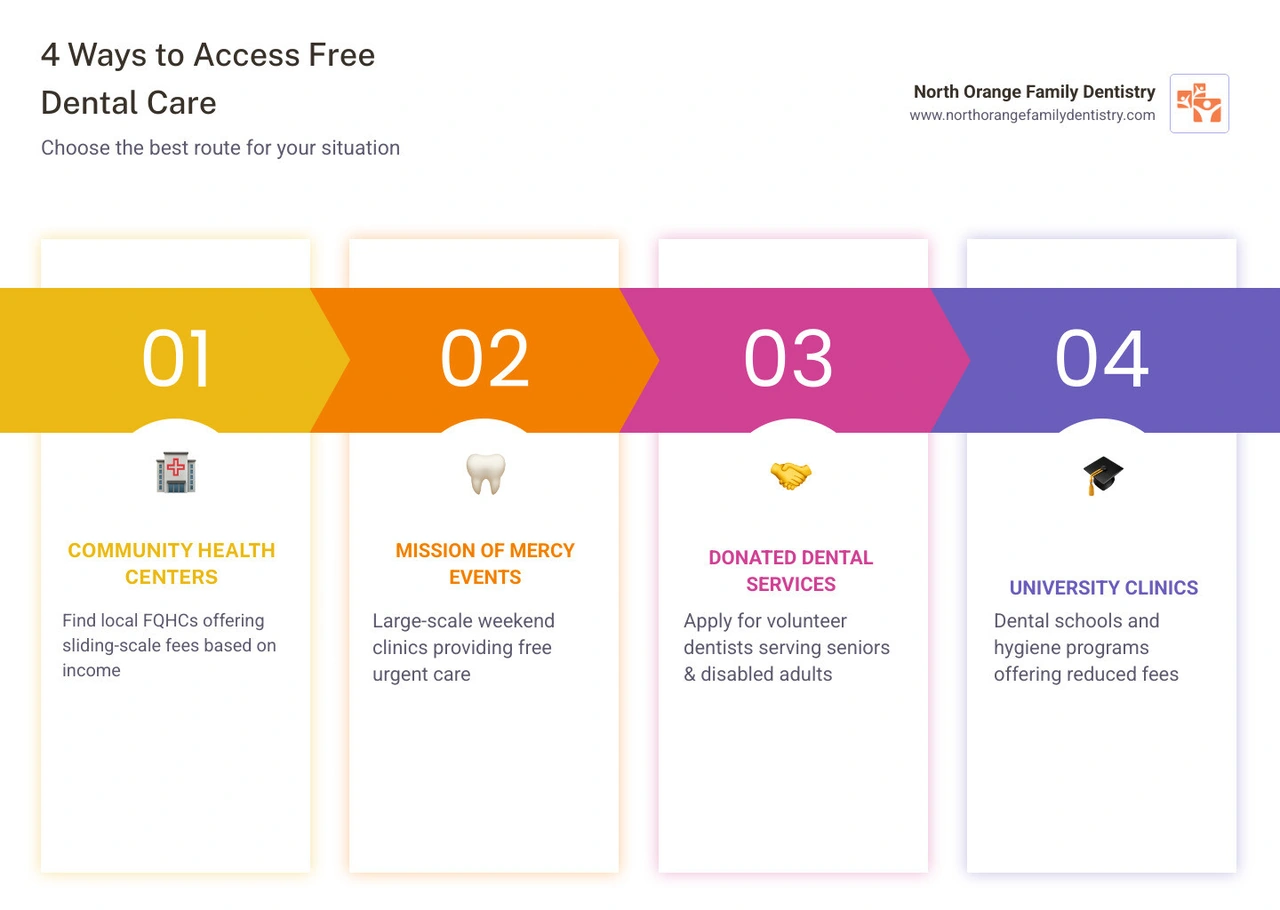
Free dental work for low-income adults is available across the U.S. — but knowing where to look makes all the difference. Here's a quick overview of your main options:
Quick Answer: Where to Find Free or Low-Cost Dental Care
| Option | Best For | How to Access |
|---|---|---|
| Community Health Centers (FQHCs) | Uninsured adults, sliding-scale fees | Search HRSA's health center finder |
| Mission of Mercy Events | Anyone needing urgent free care | Check your state dental association's website |
| Donated Dental Services (DDS) | Seniors 65+, disabled, medically fragile | Apply through Dental Lifeline Network |
| State Medicaid Programs | Income-eligible adults | Apply through your state health department |
| University/Dental School Clinics | Adults needing affordable comprehensive care | Contact dental schools in your state |
| Nonprofit Dental Clinics | Uninsured, low-income adults | Search local directories or call 2-1-1 |
Tooth pain doesn't wait. But for millions of uninsured or underinsured adults, getting dental care often means navigating long waitlists, confusing eligibility rules, and programs that vary wildly from state to state.
The need is enormous. Programs like D-DENT in Oklahoma currently have a waiting list of over 2,000 people — with wait times ranging from two months to nearly five years. Events like the Florida Mission of Mercy work hard to treat close to 2,000 patients over just two days. And still, demand far outpaces supply.
This guide breaks down every major avenue for free and reduced-cost dental care — from national volunteer networks to state Medicaid programs to local nonprofit clinics — so you can find the right fit for your situation without spending hours searching.
Explore more about free dental work for low-income adults:
Understanding Your Options for free dental work for low-income adults
When you're searching for dental care on a tight budget, the landscape can feel like a maze. However, several "safety-net" systems exist specifically to catch those who fall through the gaps of traditional insurance.

One of the most reliable options is a Federally Qualified Health Center (FQHC). These centers receive government funding to provide care in underserved areas. Unlike private practices, they use a sliding fee scale, which means the amount you pay is based directly on your income and family size. If you are at or below the Federal Poverty Level, your costs may be minimal.
To find these, we recommend using the HRSA health center finder or contacting your state’s primary care association. These clinics are designed to treat patients regardless of their ability to pay or insurance status. If you are currently struggling with the costs of care, our Affordable Dental Care Options Guide provides further insights into navigating these systems. It’s important to act early; waiting until a small cavity becomes a major infection often leads to more expensive emergency visits. You can learn more about the risks of delaying care in our article on What Happens If You Can't Afford Dental Care.
Eligibility Requirements for free dental work for low-income adults
Eligibility isn't one-size-fits-all. Most programs use the Federal Poverty Level (FPL) as a yardstick. For example, some county programs, like those in Montgomery County, MD, require family income to be no greater than 250% of the FPL.
Common requirements include:
- Residency Verification: You usually must live in the specific county or state where the clinic is located.
- Household Size: Your income is weighed against how many people you support.
- Uninsured Status: Many charitable programs only accept those with no dental insurance at all.
Navigating Wait Times for free dental work for low-income adults
We have to be honest: "free" often comes with a wait. Because these programs rely on volunteer capacity and limited donations, backlogs are common. As mentioned, D-DENT manages a massive list of over 2,000 people. In many states, Donated Dental Services (DDS) programs may even close applications for certain counties when their waitlists become too long to manage.
Wait times can range from a few months to several years. Most clinics use a triage system, prioritizing those in active pain or with life-threatening medical conditions. If you are in a "closed" county, some programs allow exceptions if you have a letter from a physician stating that dental work is a medical necessity for a surgery or treatment you need.
Major Charitable Programs and Volunteer Networks
If you don't qualify for government aid, charitable networks are your next best bet. These organizations coordinate with private dentists who donate their time and skills.

The Dental Lifeline Network is a primary player here. Their Donated Dental Services (DDS) program focuses on three specific groups:
- Seniors over the age of 65.
- People with permanent disabilities.
- Those who are medically fragile.
For those in our local area, the Ohio Dental Association provides a directory of these access-to-care programs that help bridge the gap for vulnerable populations.
Mission of Mercy (MOM) Large-Scale Events
Mission of Mercy events are like "pop-up" dental hospitals. They are often held in large convention centers or fairgrounds. For example, the Florida Mission of Mercy held in May 2026 at the Prime Osborn Convention Center in Jacksonville aims to treat nearly 2,000 patients in a single weekend.
MOM Events vs. Permanent Clinics
| Feature | MOM Events | Permanent Clinics |
|---|---|---|
| Cost | 100% Free | Often sliding-scale/low-cost |
| Pace | First-come, first-served (long lines) | Appointment-based |
| Scope | Usually urgent/single-visit care | Comprehensive/long-term care |
| Follow-up | Limited | Ongoing |
Specialized Support for Veterans and Disabled Adults
Veterans often face unique hurdles. Unless a veteran has a service-connected dental disability, they may not qualify for VA dental benefits. Programs like DDS give special consideration to honorably discharged veterans. If you're a veteran in the Powell or Delaware area, checking your Medicaid eligibility or seeking Dental Work for Veterans resources can help you find the care you earned.
Government Resources and State-Specific Medicaid Coverage
Medicaid is a vital lifeline, but the "dental" part of Medicaid varies wildly by state. In Missouri, Medicaid covers two cleanings and exams per year for adults, with a $1,500 annual cap on other services. In Vermont, the coverage is similar but excludes dentures for adults.
In Ohio, we have the Dental Wellness Plan Ohio, which helps residents understand their state-funded options. If you're looking for local resources specifically in Delaware, OH, there are clinics that accept Medicaid or offer reduced fees for residents.
Documentation Required for Income-Based Programs
To get through the door at a nonprofit clinic, you'll need to prove your financial situation. Don't show up empty-handed! Most programs require:
- Recent pay stubs or tax returns.
- SSI or Disability benefit letters.
- Proof of residency (like a utility bill).
- Photo ID.
- A list of current medications and medical history.
Bridging the Gap with Affordable Dental Alternatives
If you don't qualify for "free" care but can't afford "full-price" care, there are middle-ground options. University dental clinics and hygiene schools offer services at a fraction of the cost—often 30% to 50% less than private practices. At these clinics, dental students or residents perform the work under the strict supervision of licensed faculty dentists.
In the Columbus area, organizations like the Stowe Mission provide community-focused care. For those who want the consistency of a private practice but lack insurance, a No Insurance Dental Plan can be a much more sustainable way to manage your oral health.
Sustainable Care Through Dental Wellness Plans
At North Orange Family Dentistry, we believe every family member deserves five-star care, regardless of their insurance status. This is why we offer our own Dental Wellness Plan.
Unlike a complex insurance policy with "missing tooth clauses" or annual maximums, our wellness plan is a straightforward membership for individuals and families without insurance. It allows you to get your yearly cleanings, exams, and X-rays for a discounted price, plus a percentage off restorative work. This helps you avoid the "emergency cycle" where you only see a dentist when you're in pain—which is always the most expensive way to do dentistry. You can explore all our Dental Payment Options to see what fits your budget.
Frequently Asked Questions about Free Dental Care
Does Medicaid cover dentures for adults?
This is one of the biggest gaps in adult dental care. Many state Medicaid programs, like those in Missouri and Vermont, do not cover dentures for adults or have very strict limits. Charitable programs like D-DENT or the DDS network often prioritize dentures because they are essential for nutrition and employment, but the waitlists are long because the lab work is expensive.
Where can I find emergency dental work for low-income adults?
If you are in severe pain, have a fever, or notice swelling in your face, that is a dental emergency. County health departments often have "urgent care" slots for extractions and pain management. At North Orange Family Dentistry, we prioritize same-day emergency dental appointments most of the time to get you out of pain quickly.
Are cosmetic procedures like whitening or Invisalign covered?
Almost never. Charitable and government programs focus on "functional restoration"—meaning they want to make sure you can eat, speak, and live without infection. Procedures like teeth whitening, veneers, or Invisalign are considered elective and are not covered by free programs.
Conclusion
Navigating free dental work for low-income adults requires patience and persistence. Whether you are applying for a national program like Donated Dental Services or waiting for a local Mission of Mercy event, the key is to stay proactive.
At North Orange Family Dentistry, we are proud to serve the Delaware and Lewis Center communities. Led by Dr. Kyle Bogan—who is among the top 3% of dentists worldwide as an FICD fellow—our team offers everything from endosteal dental implants to advanced laser treatments for TMJ pain and periodontal disease.
If you don’t have insurance, don’t let that stop you from getting the care you need. Our Dental Wellness Plan is designed to make high-quality care affordable and predictable. Whether you need a routine check-up or a same-day emergency visit, we treat every patient like family.
Ready to take the next step for your smile? Visit us at North Orange Family Dentistry to learn how we can help you achieve a healthy smile that fits your budget.
Why Finding Free Dental Work for Low-Income Adults Is Harder Than It Should Be
Free dental work for low-income adults is available across the U.S. — but knowing where to look makes all the difference. Here's a quick overview of your main options:
Quick Answer: Where to Find Free or Low-Cost Dental Care
| Option | Best For | How to Access |
|---|---|---|
| Community Health Centers (FQHCs) | Uninsured adults, sliding-scale fees | Search HRSA's health center finder |
| Mission of Mercy Events | Anyone needing urgent free care | Check your state dental association's website |
| Donated Dental Services (DDS) | Seniors 65+, disabled, medically fragile | Apply through Dental Lifeline Network |
| State Medicaid Programs | Income-eligible adults | Apply through your state health department |
| University/Dental School Clinics | Adults needing affordable comprehensive care | Contact dental schools in your state |
| Nonprofit Dental Clinics | Uninsured, low-income adults | Search local directories or call 2-1-1 |
Tooth pain doesn't wait. But for millions of uninsured or underinsured adults, getting dental care often means navigating long waitlists, confusing eligibility rules, and programs that vary wildly from state to state.
The need is enormous. Programs like D-DENT in Oklahoma currently have a waiting list of over 2,000 people — with wait times ranging from two months to nearly five years. Events like the Florida Mission of Mercy work hard to treat close to 2,000 patients over just two days. And still, demand far outpaces supply.
This guide breaks down every major avenue for free and reduced-cost dental care — from national volunteer networks to state Medicaid programs to local nonprofit clinics — so you can find the right fit for your situation without spending hours searching.
Explore more about free dental work for low-income adults:
Understanding Your Options for free dental work for low-income adults
When you're searching for dental care on a tight budget, the landscape can feel like a maze. However, several "safety-net" systems exist specifically to catch those who fall through the gaps of traditional insurance.
One of the most reliable options is a Federally Qualified Health Center (FQHC). These centers receive government funding to provide care in underserved areas. Unlike private practices, they use a sliding fee scale, which means the amount you pay is based directly on your income and family size. If you are at or below the Federal Poverty Level, your costs may be minimal.
To find these, we recommend using the HRSA health center finder or contacting your state’s primary care association. These clinics are designed to treat patients regardless of their ability to pay or insurance status. If you are currently struggling with the costs of care, our Affordable Dental Care Options Guide provides further insights into navigating these systems. It’s important to act early; waiting until a small cavity becomes a major infection often leads to more expensive emergency visits. You can learn more about the risks of delaying care in our article on What Happens If You Can't Afford Dental Care.
Eligibility Requirements for free dental work for low-income adults
Eligibility isn't one-size-fits-all. Most programs use the Federal Poverty Level (FPL) as a yardstick. For example, some county programs, like those in Montgomery County, MD, require family income to be no greater than 250% of the FPL.
Common requirements include:
- Residency Verification: You usually must live in the specific county or state where the clinic is located.
- Household Size: Your income is weighed against how many people you support.
- Uninsured Status: Many charitable programs only accept those with no dental insurance at all.
Navigating Wait Times for free dental work for low-income adults
We have to be honest: "free" often comes with a wait. Because these programs rely on volunteer capacity and limited donations, backlogs are common. As mentioned, D-DENT manages a massive list of over 2,000 people. In many states, Donated Dental Services (DDS) programs may even close applications for certain counties when their waitlists become too long to manage.
Wait times can range from a few months to several years. Most clinics use a triage system, prioritizing those in active pain or with life-threatening medical conditions. If you are in a "closed" county, some programs allow exceptions if you have a letter from a physician stating that dental work is a medical necessity for a surgery or treatment you need.
Major Charitable Programs and Volunteer Networks
If you don't qualify for government aid, charitable networks are your next best bet. These organizations coordinate with private dentists who donate their time and skills.
The Dental Lifeline Network is a primary player here. Their Donated Dental Services (DDS) program focuses on three specific groups:
- Seniors over the age of 65.
- People with permanent disabilities.
- Those who are medically fragile.
For those in our local area, the Ohio Dental Association provides a directory of these access-to-care programs that help bridge the gap for vulnerable populations.
Mission of Mercy (MOM) Large-Scale Events
Mission of Mercy events are like "pop-up" dental hospitals. They are often held in large convention centers or fairgrounds. For example, the Florida Mission of Mercy held in May 2026 at the Prime Osborn Convention Center in Jacksonville aims to treat nearly 2,000 patients in a single weekend.
MOM Events vs. Permanent Clinics
| Feature | MOM Events | Permanent Clinics |
|---|---|---|
| Cost | 100% Free | Often sliding-scale/low-cost |
| Pace | First-come, first-served (long lines) | Appointment-based |
| Scope | Usually urgent/single-visit care | Comprehensive/long-term care |
| Follow-up | Limited | Ongoing |
Specialized Support for Veterans and Disabled Adults
Veterans often face unique hurdles. Unless a veteran has a service-connected dental disability, they may not qualify for VA dental benefits. Programs like DDS give special consideration to honorably discharged veterans. If you're a veteran in the Powell or Delaware area, checking your Medicaid eligibility or seeking Dental Work for Veterans resources can help you find the care you earned.
Government Resources and State-Specific Medicaid Coverage
Medicaid is a vital lifeline, but the "dental" part of Medicaid varies wildly by state. In Missouri, Medicaid covers two cleanings and exams per year for adults, with a $1,500 annual cap on other services. In Vermont, the coverage is similar but excludes dentures for adults.
In Ohio, we have the Dental Wellness Plan Ohio, which helps residents understand their state-funded options. If you're looking for local resources specifically in Delaware, OH, there are clinics that accept Medicaid or offer reduced fees for residents.
Documentation Required for Income-Based Programs
To get through the door at a nonprofit clinic, you'll need to prove your financial situation. Don't show up empty-handed! Most programs require:
- Recent pay stubs or tax returns.
- SSI or Disability benefit letters.
- Proof of residency (like a utility bill).
- Photo ID.
- A list of current medications and medical history.
Bridging the Gap with Affordable Dental Alternatives
If you don't qualify for "free" care but can't afford "full-price" care, there are middle-ground options. University dental clinics and hygiene schools offer services at a fraction of the cost—often 30% to 50% less than private practices. At these clinics, dental students or residents perform the work under the strict supervision of licensed faculty dentists.
In the Columbus area, organizations like the Stowe Mission provide community-focused care. For those who want the consistency of a private practice but lack insurance, a No Insurance Dental Plan can be a much more sustainable way to manage your oral health.
Sustainable Care Through Dental Wellness Plans
At North Orange Family Dentistry, we believe every family member deserves five-star care, regardless of their insurance status. This is why we offer our own Dental Wellness Plan.
Unlike a complex insurance policy with "missing tooth clauses" or annual maximums, our wellness plan is a straightforward membership for individuals and families without insurance. It allows you to get your yearly cleanings, exams, and X-rays for a discounted price, plus a percentage off restorative work. This helps you avoid the "emergency cycle" where you only see a dentist when you're in pain—which is always the most expensive way to do dentistry. You can explore all our Dental Payment Options to see what fits your budget.
Frequently Asked Questions about Free Dental Care
Does Medicaid cover dentures for adults?
This is one of the biggest gaps in adult dental care. Many state Medicaid programs, like those in Missouri and Vermont, do not cover dentures for adults or have very strict limits. Charitable programs like D-DENT or the DDS network often prioritize dentures because they are essential for nutrition and employment, but the waitlists are long because the lab work is expensive.
Where can I find emergency dental work for low-income adults?
If you are in severe pain, have a fever, or notice swelling in your face, that is a dental emergency. County health departments often have "urgent care" slots for extractions and pain management. At North Orange Family Dentistry, we prioritize same-day emergency dental appointments most of the time to get you out of pain quickly.
Are cosmetic procedures like whitening or Invisalign covered?
Almost never. Charitable and government programs focus on "functional restoration"—meaning they want to make sure you can eat, speak, and live without infection. Procedures like teeth whitening, veneers, or Invisalign are considered elective and are not covered by free programs.
Conclusion
Navigating free dental work for low-income adults requires patience and persistence. Whether you are applying for a national program like Donated Dental Services or waiting for a local Mission of Mercy event, the key is to stay proactive.
At North Orange Family Dentistry, we are proud to serve the Delaware and Lewis Center communities. Led by Dr. Kyle Bogan—who is among the top 3% of dentists worldwide as an FICD fellow—our team offers everything from endosteal dental implants to advanced laser treatments for TMJ pain and periodontal disease.
If you don’t have insurance, don’t let that stop you from getting the care you need. Our Dental Wellness Plan is designed to make high-quality care affordable and predictable. Whether you need a routine check-up or a same-day emergency visit, we treat every patient like family.
Ready to take the next step for your smile? Visit us at North Orange Family Dentistry to learn how we can help you achieve a healthy smile that fits your budget.
Contact Us
Have any questions? Want to learn more?

