
Does Dental Insurance Cover Invisalign?
Discover dental plans that cover Invisalign. Learn coverage, maximize benefits & save on treatment in Delaware, OH.



Does Your Dental Plan Cover Invisalign? Here's What to Know
Dental plans that cover Invisalign are more common than most people think — and understanding your benefits could save you a significant amount on treatment.
Many dental insurance plans treat Invisalign the same way they treat traditional braces. That means if your plan includes orthodontic benefits, there's a good chance it applies to clear aligners too.
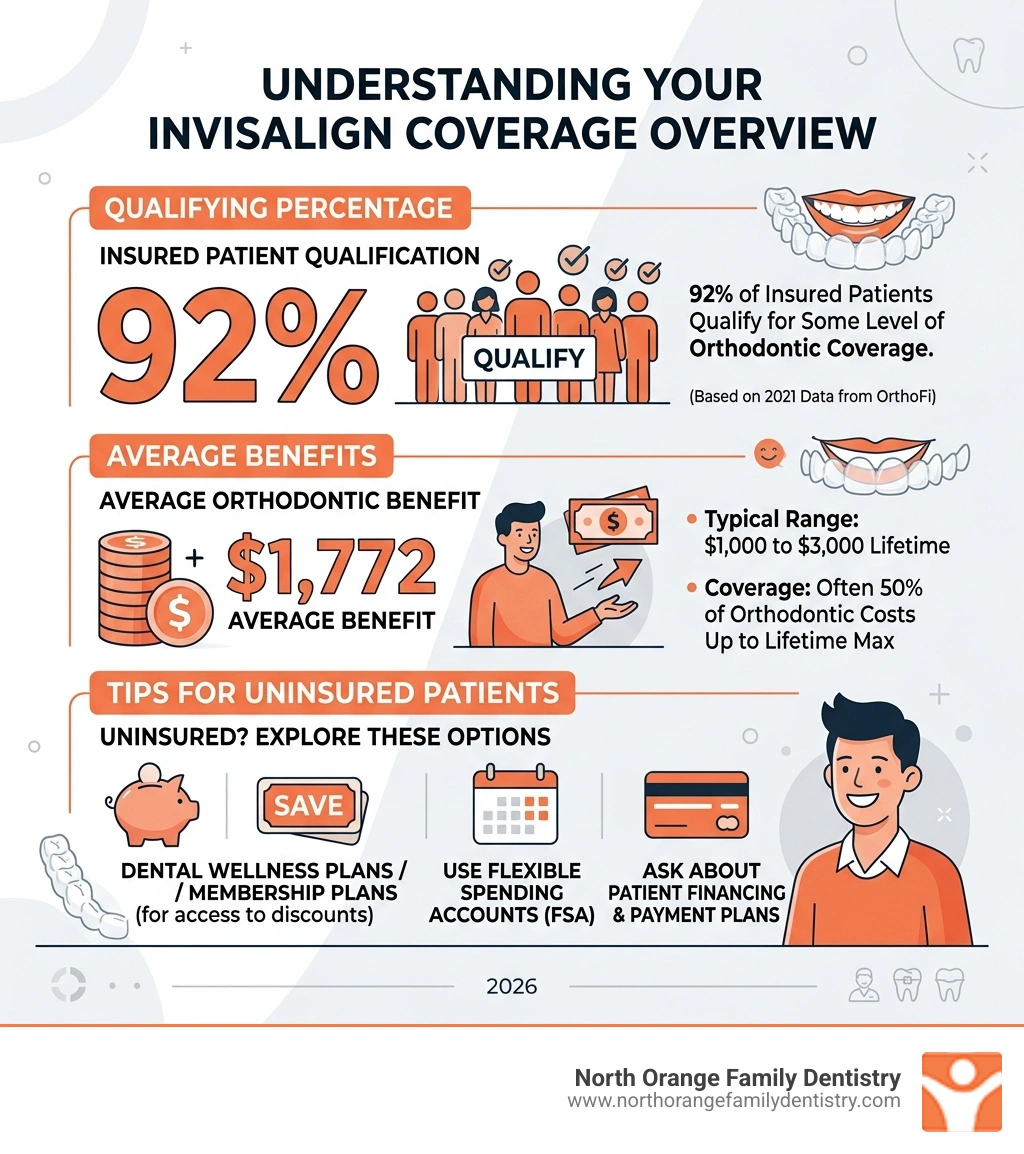
Here's a quick snapshot of what coverage typically looks like:
- Who qualifies: According to 2021 data from OrthoFi (based on over 112,000 U.S. patients), 92% of insured patients qualify for some level of orthodontic coverage
- Average benefit: Insured patients received an average of $1,772 toward orthodontic treatment
- Coverage range: Most plans cover between $1,000 and $3,000 lifetime for orthodontics
- How it works: Plans typically pay a percentage (often 50%) of orthodontic costs, up to a lifetime maximum
- Adult vs. child: Coverage for adults exists but is less common — children under 18 are more frequently covered
That said, not every plan is the same. Some classify Invisalign as cosmetic and exclude it entirely. Others have waiting periods before benefits kick in. The details really do matter.
If you don't have insurance, that doesn't mean Invisalign is out of reach. North Orange Family Dentistry offers a Dental Wellness Plan for individuals and families without insurance — giving you access to the yearly dental care you need at a discounted price.
This guide walks you through exactly how dental plans that cover Invisalign work, which factors affect your benefits, and how to make the most of what you have.
Understanding Dental Plans That Cover Invisalign
Navigating insurance can feel like trying to solve a Rubik's Cube in the dark. However, when it comes to dental plans that cover invisalign, the core concept is usually tied to "orthodontic benefits." Most standard dental insurance plans categorize procedures into preventive, basic, and major care. Orthodontics, including Invisalign, often sits in its own special category.

If your policy includes orthodontic coverage, it typically treats Invisalign the same as traditional metal braces. This is because both are designed to shift teeth into a healthier, more functional alignment. Many PPO (Preferred Provider Organization) plans offer the most flexibility, allowing you to choose a provider like those of us here at North Orange Family Dentistry while still receiving a significant reimbursement.
It is important to understand "lifetime maximums." Unlike your annual dental maximum (which resets every January), an orthodontic maximum is a one-time bucket of money. Once you use that $1,500 or $2,500 for your Invisalign treatment, it’s gone for good. You can learn more about how this fits into your overall oral health strategy by reviewing our Invisalign services page or checking out this external resource on does dental insurance cover Invisalign?
Typical Benefits in Dental Plans That Cover Invisalign
When we look at the major providers—such as Delta Dental, Cigna, Humana, and MetLife—the benefits for Invisalign usually range from $1,000 to $3,000. It is very common to see a "50% coinsurance" clause. This means if your treatment costs a certain amount, the insurance company will pay half of it, up until they hit that lifetime maximum.
For example, Cigna’s Dental 1500 plan is known to include a $1,000 maximum benefit specifically for orthodontic treatment. Similarly, many Delta Dental PPO plans cover 50% of the costs up to a limit of $1,000 to $2,000. High-tier plans offered through employers often provide even more robust coverage. If you are shopping for a plan, always look for the "Orthodontia" rider. For a deeper dive into how these tiers work, see our guide to dental insurance and the official Invisalign guide on orthodontic insurance and teeth straightening.
Factors Determining Invisalign Coverage
While 92% of patients might qualify for some coverage, several "fine print" factors can get in the way:
- Age Restrictions: This is the most common hurdle. Many employer-sponsored plans only cover orthodontics for dependents under the age of 19. If you are an adult seeking a straighter smile, we need to verify if your plan includes "Adult Orthodontic" coverage.
- Waiting Periods: Some plans require you to be a member for 6 to 12 months before they will pay for "major" work like Invisalign.
- Cosmetic vs. Medical Necessity: If your teeth are perfectly functional and you only want a tiny adjustment for photos, some insurers might label it "cosmetic." However, most cases involving bite alignment (malocclusion) are considered medically necessary.
- Workplace Limitations: Sometimes, a plan chosen by your employer specifically excludes clear aligners while covering metal braces.
Understanding these nuances is key to navigating dental insurance in Delaware and ensuring you aren't surprised by out-of-pocket costs.
How Orthodontic Insurance Coverage Works
When you visit us in Lewis Center for a consultation, we don't just look at your teeth; we look at the math. Our team works to provide a "Pre-Treatment Estimate." We send our proposed plan to your insurance company, and they send back a statement explaining exactly how much they will pay.
Most insurance companies pay out their orthodontic benefit over the course of the treatment. If your Invisalign journey takes 12 months, the insurance company might pay their portion in monthly or quarterly installments rather than one lump sum. This is why it’s important to stay with the same insurance provider throughout your treatment if possible.
When comparing traditional braces and Invisalign clear aligners, the insurance side is often very similar:
- Average cost: Invisalign and traditional braces are generally comparable in cost, though your final price depends on case complexity and treatment length.
- Insurance coverage: Plans that include orthodontic benefits often cover Invisalign at a similar level to braces, commonly around 50% up to the plan’s lifetime maximum.
- Benefit type: Both treatments usually draw from the same orthodontic lifetime maximum, meaning the benefit does not reset each year.
- Appearance: Traditional braces use visible metal brackets and wires, while Invisalign aligners are designed to be virtually invisible.
- Comfort: Braces may irritate the cheeks or gums, while Invisalign uses smooth plastic aligners that many patients find easier to wear.
For more localized information, you can view our resources on Ohio dental insurance plans.
Comparing Dental Plans That Cover Invisalign to Out-of-Pocket Costs
Without any insurance, the national average for Invisalign treatment typically ranges from $3,500 to $7,000. This depends heavily on case complexity—someone who just needs to close a small gap will pay less than someone with a severe overbite.
With dental plans that cover invisalign, the average patient savings is approximately $1,772. When you factor in that 77% of patients qualify for up to $2,000 in coverage, the "sticker shock" of Invisalign starts to fade away. We always aim to be transparent about the average price of Invisalign so you can budget effectively.
Maximizing Your Benefits and Treatment Outcomes
Beyond standard insurance, there are "hidden" ways to make your treatment more affordable. We are big fans of using tax-advantaged accounts.
- Health Savings Accounts (HSA): If you have a high-deductible health plan, you can use HSA funds to pay for Invisalign. Since this money is put aside pre-tax, you’re essentially getting a 20-30% discount depending on your tax bracket.
- Flexible Spending Accounts (FSA): Similar to an HSA, but usually "use it or lose it" by the end of the year. Invisalign is an eligible expense, making it a great way to spend down your FSA balance.
We use advanced digital scanning technology (no goopy impressions!) to create a 3D map of your smile. This allows us to show you the end result before you even start. You can explore the different types of Invisalign available or learn more about our advanced dentistry approach.
Steps to Take Before Starting Treatment
Before you commit, we recommend these three steps:
- Download the My Invisalign App: It has a built-in tool to help you estimate your insurance coverage.
- Check with HR: Your benefits coordinator can tell you if there is an "age 19" limit on your orthodontic coverage.
- Schedule a Consultation: We can provide a clinical evaluation to determine if you are a candidate.
Our Dental Wellness Plan in Ohio is also a fantastic resource if you find that your current insurance is lacking.
Alternatives for Patients Without Insurance
We believe everyone in Delaware County deserves a smile they love, regardless of whether they have a fancy corporate insurance plan. For our patients without traditional coverage, we created the North Orange Family Dentistry Dental Wellness Plan.
This is not insurance; it’s better. It’s an in-house membership that allows individuals and families to receive their yearly preventive care—cleanings, exams, and X-rays—for a flat, discounted annual fee. More importantly, it provides significant discounts on other treatments, including Invisalign. It’s our way of making no insurance dental plans simple and accessible.
Comprehensive Care and Advanced Technology
While Invisalign is a major focus for us, we are a full-service practice. We use cutting-edge technology to make every visit more comfortable.
- Laser Treatments: We use specialized lasers for TMJ pain relief, healing canker sores instantly, and treating periodontal (gum) disease. This is a level of care you won't find at every corner dentist.
- Dental Implants: If you’re missing a tooth, we provide endosteal dental implants. The average cost for a single-tooth implant is about $4,500, providing a permanent, lifelike replacement. You can read more about affordable dental implants on our site.
- Emergency Care: Tooth pain doesn't wait for an appointment. We offer same-day emergency dental visits most of the time to get you out of pain fast.
Frequently Asked Questions about Invisalign Coverage
Does dental insurance typically cover Invisalign for adults?
It depends on the specific "rider" your employer chose. While many basic plans cut off orthodontic coverage at age 19, many modern PPO plans include adult orthodontics. If your plan doesn't, you might consider a supplemental plan or our Dental Wellness Plan.
How can I check my specific insurance coverage for Invisalign?
The easiest way is to call the number on the back of your insurance card and ask: "Do I have a lifetime orthodontic benefit for adults, and what is the percentage covered?" Alternatively, bring your card to your consultation with us, and our expert team will do the legwork for you.
What if my insurance classifies Invisalign as cosmetic?
If your insurer denies a claim because they think it's "just for looks," we can often help by providing documentation of functional issues. This includes things like difficulty cleaning crowded teeth (which leads to decay), jaw pain, or "malocclusion" (a bad bite) that could lead to tooth wear.
Conclusion
At North Orange Family Dentistry, we aren't just straightening teeth; we’re building confidence. Led by Dr. Kyle Bogan—who is in the top 3% of dentists worldwide as an FICD Fellow—our team is dedicated to providing five-star care that fits your budget.
Whether you are utilizing dental plans that cover invisalign or joining our in-house Dental Wellness Plan, we are here to help you navigate the process. From our OSU-trained doctors to our advanced laser technology, we serve the Lewis Center and Delaware, Ohio communities with a commitment to excellence and comfort.
Ready to start your journey? Our final appointments of the day are at 3:00 PM to ensure every patient gets the focused time they deserve. Schedule your Invisalign consultation with us today and let's get you the smile you've always wanted!
Does Your Dental Plan Cover Invisalign? Here's What to Know
Dental plans that cover Invisalign are more common than most people think — and understanding your benefits could save you a significant amount on treatment.
Many dental insurance plans treat Invisalign the same way they treat traditional braces. That means if your plan includes orthodontic benefits, there's a good chance it applies to clear aligners too.
Here's a quick snapshot of what coverage typically looks like:
- Who qualifies: According to 2021 data from OrthoFi (based on over 112,000 U.S. patients), 92% of insured patients qualify for some level of orthodontic coverage
- Average benefit: Insured patients received an average of $1,772 toward orthodontic treatment
- Coverage range: Most plans cover between $1,000 and $3,000 lifetime for orthodontics
- How it works: Plans typically pay a percentage (often 50%) of orthodontic costs, up to a lifetime maximum
- Adult vs. child: Coverage for adults exists but is less common — children under 18 are more frequently covered
That said, not every plan is the same. Some classify Invisalign as cosmetic and exclude it entirely. Others have waiting periods before benefits kick in. The details really do matter.
If you don't have insurance, that doesn't mean Invisalign is out of reach. North Orange Family Dentistry offers a Dental Wellness Plan for individuals and families without insurance — giving you access to the yearly dental care you need at a discounted price.
This guide walks you through exactly how dental plans that cover Invisalign work, which factors affect your benefits, and how to make the most of what you have.
Understanding Dental Plans That Cover Invisalign
Navigating insurance can feel like trying to solve a Rubik's Cube in the dark. However, when it comes to dental plans that cover invisalign, the core concept is usually tied to "orthodontic benefits." Most standard dental insurance plans categorize procedures into preventive, basic, and major care. Orthodontics, including Invisalign, often sits in its own special category.
If your policy includes orthodontic coverage, it typically treats Invisalign the same as traditional metal braces. This is because both are designed to shift teeth into a healthier, more functional alignment. Many PPO (Preferred Provider Organization) plans offer the most flexibility, allowing you to choose a provider like those of us here at North Orange Family Dentistry while still receiving a significant reimbursement.
It is important to understand "lifetime maximums." Unlike your annual dental maximum (which resets every January), an orthodontic maximum is a one-time bucket of money. Once you use that $1,500 or $2,500 for your Invisalign treatment, it’s gone for good. You can learn more about how this fits into your overall oral health strategy by reviewing our Invisalign services page or checking out this external resource on does dental insurance cover Invisalign?
Typical Benefits in Dental Plans That Cover Invisalign
When we look at the major providers—such as Delta Dental, Cigna, Humana, and MetLife—the benefits for Invisalign usually range from $1,000 to $3,000. It is very common to see a "50% coinsurance" clause. This means if your treatment costs a certain amount, the insurance company will pay half of it, up until they hit that lifetime maximum.
For example, Cigna’s Dental 1500 plan is known to include a $1,000 maximum benefit specifically for orthodontic treatment. Similarly, many Delta Dental PPO plans cover 50% of the costs up to a limit of $1,000 to $2,000. High-tier plans offered through employers often provide even more robust coverage. If you are shopping for a plan, always look for the "Orthodontia" rider. For a deeper dive into how these tiers work, see our guide to dental insurance and the official Invisalign guide on orthodontic insurance and teeth straightening.
Factors Determining Invisalign Coverage
While 92% of patients might qualify for some coverage, several "fine print" factors can get in the way:
- Age Restrictions: This is the most common hurdle. Many employer-sponsored plans only cover orthodontics for dependents under the age of 19. If you are an adult seeking a straighter smile, we need to verify if your plan includes "Adult Orthodontic" coverage.
- Waiting Periods: Some plans require you to be a member for 6 to 12 months before they will pay for "major" work like Invisalign.
- Cosmetic vs. Medical Necessity: If your teeth are perfectly functional and you only want a tiny adjustment for photos, some insurers might label it "cosmetic." However, most cases involving bite alignment (malocclusion) are considered medically necessary.
- Workplace Limitations: Sometimes, a plan chosen by your employer specifically excludes clear aligners while covering metal braces.
Understanding these nuances is key to navigating dental insurance in Delaware and ensuring you aren't surprised by out-of-pocket costs.
How Orthodontic Insurance Coverage Works
When you visit us in Lewis Center for a consultation, we don't just look at your teeth; we look at the math. Our team works to provide a "Pre-Treatment Estimate." We send our proposed plan to your insurance company, and they send back a statement explaining exactly how much they will pay.
Most insurance companies pay out their orthodontic benefit over the course of the treatment. If your Invisalign journey takes 12 months, the insurance company might pay their portion in monthly or quarterly installments rather than one lump sum. This is why it’s important to stay with the same insurance provider throughout your treatment if possible.
When comparing traditional braces and Invisalign clear aligners, the insurance side is often very similar:
- Average cost: Invisalign and traditional braces are generally comparable in cost, though your final price depends on case complexity and treatment length.
- Insurance coverage: Plans that include orthodontic benefits often cover Invisalign at a similar level to braces, commonly around 50% up to the plan’s lifetime maximum.
- Benefit type: Both treatments usually draw from the same orthodontic lifetime maximum, meaning the benefit does not reset each year.
- Appearance: Traditional braces use visible metal brackets and wires, while Invisalign aligners are designed to be virtually invisible.
- Comfort: Braces may irritate the cheeks or gums, while Invisalign uses smooth plastic aligners that many patients find easier to wear.
For more localized information, you can view our resources on Ohio dental insurance plans.
Comparing Dental Plans That Cover Invisalign to Out-of-Pocket Costs
Without any insurance, the national average for Invisalign treatment typically ranges from $3,500 to $7,000. This depends heavily on case complexity—someone who just needs to close a small gap will pay less than someone with a severe overbite.
With dental plans that cover invisalign, the average patient savings is approximately $1,772. When you factor in that 77% of patients qualify for up to $2,000 in coverage, the "sticker shock" of Invisalign starts to fade away. We always aim to be transparent about the average price of Invisalign so you can budget effectively.
Maximizing Your Benefits and Treatment Outcomes
Beyond standard insurance, there are "hidden" ways to make your treatment more affordable. We are big fans of using tax-advantaged accounts.
- Health Savings Accounts (HSA): If you have a high-deductible health plan, you can use HSA funds to pay for Invisalign. Since this money is put aside pre-tax, you’re essentially getting a 20-30% discount depending on your tax bracket.
- Flexible Spending Accounts (FSA): Similar to an HSA, but usually "use it or lose it" by the end of the year. Invisalign is an eligible expense, making it a great way to spend down your FSA balance.
We use advanced digital scanning technology (no goopy impressions!) to create a 3D map of your smile. This allows us to show you the end result before you even start. You can explore the different types of Invisalign available or learn more about our advanced dentistry approach.
Steps to Take Before Starting Treatment
Before you commit, we recommend these three steps:
- Download the My Invisalign App: It has a built-in tool to help you estimate your insurance coverage.
- Check with HR: Your benefits coordinator can tell you if there is an "age 19" limit on your orthodontic coverage.
- Schedule a Consultation: We can provide a clinical evaluation to determine if you are a candidate.
Our Dental Wellness Plan in Ohio is also a fantastic resource if you find that your current insurance is lacking.
Alternatives for Patients Without Insurance
We believe everyone in Delaware County deserves a smile they love, regardless of whether they have a fancy corporate insurance plan. For our patients without traditional coverage, we created the North Orange Family Dentistry Dental Wellness Plan.
This is not insurance; it’s better. It’s an in-house membership that allows individuals and families to receive their yearly preventive care—cleanings, exams, and X-rays—for a flat, discounted annual fee. More importantly, it provides significant discounts on other treatments, including Invisalign. It’s our way of making no insurance dental plans simple and accessible.
Comprehensive Care and Advanced Technology
While Invisalign is a major focus for us, we are a full-service practice. We use cutting-edge technology to make every visit more comfortable.
- Laser Treatments: We use specialized lasers for TMJ pain relief, healing canker sores instantly, and treating periodontal (gum) disease. This is a level of care you won't find at every corner dentist.
- Dental Implants: If you’re missing a tooth, we provide endosteal dental implants. The average cost for a single-tooth implant is about $4,500, providing a permanent, lifelike replacement. You can read more about affordable dental implants on our site.
- Emergency Care: Tooth pain doesn't wait for an appointment. We offer same-day emergency dental visits most of the time to get you out of pain fast.
Frequently Asked Questions about Invisalign Coverage
Does dental insurance typically cover Invisalign for adults?
It depends on the specific "rider" your employer chose. While many basic plans cut off orthodontic coverage at age 19, many modern PPO plans include adult orthodontics. If your plan doesn't, you might consider a supplemental plan or our Dental Wellness Plan.
How can I check my specific insurance coverage for Invisalign?
The easiest way is to call the number on the back of your insurance card and ask: "Do I have a lifetime orthodontic benefit for adults, and what is the percentage covered?" Alternatively, bring your card to your consultation with us, and our expert team will do the legwork for you.
What if my insurance classifies Invisalign as cosmetic?
If your insurer denies a claim because they think it's "just for looks," we can often help by providing documentation of functional issues. This includes things like difficulty cleaning crowded teeth (which leads to decay), jaw pain, or "malocclusion" (a bad bite) that could lead to tooth wear.
Conclusion
At North Orange Family Dentistry, we aren't just straightening teeth; we’re building confidence. Led by Dr. Kyle Bogan—who is in the top 3% of dentists worldwide as an FICD Fellow—our team is dedicated to providing five-star care that fits your budget.
Whether you are utilizing dental plans that cover invisalign or joining our in-house Dental Wellness Plan, we are here to help you navigate the process. From our OSU-trained doctors to our advanced laser technology, we serve the Lewis Center and Delaware, Ohio communities with a commitment to excellence and comfort.
Ready to start your journey? Our final appointments of the day are at 3:00 PM to ensure every patient gets the focused time they deserve. Schedule your Invisalign consultation with us today and let's get you the smile you've always wanted!
Contact Us
Have any questions? Want to learn more?

