
Brace Yourself: A Guide to Dental Insurance Coverage
Learn how dental coverage for braces works, including Invisalign, lifetime maximums, and adult options to maximize your benefits.


Why Dental Coverage for Braces Is Harder to Navigate Than You Think
Dental coverage for braces is one of the most misunderstood areas of dental insurance — and for good reason. Most people assume their dental plan covers orthodontic treatment the way it covers cleanings or fillings. Often, it doesn't work that way at all.
Here's a quick answer to what most people want to know:
How dental insurance typically covers braces:
- What's usually covered: Traditional metal braces, ceramic braces, clear aligners (like Invisalign), and retainers — if your plan includes orthodontic benefits
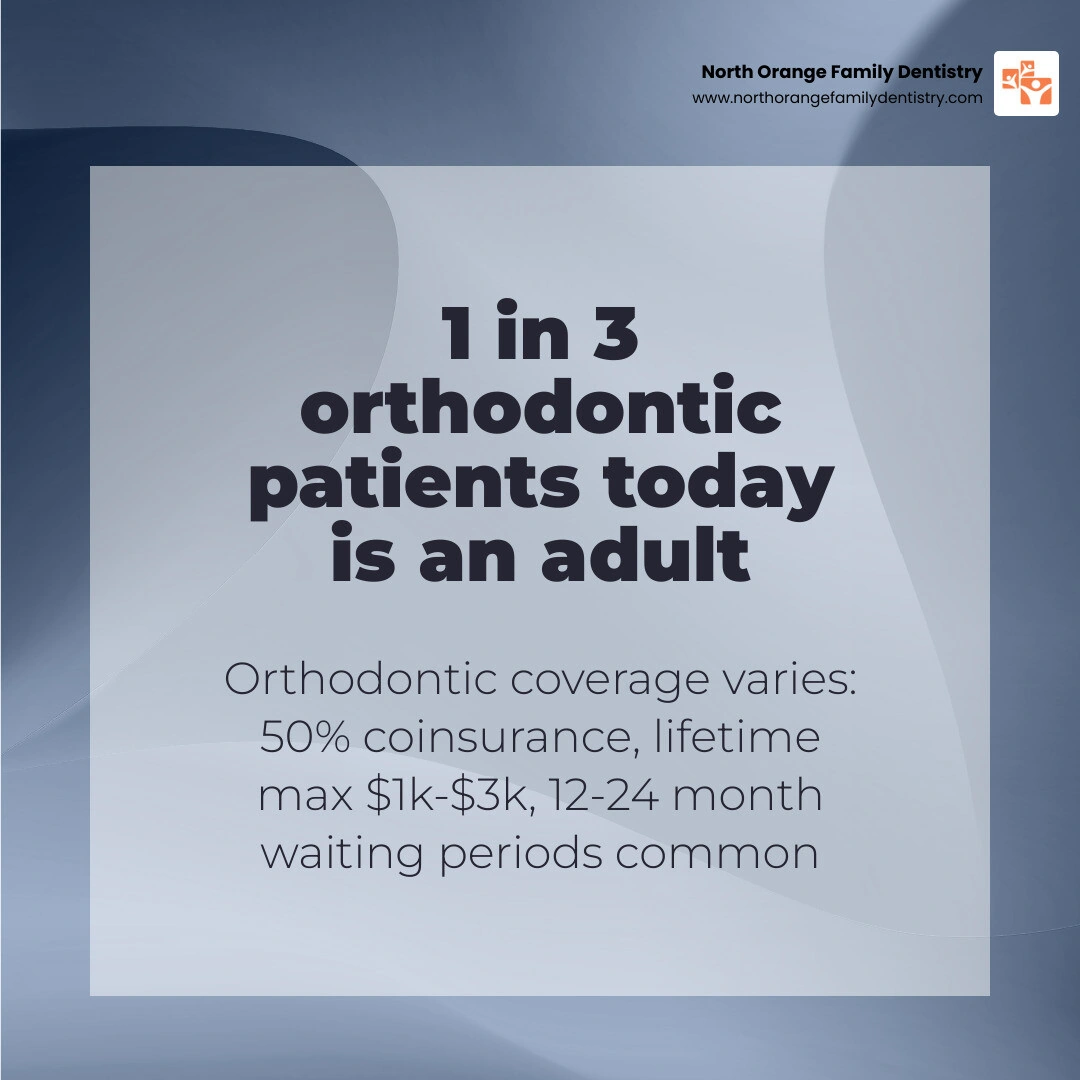
- How much: Most plans with orthodontic coverage pay 50% of the cost, up to a lifetime maximum (commonly $1,000–$3,000)
- Who's covered: Many plans cover children under 18 or 19; adult coverage is less common but exists in some plans
- Waiting periods: Many plans require you to be enrolled for 12–24 months before orthodontic benefits kick in
- Plan types: PPO plans tend to offer better orthodontic benefits than HMO-style plans
- Invisalign: Often covered at the same level as traditional braces, but varies by plan
Orthodontic treatment isn't just cosmetic. Misaligned teeth — known as malocclusion — can make chewing and speaking harder, increase your risk of gum disease, and cause chronic jaw pain over time. That makes understanding your coverage genuinely important, not just a nice-to-have.
As of 2020, one in three orthodontic patients is an adult, which means this isn't just a question parents are asking for their kids. Adults are increasingly seeking treatment too — and finding that their insurance options look very different.
Whether you're a parent sorting out coverage for your teenager, or an adult finally considering braces for yourself, this guide walks you through everything you need to know.
Understanding Dental Coverage for Braces and Orthodontic Care

When we talk about Does Dental Insurance Cover Braces?, the answer is rarely a simple "yes" or "no." Most dental insurance plans categorize services into preventive, basic, and major. Orthodontics, however, often sits in its own category with its own set of rules.
The type of plan you choose—usually a PPO (Preferred Provider Organization) or an HMO (Health Maintenance Organization)—significantly impacts your out-of-pocket costs. PPO plans generally offer the widest selection of orthodontists and more flexible benefits, while HMOs may require you to stay within a very strict network. Furthermore, some plans only pay out if the braces are deemed a "medical necessity." This usually means the misalignment is so severe it causes functional problems like difficulty eating or breathing, rather than just being a cosmetic preference.
Types of Orthodontic Treatments Covered
In May 2026, patients have more choices than ever for straightening their teeth. Most plans that include orthodontic benefits will cover:
- Traditional Braces: The gold standard for complex cases, using metal brackets and wires.
- Clear Aligners: Removable, transparent trays that are popular for their discretion. If you are debating between Aligners vs Braces, insurance often treats them similarly, though it’s vital to check your specific policy.
- Retainers: These are crucial for maintaining your results. Most plans cover the initial set of retainers, but replacements are usually an out-of-pocket expense.
- Specialized Appliances: This includes space maintainers or palatal expanders used primarily for children.
Whether you are looking into Clear Aligners or Clear Aligners for Teeth, we recommend verifying if your plan has a "least expensive alternative treatment" clause, which might limit coverage to the cost of metal braces.
Adult vs. Child Dental Coverage for Braces
There is often a significant gap between coverage for kids and adults. Many employer-sponsored plans provide Orthodontic benefits for Oregon Health Plan members or similar state-specific programs that focus heavily on dependents under age 19 or 21.
For example, Does TRICARE cover braces and orthodontics? The TRICARE Dental Program covers dependent children up to age 21 (or 23 for students) but generally excludes active-duty service members and their spouses from orthodontic benefits. For adults in the private sector, it is common to find "age-out" clauses. If you are over 19, your standard dental plan might not pay a dime for braces unless you specifically selected a plan with adult orthodontic riders.
How Orthodontic Benefits Work: Maximums and Coinsurance

Understanding the math behind your dental coverage for braces is the best way to avoid "sticker shock." Unlike regular dental benefits that reset every year, orthodontic benefits usually come with a Lifetime Maximum.
If your Dental Insurance Coverage for Braces - Humana or a similar provider states a $1,500 lifetime maximum, that is the total amount they will ever pay for braces for that individual. Once that money is spent, it’s gone. This is typically paired with a 50% coinsurance rate. This means if the treatment costs $5,000, the insurance would theoretically pay $2,500—but because of the $1,500 lifetime maximum, they will only pay $1,500, leaving you to cover the remaining $3,500.
What Dental Insurance Covers Orthodontics? Most major carriers offer plans that include these benefits, but you must ensure "orthodontia" is explicitly listed in your Summary of Benefits.
Navigating Waiting Periods for Braces
One of the most frustrating hurdles for new enrollees is the waiting period. To prevent people from signing up for insurance only when they need expensive braces and then canceling, many providers implement a 12-to-24-month waiting period. This means you must pay premiums for a full year or more before you can use your orthodontic benefits.
If you are planning treatment, timing is everything. Enrolling during an open enrollment period well before you need a Dental Braces Payment Plan is the smartest move. Some plans may waive this wait if you had "continuous coverage" from a previous insurer, so always keep your records handy.
Comparing Invisalign and Traditional Braces Coverage
A common question we hear is, Does Insurance Cover Invisalign? In 2026, most plans that cover traditional braces also cover Invisalign. However, because the Average Price of Invisalign can sometimes be higher than metal braces, your out-of-pocket portion might increase if your lifetime maximum is low.
For those with Invisalign for Mild Cases, the treatment time is often shorter, which can make the cost more manageable even with limited insurance. There are various Types of Invisalign available, including Express and Full, and your insurance benefit usually applies to the "orthodontic treatment" as a whole, regardless of the specific Invisalign product used.
How to Check Your Specific Dental Coverage for Braces
Before you get your heart set on a specific treatment, follow these steps to verify your benefits:
- Request a Pre-Treatment Estimate: Ask your orthodontist to submit a "pre-determination" to your insurer. This provides a written breakdown of what the insurance will pay and what you will owe.
- Review Plan Documents: Look for the "Exclusions and Limitations" section.
- Check Network Status: Using an in-network provider can save you hundreds, if not thousands, of dollars compared to out-of-network rates.
- Verify Age Limits: Double-check that the patient hasn't "aged out" of coverage.
For a deeper dive into these steps, resources like Does Dental Insurance Cover Braces? | eHealth can help you compare different plan structures side-by-side.
Alternatives When You Lack Orthodontic Insurance
If your current insurance doesn't offer dental coverage for braces, don't panic. You aren't necessarily stuck paying the full retail price upfront. Many patients find that the How Much Is Invisalign Out of Pocket cost is more manageable when they use tax-advantaged accounts like an HSA (Health Savings Account) or FSA (Flexible Spending Account). Since braces are medically necessary, these funds can be used pre-tax, effectively giving you a 20-30% discount depending on your tax bracket.
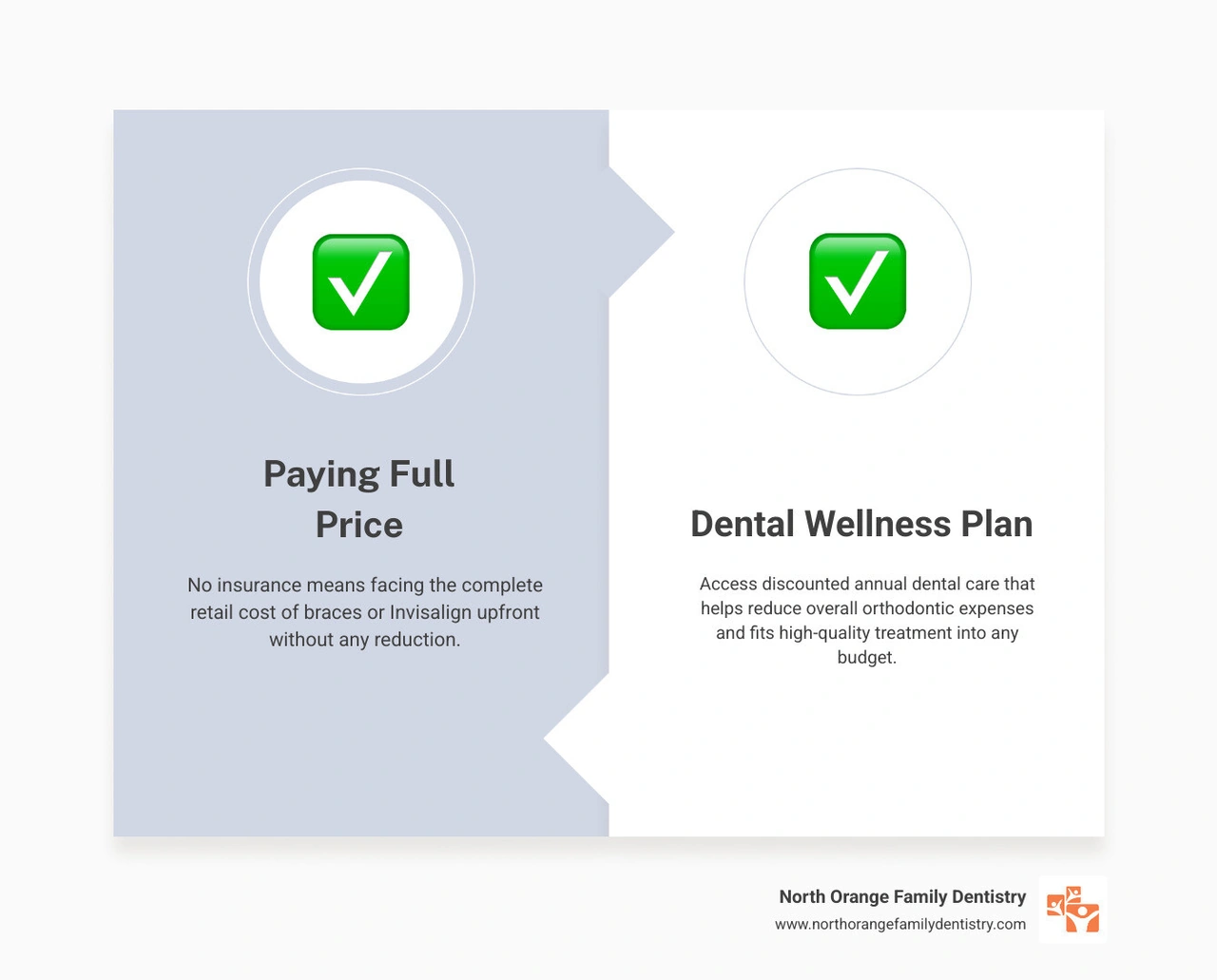
At North Orange Family Dentistry, we believe every family member deserves a five-star smile regardless of their insurance status. For our patients in Delaware and Lewis Center who do not have traditional insurance, we offer an in-house Dental Wellness Plan. This plan allows individuals and families to get their yearly dental care at a discounted price, helping to fit high-quality care into any budget.
Frequently Asked Questions about Orthodontic Insurance
Does insurance cover Invisalign the same as metal braces?
In most cases, yes. If your plan has orthodontic benefits, they typically apply a flat dollar amount (the lifetime maximum) to the treatment of your choice. However, some plans may only cover the cost up to the price of traditional metal braces.
What is a typical lifetime maximum for braces?
While it varies, most plans in 2026 offer a lifetime maximum between $1,000 and $3,000. Once this limit is reached, all additional costs for that individual's orthodontic care are your responsibility.
Are retainers covered after the braces are removed?
Most insurance plans cover the very first set of retainers as part of the total "orthodontic treatment" fee. However, if you lose your retainer or it breaks a year later, the replacement is almost always an out-of-pocket cost.
Conclusion
Navigating dental coverage for braces can feel like a maze, but you don't have to do it alone. At North Orange Family Dentistry, led by Dr. Kyle Bogan—a Fellow of the International College of Dentists (top 3% worldwide)—we are committed to helping our Delaware County community achieve healthy, beautiful smiles.
Located conveniently in the Lewis Center area, our modern facility serves patients from 6 months to 106 years old. We pride ourselves on using cutting-edge technology, including laser treatments for TMJ pain, canker sore healing, and non-surgical gum disease treatment. We also offer same-day emergency dental appointments most of the time for those unexpected moments.
Whether you have top-tier insurance or are interested in our Wellness Plan, we are here to provide the personalized, advanced care you deserve. Ready to start your journey to a straighter smile? Come see us at North Orange Family Dentistry and experience the difference of a practice that treats you like family.
Why Dental Coverage for Braces Is Harder to Navigate Than You Think
Dental coverage for braces is one of the most misunderstood areas of dental insurance — and for good reason. Most people assume their dental plan covers orthodontic treatment the way it covers cleanings or fillings. Often, it doesn't work that way at all.
Here's a quick answer to what most people want to know:
How dental insurance typically covers braces:
- What's usually covered: Traditional metal braces, ceramic braces, clear aligners (like Invisalign), and retainers — if your plan includes orthodontic benefits
- How much: Most plans with orthodontic coverage pay 50% of the cost, up to a lifetime maximum (commonly $1,000–$3,000)
- Who's covered: Many plans cover children under 18 or 19; adult coverage is less common but exists in some plans
- Waiting periods: Many plans require you to be enrolled for 12–24 months before orthodontic benefits kick in
- Plan types: PPO plans tend to offer better orthodontic benefits than HMO-style plans
- Invisalign: Often covered at the same level as traditional braces, but varies by plan
Orthodontic treatment isn't just cosmetic. Misaligned teeth — known as malocclusion — can make chewing and speaking harder, increase your risk of gum disease, and cause chronic jaw pain over time. That makes understanding your coverage genuinely important, not just a nice-to-have.
As of 2020, one in three orthodontic patients is an adult, which means this isn't just a question parents are asking for their kids. Adults are increasingly seeking treatment too — and finding that their insurance options look very different.
Whether you're a parent sorting out coverage for your teenager, or an adult finally considering braces for yourself, this guide walks you through everything you need to know.
Understanding Dental Coverage for Braces and Orthodontic Care
When we talk about Does Dental Insurance Cover Braces?, the answer is rarely a simple "yes" or "no." Most dental insurance plans categorize services into preventive, basic, and major. Orthodontics, however, often sits in its own category with its own set of rules.
The type of plan you choose—usually a PPO (Preferred Provider Organization) or an HMO (Health Maintenance Organization)—significantly impacts your out-of-pocket costs. PPO plans generally offer the widest selection of orthodontists and more flexible benefits, while HMOs may require you to stay within a very strict network. Furthermore, some plans only pay out if the braces are deemed a "medical necessity." This usually means the misalignment is so severe it causes functional problems like difficulty eating or breathing, rather than just being a cosmetic preference.
Types of Orthodontic Treatments Covered
In May 2026, patients have more choices than ever for straightening their teeth. Most plans that include orthodontic benefits will cover:
- Traditional Braces: The gold standard for complex cases, using metal brackets and wires.
- Clear Aligners: Removable, transparent trays that are popular for their discretion. If you are debating between Aligners vs Braces, insurance often treats them similarly, though it’s vital to check your specific policy.
- Retainers: These are crucial for maintaining your results. Most plans cover the initial set of retainers, but replacements are usually an out-of-pocket expense.
- Specialized Appliances: This includes space maintainers or palatal expanders used primarily for children.
Whether you are looking into Clear Aligners or Clear Aligners for Teeth, we recommend verifying if your plan has a "least expensive alternative treatment" clause, which might limit coverage to the cost of metal braces.
Adult vs. Child Dental Coverage for Braces
There is often a significant gap between coverage for kids and adults. Many employer-sponsored plans provide Orthodontic benefits for Oregon Health Plan members or similar state-specific programs that focus heavily on dependents under age 19 or 21.
For example, Does TRICARE cover braces and orthodontics? The TRICARE Dental Program covers dependent children up to age 21 (or 23 for students) but generally excludes active-duty service members and their spouses from orthodontic benefits. For adults in the private sector, it is common to find "age-out" clauses. If you are over 19, your standard dental plan might not pay a dime for braces unless you specifically selected a plan with adult orthodontic riders.
How Orthodontic Benefits Work: Maximums and Coinsurance
Understanding the math behind your dental coverage for braces is the best way to avoid "sticker shock." Unlike regular dental benefits that reset every year, orthodontic benefits usually come with a Lifetime Maximum.
If your Dental Insurance Coverage for Braces - Humana or a similar provider states a $1,500 lifetime maximum, that is the total amount they will ever pay for braces for that individual. Once that money is spent, it’s gone. This is typically paired with a 50% coinsurance rate. This means if the treatment costs $5,000, the insurance would theoretically pay $2,500—but because of the $1,500 lifetime maximum, they will only pay $1,500, leaving you to cover the remaining $3,500.
What Dental Insurance Covers Orthodontics? Most major carriers offer plans that include these benefits, but you must ensure "orthodontia" is explicitly listed in your Summary of Benefits.
Navigating Waiting Periods for Braces
One of the most frustrating hurdles for new enrollees is the waiting period. To prevent people from signing up for insurance only when they need expensive braces and then canceling, many providers implement a 12-to-24-month waiting period. This means you must pay premiums for a full year or more before you can use your orthodontic benefits.
If you are planning treatment, timing is everything. Enrolling during an open enrollment period well before you need a Dental Braces Payment Plan is the smartest move. Some plans may waive this wait if you had "continuous coverage" from a previous insurer, so always keep your records handy.
Comparing Invisalign and Traditional Braces Coverage
A common question we hear is, Does Insurance Cover Invisalign? In 2026, most plans that cover traditional braces also cover Invisalign. However, because the Average Price of Invisalign can sometimes be higher than metal braces, your out-of-pocket portion might increase if your lifetime maximum is low.
For those with Invisalign for Mild Cases, the treatment time is often shorter, which can make the cost more manageable even with limited insurance. There are various Types of Invisalign available, including Express and Full, and your insurance benefit usually applies to the "orthodontic treatment" as a whole, regardless of the specific Invisalign product used.
How to Check Your Specific Dental Coverage for Braces
Before you get your heart set on a specific treatment, follow these steps to verify your benefits:
- Request a Pre-Treatment Estimate: Ask your orthodontist to submit a "pre-determination" to your insurer. This provides a written breakdown of what the insurance will pay and what you will owe.
- Review Plan Documents: Look for the "Exclusions and Limitations" section.
- Check Network Status: Using an in-network provider can save you hundreds, if not thousands, of dollars compared to out-of-network rates.
- Verify Age Limits: Double-check that the patient hasn't "aged out" of coverage.
For a deeper dive into these steps, resources like Does Dental Insurance Cover Braces? | eHealth can help you compare different plan structures side-by-side.
Alternatives When You Lack Orthodontic Insurance
If your current insurance doesn't offer dental coverage for braces, don't panic. You aren't necessarily stuck paying the full retail price upfront. Many patients find that the How Much Is Invisalign Out of Pocket cost is more manageable when they use tax-advantaged accounts like an HSA (Health Savings Account) or FSA (Flexible Spending Account). Since braces are medically necessary, these funds can be used pre-tax, effectively giving you a 20-30% discount depending on your tax bracket.
At North Orange Family Dentistry, we believe every family member deserves a five-star smile regardless of their insurance status. For our patients in Delaware and Lewis Center who do not have traditional insurance, we offer an in-house Dental Wellness Plan. This plan allows individuals and families to get their yearly dental care at a discounted price, helping to fit high-quality care into any budget.
Frequently Asked Questions about Orthodontic Insurance
Does insurance cover Invisalign the same as metal braces?
In most cases, yes. If your plan has orthodontic benefits, they typically apply a flat dollar amount (the lifetime maximum) to the treatment of your choice. However, some plans may only cover the cost up to the price of traditional metal braces.
What is a typical lifetime maximum for braces?
While it varies, most plans in 2026 offer a lifetime maximum between $1,000 and $3,000. Once this limit is reached, all additional costs for that individual's orthodontic care are your responsibility.
Are retainers covered after the braces are removed?
Most insurance plans cover the very first set of retainers as part of the total "orthodontic treatment" fee. However, if you lose your retainer or it breaks a year later, the replacement is almost always an out-of-pocket cost.
Conclusion
Navigating dental coverage for braces can feel like a maze, but you don't have to do it alone. At North Orange Family Dentistry, led by Dr. Kyle Bogan—a Fellow of the International College of Dentists (top 3% worldwide)—we are committed to helping our Delaware County community achieve healthy, beautiful smiles.
Located conveniently in the Lewis Center area, our modern facility serves patients from 6 months to 106 years old. We pride ourselves on using cutting-edge technology, including laser treatments for TMJ pain, canker sore healing, and non-surgical gum disease treatment. We also offer same-day emergency dental appointments most of the time for those unexpected moments.
Whether you have top-tier insurance or are interested in our Wellness Plan, we are here to provide the personalized, advanced care you deserve. Ready to start your journey to a straighter smile? Come see us at North Orange Family Dentistry and experience the difference of a practice that treats you like family.
Contact Us
Have any questions? Want to learn more?

