
Cheat Sheet to Dental Bonding Procedure
Discover how dental bonding fixes chips, gaps, and discoloration in one painless visit with natural-looking composite resin.


What Is Dental Bonding? (And Is It Right for You?)
Dental bonding is a quick, minimally invasive cosmetic procedure where a tooth-colored composite resin is applied directly to your tooth, shaped to look natural, and hardened with a special light — all in a single visit.
Here's a fast-answer snapshot:
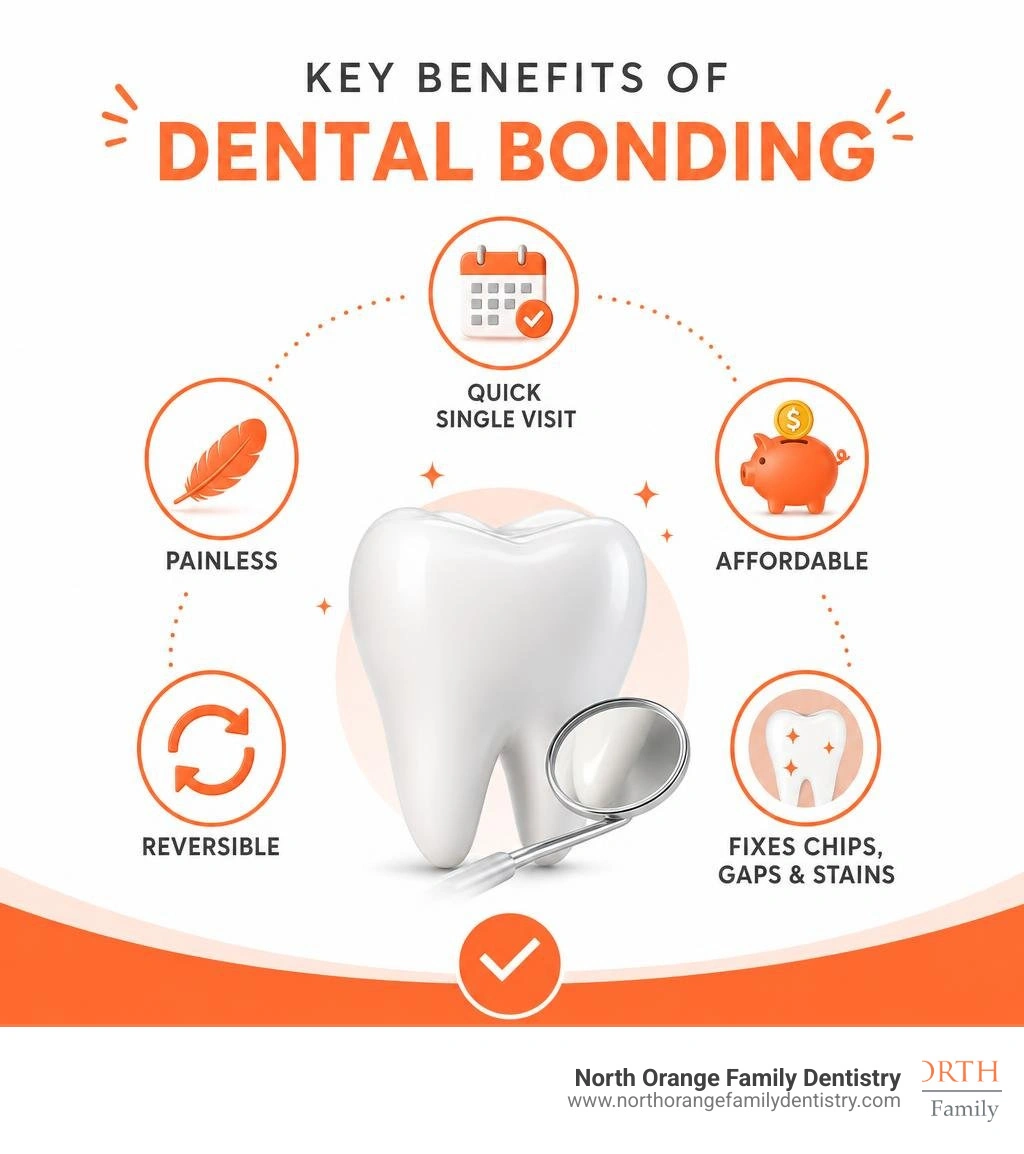
- What it fixes: Chips, cracks, gaps, stains, worn edges, and minor decay
- How long it takes: 30 to 60 minutes per tooth
- How long it lasts: 3 to 10 years with proper care
- Does it hurt? No — most cases require no anesthesia at all
- Is it reversible? Yes — unlike veneers, it typically requires no enamel removal
- Cost range: Generally one of the least expensive cosmetic dental options available
If you've been living with a small chip, a stubborn stain, or a gap you'd rather not see in photos, bonding is often the fastest path to fixing it. No drilling. No multiple appointments. No dramatic procedure.
It's one of the most popular cosmetic treatments we offer at North Orange Family Dentistry — and for good reason. Composite resin is used in about 72% of dental restorations, and the results can look completely natural when done well.
This guide walks you through everything: how bonding works, what it treats, how it compares to veneers and crowns, what it costs, and how to make it last.
Dental bonding terms to remember:
What is Dental Bonding and How Does It Work?
To understand how a simple What Is Dental Bonding procedure can completely transform your smile, it helps to look at the science behind it. Unlike lab-fabricated restorations that require weeks of waiting, bonding is a direct, chairside technique.
When you read a clinical resource like the Cleveland Clinic's guide on What is Dental Bonding & What To Expect , you will learn that the process relies on creating a highly secure chemical and mechanical bond between your natural tooth and the composite resin.
Because we do not need to cut deep into your tooth structure, the process is incredibly conservative. We focus heavily on enamel preservation, keeping your natural teeth strong and intact.
Understanding the Composite Resin Material
The star of the show is the composite resin itself. In modern aesthetic dentistry, we use state-of-the-art nanohybrid composite materials. These composites are a specialized blend of microscopic glass and plastic particles that mimic the natural translucency, light reflection, and strength of real tooth enamel.
We use a physical shade guide to analyze your surrounding teeth under natural light. This meticulous color matching process ensures that the resin blends seamlessly with your smile. No one will be able to tell where your natural tooth ends and the bonding begins!
What to Expect During Your Dental Bonding Procedure

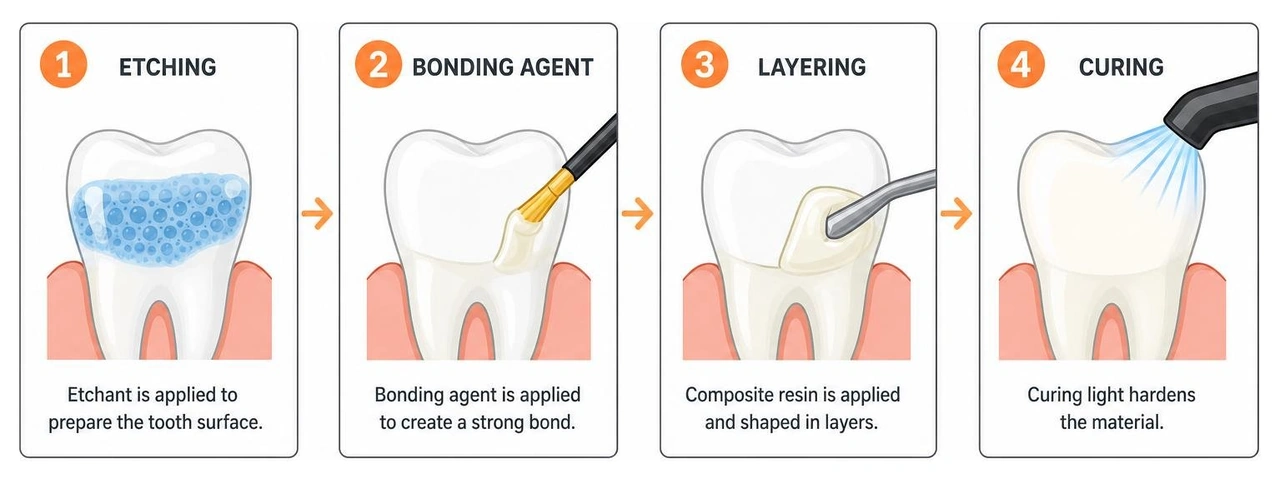
Getting your teeth bonded is a straightforward, single-visit treatment. Here is exactly what happens during a standard Cosmetic Tooth Bonding Procedure:
- Preparation: We clean the surface of the tooth thoroughly. Because the process is non-invasive, local anesthesia is rarely needed unless we are treating a cavity or working close to a sensitive nerve.
- Etching: We apply a mild, phosphoric acid etching liquid to the surface of the enamel. This creates microscopic rough spots on the tooth, which are essential for the bonding agent to cling to.
- Conditioning: We wash away the etching gel and brush on a liquid conditioning agent. This acts as the "glue" that locks into the etched enamel pores.
- Resin Application and Sculpting: We apply the putty-like composite resin in thin layers, meticulously shaping and sculpting it to match your natural tooth contours.
- Curing: We use a special blue curing light (typically an LED light in the 400 to 500-nanometer range) to harden each layer of resin in just 10 to 20 seconds.
- Polishing: Once fully hardened, we trim, shape, and polish the bonded area to a beautiful, natural shine that matches the rest of your smile.
The entire process generally takes only 30 to 60 minutes per tooth, meaning you can walk in with a chip and walk out with a flawless smile during your lunch break.
What Cosmetic and Restorative Issues Can Tooth Bonding Treat?
Because composite resin is incredibly versatile, we use it to address a wide range of cosmetic and restorative concerns:
- Chipped or Cracked Teeth: This is the most common reason patients request bonding. A quick repair restores both the look and structural integrity of the tooth.
- Closing Gaps (Diastemas): If you have small spaces between your front teeth, Tooth Bonding For Gaps is a fast, braces-free alternative to close those gaps.
- Masking Tooth Discoloration: For stubborn, internal stains that do not respond to traditional teeth whitening, we can cover the surface with a bright, custom-shaded layer of resin.
- Reshaping Misshapen or Worn Teeth: If you have teeth that are naturally short, uneven, or worn down from grinding, we can build up the edges to create a balanced smile line.
- Protecting Exposed Roots: When gum recession exposes the sensitive roots of your teeth, bonding a layer of composite over the roots shields them from painful hot and cold sensations.
- Treating Minor Decay: Composite resin is the standard material used for tooth-colored fillings, sealing away decay while keeping your smile bright.
Dental Bonding vs. Veneers and Crowns: How Do They Compare?
When exploring cosmetic dentistry, you will likely compare bonding to other popular options like porcelain veneers and dental crowns.
How do you choose? Here is how they stack up when you look at the Dental Bonding Vs Veneers Cost and structural differences:
- Enamel Removal and Reversibility: Porcelain veneers require us to shave down up to 30% of your healthy tooth enamel, making them a permanent, irreversible commitment. Dental crowns require even more enamel removal to fit over the entire tooth. Dental bonding, on the other hand, requires virtually no enamel removal. It is a completely reversible treatment.
- Structural Support: Crowns are designed to wrap around a heavily damaged or root-canaled tooth to provide maximum structural support. Bonding is ideal for minor to moderate cosmetic issues but is not strong enough to rebuild a severely broken tooth.
- Convenience: Veneers and crowns are custom-made in an off-site dental lab, requiring at least two appointments and temporary restorations. Bonding is completed chairside in a single, efficient visit.
As noted in the comprehensive What is dental bonding? Complete patient guide for 2026 | Serenity Dental , bonding is an exceptional, conservative starting point for patients who want to enhance their smiles without committing to permanent enamel removal.
Cost, Lifespan, and Aftercare of Your Bonded Smile
One of the greatest benefits of choosing a treatment outlined in our Dental Bonding Cost Guide 2026 is its exceptional affordability. It is widely recognized as one of the most budget-friendly cosmetic dental procedures available.
If your bonding is performed for restorative reasons—such as filling a cavity or repairing a structurally damaged tooth—your dental insurance may cover a significant portion of the cost. If it is purely cosmetic, it is typically an out-of-pocket investment.
For our patients without dental insurance, we are proud to offer our in-house Dental Wellness Plan. This plan is designed specifically to help individuals and families get the yearly preventive care they need at a discounted price, making high-quality cosmetic and restorative treatments much more accessible.
How Long Does Dental Bonding Last?
While bonding is highly durable, it is not permanent. According to our guide on How Long Do Dental Bonding Last, you can expect your bonding to last anywhere from 3 to 10 years.
Its ultimate lifespan depends on several key factors:
- Location: Bonding on the thin biting edges of your front teeth experiences more daily chewing friction than bonding on flat surfaces.
- Oral Habits: Chewing on ice, biting your fingernails, or using your teeth as tools to open packages will quickly chip the resin.
- Bruxism (Teeth Grinding): Heavy night grinding puts extreme pressure on bonded teeth.
When the material eventually wears down, we can easily perform quick touch-up treatments or replace the composite to keep your smile looking brand new.
Essential Aftercare and Maintenance Tips
To maximize the lifespan of your newly bonded teeth, follow these simple aftercare habits:
- Avoid Staining Substances: Composite resin is slightly more porous than natural enamel. Limit dark beverages like coffee, black tea, and red wine—especially during the first 48 hours after your procedure while the material fully settles.
- Use Non-Abrasive Toothpaste: Hard-bristled toothbrushes and abrasive whitening toothpastes can scratch the polished surface of your bonding, making it lose its shine and stain more easily.
- Protect Against Grinding: If you tend to clench or grind your teeth at night, we highly recommend wearing a custom nightguard to protect both your natural teeth and your bonding.
- Ditch Bad Habits: Never use your bonded teeth to bite hard candies, chew on pens, or rip open packaging.
- Keep Up with Cleanings: Regular professional cleanings and checkups allow us to polish away minor surface stains and ensure your bonding remains perfectly sealed.
Frequently Asked Questions about Dental Bonding
Is dental bonding a good option for children and teens?
Yes! In fact, as we explain in our guide to Dental Bonding For Kids, bonding is a fantastic tool in pediatric dentistry.
Children and teenagers are highly prone to chipping their front teeth during sports, playground falls, or bike rides. Because their mouths and jawbones are still developing, permanent options like porcelain veneers or crowns are not appropriate. Bonding provides a beautiful, temporary, and easily repairable restoration that protects their teeth until they reach adulthood.
Does the dental bonding procedure hurt?
Not at all! Dental bonding is a fundamentally painless procedure. Because we are simply preparing the surface of your enamel and not drilling deep into the tooth's sensitive inner layers, we rarely need to use local anesthesia. You might experience very mild, temporary tooth sensitivity to cold or hot temperatures for a day or two after the procedure, but this resolves quickly on its own.
Can dental bonding be removed or replaced?
Yes. Because the natural tooth structure underneath remains entirely intact, bonding is a reversible treatment. If you decide years down the road that you want to upgrade to porcelain veneers, or if your composite resin chips, we can safely remove the old material and perform a replacement. You can read more about this in our resource on Can Dental Bonding Be Removed.
Conclusion
If you are looking for a fast, comfortable, and highly effective way to upgrade your smile, dental bonding is an outstanding choice. It blends clinical science with artistic design to deliver immediate results in a single visit.
At North Orange Family Dentistry, Dr. Kyle Bogan and our highly skilled dental team are committed to providing a warm, five-star dental experience for families throughout Delaware County, including Lewis Center, Delaware, OH, Orange, OH, and Powell, Ohio. Whether you need a routine checkup, advanced laser treatments for TMJ pain, non-surgical periodontal care with Perio Protect, or a complete cosmetic transformation, we are here to help. We even offer same-day emergency appointments to handle unexpected chips or dental pain right when you need us.
Ready to see what bonding can do for your confidence? Schedule a Tooth Bonding Consultation with us today!
What Is Dental Bonding? (And Is It Right for You?)
Dental bonding is a quick, minimally invasive cosmetic procedure where a tooth-colored composite resin is applied directly to your tooth, shaped to look natural, and hardened with a special light — all in a single visit.
Here's a fast-answer snapshot:
- What it fixes: Chips, cracks, gaps, stains, worn edges, and minor decay
- How long it takes: 30 to 60 minutes per tooth
- How long it lasts: 3 to 10 years with proper care
- Does it hurt? No — most cases require no anesthesia at all
- Is it reversible? Yes — unlike veneers, it typically requires no enamel removal
- Cost range: Generally one of the least expensive cosmetic dental options available
If you've been living with a small chip, a stubborn stain, or a gap you'd rather not see in photos, bonding is often the fastest path to fixing it. No drilling. No multiple appointments. No dramatic procedure.
It's one of the most popular cosmetic treatments we offer at North Orange Family Dentistry — and for good reason. Composite resin is used in about 72% of dental restorations, and the results can look completely natural when done well.
This guide walks you through everything: how bonding works, what it treats, how it compares to veneers and crowns, what it costs, and how to make it last.
Dental bonding terms to remember:
What is Dental Bonding and How Does It Work?
To understand how a simple What Is Dental Bonding procedure can completely transform your smile, it helps to look at the science behind it. Unlike lab-fabricated restorations that require weeks of waiting, bonding is a direct, chairside technique.
When you read a clinical resource like the Cleveland Clinic's guide on What is Dental Bonding & What To Expect , you will learn that the process relies on creating a highly secure chemical and mechanical bond between your natural tooth and the composite resin.
Because we do not need to cut deep into your tooth structure, the process is incredibly conservative. We focus heavily on enamel preservation, keeping your natural teeth strong and intact.
Understanding the Composite Resin Material
The star of the show is the composite resin itself. In modern aesthetic dentistry, we use state-of-the-art nanohybrid composite materials. These composites are a specialized blend of microscopic glass and plastic particles that mimic the natural translucency, light reflection, and strength of real tooth enamel.
We use a physical shade guide to analyze your surrounding teeth under natural light. This meticulous color matching process ensures that the resin blends seamlessly with your smile. No one will be able to tell where your natural tooth ends and the bonding begins!
What to Expect During Your Dental Bonding Procedure
Getting your teeth bonded is a straightforward, single-visit treatment. Here is exactly what happens during a standard Cosmetic Tooth Bonding Procedure:
- Preparation: We clean the surface of the tooth thoroughly. Because the process is non-invasive, local anesthesia is rarely needed unless we are treating a cavity or working close to a sensitive nerve.
- Etching: We apply a mild, phosphoric acid etching liquid to the surface of the enamel. This creates microscopic rough spots on the tooth, which are essential for the bonding agent to cling to.
- Conditioning: We wash away the etching gel and brush on a liquid conditioning agent. This acts as the "glue" that locks into the etched enamel pores.
- Resin Application and Sculpting: We apply the putty-like composite resin in thin layers, meticulously shaping and sculpting it to match your natural tooth contours.
- Curing: We use a special blue curing light (typically an LED light in the 400 to 500-nanometer range) to harden each layer of resin in just 10 to 20 seconds.
- Polishing: Once fully hardened, we trim, shape, and polish the bonded area to a beautiful, natural shine that matches the rest of your smile.
The entire process generally takes only 30 to 60 minutes per tooth, meaning you can walk in with a chip and walk out with a flawless smile during your lunch break.
What Cosmetic and Restorative Issues Can Tooth Bonding Treat?
Because composite resin is incredibly versatile, we use it to address a wide range of cosmetic and restorative concerns:
- Chipped or Cracked Teeth: This is the most common reason patients request bonding. A quick repair restores both the look and structural integrity of the tooth.
- Closing Gaps (Diastemas): If you have small spaces between your front teeth, Tooth Bonding For Gaps is a fast, braces-free alternative to close those gaps.
- Masking Tooth Discoloration: For stubborn, internal stains that do not respond to traditional teeth whitening, we can cover the surface with a bright, custom-shaded layer of resin.
- Reshaping Misshapen or Worn Teeth: If you have teeth that are naturally short, uneven, or worn down from grinding, we can build up the edges to create a balanced smile line.
- Protecting Exposed Roots: When gum recession exposes the sensitive roots of your teeth, bonding a layer of composite over the roots shields them from painful hot and cold sensations.
- Treating Minor Decay: Composite resin is the standard material used for tooth-colored fillings, sealing away decay while keeping your smile bright.
Dental Bonding vs. Veneers and Crowns: How Do They Compare?
When exploring cosmetic dentistry, you will likely compare bonding to other popular options like porcelain veneers and dental crowns.
How do you choose? Here is how they stack up when you look at the Dental Bonding Vs Veneers Cost and structural differences:
- Enamel Removal and Reversibility: Porcelain veneers require us to shave down up to 30% of your healthy tooth enamel, making them a permanent, irreversible commitment. Dental crowns require even more enamel removal to fit over the entire tooth. Dental bonding, on the other hand, requires virtually no enamel removal. It is a completely reversible treatment.
- Structural Support: Crowns are designed to wrap around a heavily damaged or root-canaled tooth to provide maximum structural support. Bonding is ideal for minor to moderate cosmetic issues but is not strong enough to rebuild a severely broken tooth.
- Convenience: Veneers and crowns are custom-made in an off-site dental lab, requiring at least two appointments and temporary restorations. Bonding is completed chairside in a single, efficient visit.
As noted in the comprehensive What is dental bonding? Complete patient guide for 2026 | Serenity Dental , bonding is an exceptional, conservative starting point for patients who want to enhance their smiles without committing to permanent enamel removal.
Cost, Lifespan, and Aftercare of Your Bonded Smile
One of the greatest benefits of choosing a treatment outlined in our Dental Bonding Cost Guide 2026 is its exceptional affordability. It is widely recognized as one of the most budget-friendly cosmetic dental procedures available.
If your bonding is performed for restorative reasons—such as filling a cavity or repairing a structurally damaged tooth—your dental insurance may cover a significant portion of the cost. If it is purely cosmetic, it is typically an out-of-pocket investment.
For our patients without dental insurance, we are proud to offer our in-house Dental Wellness Plan. This plan is designed specifically to help individuals and families get the yearly preventive care they need at a discounted price, making high-quality cosmetic and restorative treatments much more accessible.
How Long Does Dental Bonding Last?
While bonding is highly durable, it is not permanent. According to our guide on How Long Do Dental Bonding Last, you can expect your bonding to last anywhere from 3 to 10 years.
Its ultimate lifespan depends on several key factors:
- Location: Bonding on the thin biting edges of your front teeth experiences more daily chewing friction than bonding on flat surfaces.
- Oral Habits: Chewing on ice, biting your fingernails, or using your teeth as tools to open packages will quickly chip the resin.
- Bruxism (Teeth Grinding): Heavy night grinding puts extreme pressure on bonded teeth.
When the material eventually wears down, we can easily perform quick touch-up treatments or replace the composite to keep your smile looking brand new.
Essential Aftercare and Maintenance Tips
To maximize the lifespan of your newly bonded teeth, follow these simple aftercare habits:
- Avoid Staining Substances: Composite resin is slightly more porous than natural enamel. Limit dark beverages like coffee, black tea, and red wine—especially during the first 48 hours after your procedure while the material fully settles.
- Use Non-Abrasive Toothpaste: Hard-bristled toothbrushes and abrasive whitening toothpastes can scratch the polished surface of your bonding, making it lose its shine and stain more easily.
- Protect Against Grinding: If you tend to clench or grind your teeth at night, we highly recommend wearing a custom nightguard to protect both your natural teeth and your bonding.
- Ditch Bad Habits: Never use your bonded teeth to bite hard candies, chew on pens, or rip open packaging.
- Keep Up with Cleanings: Regular professional cleanings and checkups allow us to polish away minor surface stains and ensure your bonding remains perfectly sealed.
Frequently Asked Questions about Dental Bonding
Is dental bonding a good option for children and teens?
Yes! In fact, as we explain in our guide to Dental Bonding For Kids, bonding is a fantastic tool in pediatric dentistry.
Children and teenagers are highly prone to chipping their front teeth during sports, playground falls, or bike rides. Because their mouths and jawbones are still developing, permanent options like porcelain veneers or crowns are not appropriate. Bonding provides a beautiful, temporary, and easily repairable restoration that protects their teeth until they reach adulthood.
Does the dental bonding procedure hurt?
Not at all! Dental bonding is a fundamentally painless procedure. Because we are simply preparing the surface of your enamel and not drilling deep into the tooth's sensitive inner layers, we rarely need to use local anesthesia. You might experience very mild, temporary tooth sensitivity to cold or hot temperatures for a day or two after the procedure, but this resolves quickly on its own.
Can dental bonding be removed or replaced?
Yes. Because the natural tooth structure underneath remains entirely intact, bonding is a reversible treatment. If you decide years down the road that you want to upgrade to porcelain veneers, or if your composite resin chips, we can safely remove the old material and perform a replacement. You can read more about this in our resource on Can Dental Bonding Be Removed.
Conclusion
If you are looking for a fast, comfortable, and highly effective way to upgrade your smile, dental bonding is an outstanding choice. It blends clinical science with artistic design to deliver immediate results in a single visit.
At North Orange Family Dentistry, Dr. Kyle Bogan and our highly skilled dental team are committed to providing a warm, five-star dental experience for families throughout Delaware County, including Lewis Center, Delaware, OH, Orange, OH, and Powell, Ohio. Whether you need a routine checkup, advanced laser treatments for TMJ pain, non-surgical periodontal care with Perio Protect, or a complete cosmetic transformation, we are here to help. We even offer same-day emergency appointments to handle unexpected chips or dental pain right when you need us.
Ready to see what bonding can do for your confidence? Schedule a Tooth Bonding Consultation with us today!
Contact Us
Have any questions? Want to learn more?

