
The Cost of Getting a Crown
Learn what affects the cost of crown procedures, materials, insurance, and payment options to protect and restore your smile.


What Does a Dental Crown Cost? Here's What to Know First
The cost of a crown is one of the most common questions patients ask before agreeing to treatment — and for good reason. It's a significant investment, and the price can vary widely depending on several factors.
Here's a quick summary of what most people pay in 2026:
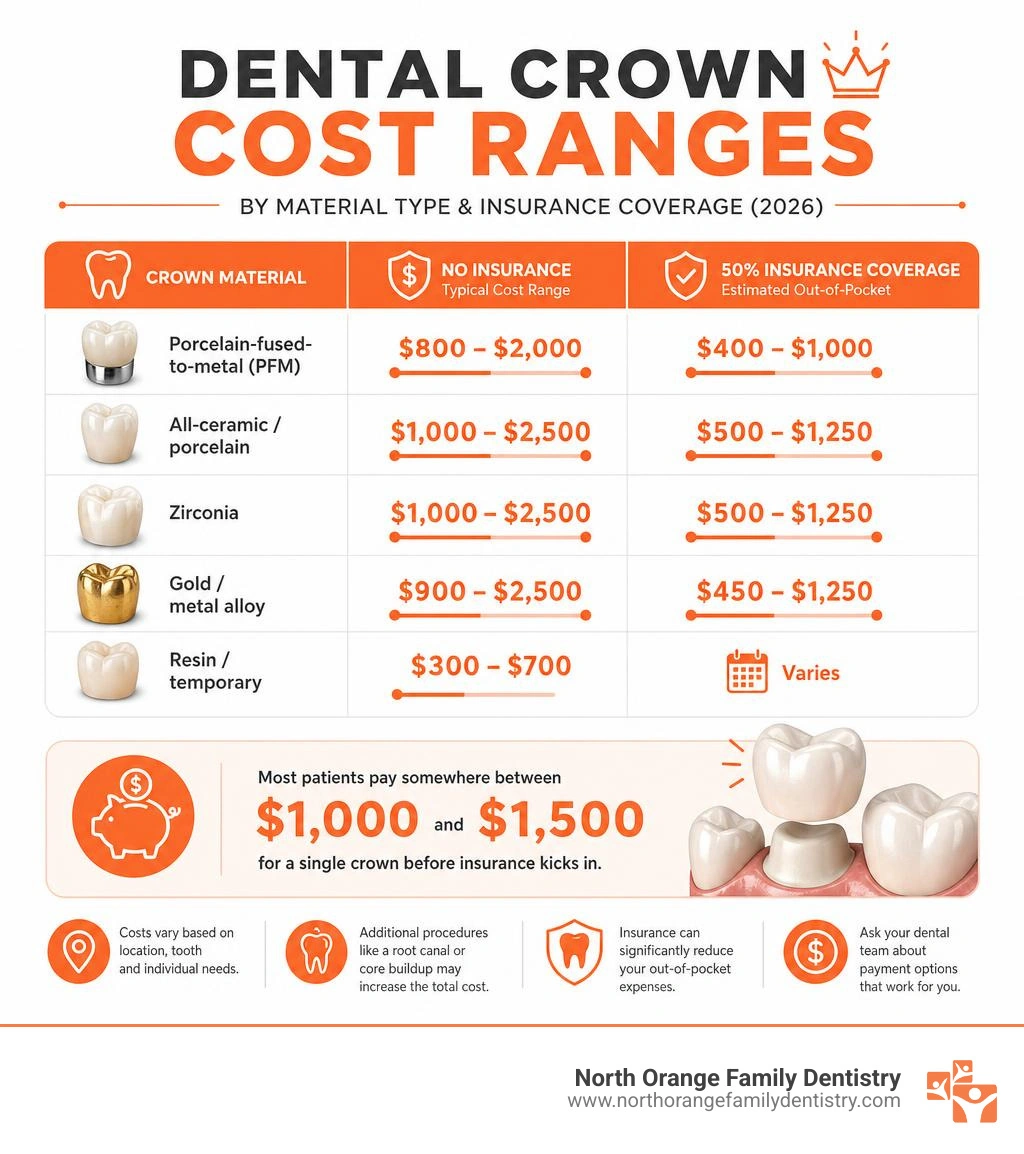
- Porcelain-fused-to-metal (PFM) crowns typically cost $800–$2,000 without insurance. With 50% insurance coverage, patients often pay about $400–$1,000 out of pocket.
- All-ceramic or porcelain crowns usually cost $1,000–$2,500 without insurance. With 50% coverage, the estimated out-of-pocket cost is about $500–$1,250.
- Zirconia crowns generally fall in the $1,000–$2,500 range without insurance. With 50% coverage, patients may pay around $500–$1,250.
- Gold or metal alloy crowns commonly cost $900–$2,500 without insurance. With 50% coverage, the out-of-pocket estimate is about $450–$1,250.
- Resin or temporary crowns are usually lower cost, often around $300–$700, though insurance coverage can vary.
Most patients pay somewhere between $1,000 and $1,500 for a single crown before insurance kicks in.
The final number you pay depends on the material, which tooth needs the crown, where you live, and whether you have dental insurance. Additional procedures — like a root canal or core buildup — can also add to the total.
If cost is a barrier, North Orange Family Dentistry offers a Dental Wellness Plan for individuals and families without insurance, giving you access to the care you need at a more manageable price.
This guide walks through everything — materials, insurance, hidden fees, alternatives, and how to make a smart decision for your smile and your budget.
Important cost of crown terms:
What is a Dental Crown and When is it Needed?
A crown of tooth, often referred to as a tooth cap, is a custom-made restoration that fits completely over a damaged tooth. Its primary job is to restore the tooth's shape, size, strength, and overall appearance. Think of it as a protective helmet for a vulnerable tooth.
We typically recommend dental crowns when a tooth has lost its structural integrity. This can happen due to:
- Severe Enamel Decay: When a cavity is too large for a standard filling to support, a crown is required to keep the tooth from breaking.
- A Cracked or Fractured Tooth: To hold the pieces of a cracked tooth together and prevent further split damage.
- Root Canal Therapy: After a root canal, the tooth becomes brittle and hollow (much like a hollow chocolate Easter bunny). A crown protects it from shattering under chewing pressure.
- Dental Bridge Anchor: Crowns are placed on the healthy teeth adjacent to a gap to secure a dental bridge in place.
Understanding when and why you need this treatment is the first step in taking control of your oral health. You can read more in our guide on everything you need to know about dental crowns protect and enhance your teeth.
The Average Cost of Crown Without Insurance in 2026
When navigating the dental crown cost without insurance, it is helpful to look at national and regional averages. Across the United States in 2026, the baseline average cost of dental crowns varies significantly. Out-of-network fees and private practice overhead mean that the sticker price you see on a treatment plan can fluctuate.
Without coverage, a single permanent crown typically spans a wide range of price tiers. The ultimate cost of crown tooth projects differently based on the material used and the complexity of your specific case. For a detailed breakdown of these uninsured price points, you can read more about how much is a crown without insurance? $800–$3,000 in 2026.
How Material Choices Affect the Cost of Crown Procedures
The material you select with your dentist is the single largest driver of the base price. Each material offers distinct advantages in terms of aesthetics, strength, and longevity:
- Zirconia: Known for its extreme durability and fracture resistance, zirconia is an excellent choice for back molars that endure heavy chewing forces. It offers a great balance of natural appearance and metal-free strength.
- Porcelain-Fused-to-Metal (PFM): A classic option where porcelain is baked over a metal alloy base. While strong, they can sometimes show a dark metal line near the gumline over time as gums naturally recede.
- Gold Alloy: The gold standard for longevity. Gold crowns require the least amount of natural enamel removal and are highly gentle on opposing teeth. They are typically reserved for non-visible back molars.
- Composite Resin: Often used for temporary crowns or lower-cost provisional restorations. While budget-friendly upfront, they wear down much faster than ceramic or metal.
For a closer look at porcelain pricing, check out our resources on the porcelain tooth cap cost. You can also find comprehensive breakdowns in the Crown Cost Guide for Dental Crowns in the U.S. – Cost Notes.
Here is how the most common crown materials compare:
- Composite resin crowns are usually the lowest-cost option. They have a moderate appearance and typically last about 5 to 8 years, making them more common for temporary or short-term restorations than long-term crown work.
- Porcelain-fused-to-metal crowns are a mid-range option. They usually last about 10 to 15 years and offer a natural-looking result, though a thin dark line may become visible near the gumline over time.
- All-porcelain or all-ceramic crowns are a higher-cost choice, especially for front teeth. They provide the most lifelike appearance and generally last about 10 to 15 years with proper care.
- Zirconia crowns are also in the higher-cost range because they combine strength, durability, and a natural look. They often last 15 to 25 years or longer, especially on back teeth that handle heavy chewing pressure.
- Gold alloy crowns are typically higher-cost restorations with a metallic appearance. They are not tooth-colored, but they can last 20 to 40 years or more and are one of the most durable options for molars.
Geographic and Tooth Location Cost Factors
Where the tooth is located in your mouth also plays a role in the final fee. Front teeth require meticulous cosmetic characterization to match the exact shade, translucency, and shape of your surrounding natural teeth. Because of this high aesthetic demand, all-ceramic or porcelain crowns for front teeth often cost more than standard molar crowns.
Conversely, back molars require thicker, stronger materials like zirconia or gold to withstand hundreds of pounds of daily chewing pressure.
Geography is another major factor. Dental fees reflect the local cost of living and business overhead. For instance, getting dental work in metropolitan areas or high-cost coastal cities generally carries a premium compared to the Midwest. For a state-by-state look at how regional economics affect dental pricing, you can read the resource Ohio Dental Crown Costs: A Royal Breakdown.
Additional Dental Fees and Preparatory Procedures
The crown itself is rarely the only line item on your treatment plan. A tooth must be healthy and structurally sound before a crown can be permanently cemented over it. Depending on the condition of your tooth, you may need one or more of these preparatory procedures:
- Diagnostic X-rays and Exams: Necessary to evaluate the health of the tooth root and surrounding bone.
- Core Buildup: If a large portion of the tooth is missing due to decay or a fracture, we must rebuild the "core" of the tooth using filling material to give the crown a secure anchor.
- Post and Core: If the tooth has had a root canal, a metal or fiber post may need to be placed down into the root canal space to help support the core buildup.
- Root Canal Therapy: If decay has reached the pulp (the nerve) of the tooth, a root canal must be performed before the crown is placed to prevent infection and pain.
- Crown Lengthening: If the tooth is broken off below the gumline, a minor surgical procedure is required to expose more healthy tooth structure so the crown can grip it properly.
To estimate how these variables stack up, you can consult tools like the How Much Does a Dental Crown Cost? Calculator or the Dental Crown Cost Calculator — CalculatorCove.
Navigating Insurance and Affordable Payment Options

Understanding how your benefits work can save you from unexpected out-of-pocket surprises.
Understanding the Total Cost of Crown Restorations with Insurance
Most private dental insurance policies classify dental crowns as "major services." Under a typical dental plan, preventive care (like cleanings) is covered at 100%, basic services (like fillings) at 80%, and major services (like crowns) at 50%.
However, you must keep three details in mind:
- Deductibles: The flat fee you must pay out of pocket before your insurance benefits kick in.
- Annual Maximums: Most insurance plans cap their annual payouts between a set limit per year. If your treatment exceeds this limit, you are responsible for the remainder.
- Waiting Periods: Many new policies require you to be enrolled for 6 to 12 months before they will pay for major restorative work.
We always recommend requesting a pre-treatment estimate from your insurance company before starting your procedure. This provides a clear breakdown of what they will cover and what you will owe. For more details on maximizing your benefits, read our tooth crown cost with insurance guide or the How Much Dental Crown Costs in 2026: Ultimate Guide.
Affordable Solutions for Uninsured Patients
If you do not have dental insurance, you do not have to skip necessary dental care. Delaying a crown can lead to root infections or tooth fractures that require extraction.
To make care accessible, we offer an in-house Dental Wellness Plan specifically for our uninsured individuals and families. This plan allows you to receive your routine yearly preventive care — including cleanings, exams, and diagnostic X-rays — for a discounted price, while also providing a percentage off restorative procedures like crowns.
For more tips on finding accessible care near you, view our affordable tooth crown resources or the Dental Crowns Near Me Guide.
Comparing Dental Crowns to Restorative Alternatives
Before committing to a crown, it is worth comparing it to other restorative options to see which best fits your clinical needs and budget:
- Dental Veneers: Excellent for purely cosmetic issues on front teeth (like staining or minor chips), but they require a healthy tooth structure and do not add significant strength to back chewing teeth.
- Tooth Bonding: A quick, conservative option where tooth-colored resin is applied to repair minor chips. While highly affordable, bonding is not durable enough to restore teeth with major decay or structural damage.
- Onlays: Often called "partial crowns," these fit over only a portion of the tooth. They preserve more natural tooth structure than a full crown but are only suitable if the damage is moderate.
- Endosteal Dental Implants: If a tooth is completely unsavable and must be extracted, an endosteal dental implant is the gold standard replacement. At our practice, a single dental implant tooth restoration averages about $4,500. While a larger upfront investment than a crown, it replaces the entire tooth root and can last a lifetime.
To weigh your options, read about the advantages and disadvantages of dental crowns, explore understanding dental crown services what you need to know, or search for dental crowns and bridges near me.
Frequently Asked Questions About Dental Crowns
How long do dental crowns typically last?
On average, a high-quality dental crown lasts between 10 and 15 years, though durable materials like zirconia and gold can easily last 20 to 40 years with excellent care. Longevity depends heavily on your oral hygiene habits. Brushing twice a day, flossing daily, and wearing a custom night guard if you grind your teeth at night are the best ways to protect your investment from premature wear and tear.
Does getting a dental crown hurt?
Not at all! We use local anesthesia to completely numb the tooth and surrounding gums before we begin shaping the enamel. You may feel some mild pressure during the procedure, but you should not feel pain. Afterward, it is normal to experience some mild gum soreness or tooth sensitivity to hot and cold for a few days, which easily resolves with over-the-counter pain relievers.
What happens if I delay getting a recommended crown?
Delaying a crown leaves a compromised tooth completely exposed to chewing forces. Over time, the tooth is highly likely to suffer a severe fracture. If the crack extends below the gumline or into the root, the tooth can no longer be saved and must be extracted. Delaying treatment also allows decay to reach the nerve, turning a simple crown procedure into a more complex root canal therapy or tooth extraction.
Conclusion
Investing in a dental crown is about protecting your oral health, restoring your bite, and keeping your natural smile intact for years to come. At North Orange Family Dentistry, Dr. Kyle Bogan and our highly trained team are dedicated to providing comfortable, state-of-the-art care that fits your family's budget.
Whether you need to utilize your dental insurance or take advantage of our in-house Dental Wellness Plan for savings, we are here to help. We also offer advanced laser treatments for TMJ pain, rapid canker sore healing, and non-surgical periodontal therapy to keep your mouth feeling its best. Plus, if you ever experience a sudden toothache or dental injury, we offer same-day emergency appointments to get you out of pain fast.
Ready to restore your smile? Schedule a consultation for a dental crown with us in Delaware, Ohio today!
What Does a Dental Crown Cost? Here's What to Know First
The cost of a crown is one of the most common questions patients ask before agreeing to treatment — and for good reason. It's a significant investment, and the price can vary widely depending on several factors.
Here's a quick summary of what most people pay in 2026:
- Porcelain-fused-to-metal (PFM) crowns typically cost $800–$2,000 without insurance. With 50% insurance coverage, patients often pay about $400–$1,000 out of pocket.
- All-ceramic or porcelain crowns usually cost $1,000–$2,500 without insurance. With 50% coverage, the estimated out-of-pocket cost is about $500–$1,250.
- Zirconia crowns generally fall in the $1,000–$2,500 range without insurance. With 50% coverage, patients may pay around $500–$1,250.
- Gold or metal alloy crowns commonly cost $900–$2,500 without insurance. With 50% coverage, the out-of-pocket estimate is about $450–$1,250.
- Resin or temporary crowns are usually lower cost, often around $300–$700, though insurance coverage can vary.
Most patients pay somewhere between $1,000 and $1,500 for a single crown before insurance kicks in.
The final number you pay depends on the material, which tooth needs the crown, where you live, and whether you have dental insurance. Additional procedures — like a root canal or core buildup — can also add to the total.
If cost is a barrier, North Orange Family Dentistry offers a Dental Wellness Plan for individuals and families without insurance, giving you access to the care you need at a more manageable price.
This guide walks through everything — materials, insurance, hidden fees, alternatives, and how to make a smart decision for your smile and your budget.
Important cost of crown terms:
What is a Dental Crown and When is it Needed?
A crown of tooth, often referred to as a tooth cap, is a custom-made restoration that fits completely over a damaged tooth. Its primary job is to restore the tooth's shape, size, strength, and overall appearance. Think of it as a protective helmet for a vulnerable tooth.
We typically recommend dental crowns when a tooth has lost its structural integrity. This can happen due to:
- Severe Enamel Decay: When a cavity is too large for a standard filling to support, a crown is required to keep the tooth from breaking.
- A Cracked or Fractured Tooth: To hold the pieces of a cracked tooth together and prevent further split damage.
- Root Canal Therapy: After a root canal, the tooth becomes brittle and hollow (much like a hollow chocolate Easter bunny). A crown protects it from shattering under chewing pressure.
- Dental Bridge Anchor: Crowns are placed on the healthy teeth adjacent to a gap to secure a dental bridge in place.
Understanding when and why you need this treatment is the first step in taking control of your oral health. You can read more in our guide on everything you need to know about dental crowns protect and enhance your teeth.
The Average Cost of Crown Without Insurance in 2026
When navigating the dental crown cost without insurance, it is helpful to look at national and regional averages. Across the United States in 2026, the baseline average cost of dental crowns varies significantly. Out-of-network fees and private practice overhead mean that the sticker price you see on a treatment plan can fluctuate.
Without coverage, a single permanent crown typically spans a wide range of price tiers. The ultimate cost of crown tooth projects differently based on the material used and the complexity of your specific case. For a detailed breakdown of these uninsured price points, you can read more about how much is a crown without insurance? $800–$3,000 in 2026.
How Material Choices Affect the Cost of Crown Procedures
The material you select with your dentist is the single largest driver of the base price. Each material offers distinct advantages in terms of aesthetics, strength, and longevity:
- Zirconia: Known for its extreme durability and fracture resistance, zirconia is an excellent choice for back molars that endure heavy chewing forces. It offers a great balance of natural appearance and metal-free strength.
- Porcelain-Fused-to-Metal (PFM): A classic option where porcelain is baked over a metal alloy base. While strong, they can sometimes show a dark metal line near the gumline over time as gums naturally recede.
- Gold Alloy: The gold standard for longevity. Gold crowns require the least amount of natural enamel removal and are highly gentle on opposing teeth. They are typically reserved for non-visible back molars.
- Composite Resin: Often used for temporary crowns or lower-cost provisional restorations. While budget-friendly upfront, they wear down much faster than ceramic or metal.
For a closer look at porcelain pricing, check out our resources on the porcelain tooth cap cost. You can also find comprehensive breakdowns in the Crown Cost Guide for Dental Crowns in the U.S. – Cost Notes.
Here is how the most common crown materials compare:
- Composite resin crowns are usually the lowest-cost option. They have a moderate appearance and typically last about 5 to 8 years, making them more common for temporary or short-term restorations than long-term crown work.
- Porcelain-fused-to-metal crowns are a mid-range option. They usually last about 10 to 15 years and offer a natural-looking result, though a thin dark line may become visible near the gumline over time.
- All-porcelain or all-ceramic crowns are a higher-cost choice, especially for front teeth. They provide the most lifelike appearance and generally last about 10 to 15 years with proper care.
- Zirconia crowns are also in the higher-cost range because they combine strength, durability, and a natural look. They often last 15 to 25 years or longer, especially on back teeth that handle heavy chewing pressure.
- Gold alloy crowns are typically higher-cost restorations with a metallic appearance. They are not tooth-colored, but they can last 20 to 40 years or more and are one of the most durable options for molars.
Geographic and Tooth Location Cost Factors
Where the tooth is located in your mouth also plays a role in the final fee. Front teeth require meticulous cosmetic characterization to match the exact shade, translucency, and shape of your surrounding natural teeth. Because of this high aesthetic demand, all-ceramic or porcelain crowns for front teeth often cost more than standard molar crowns.
Conversely, back molars require thicker, stronger materials like zirconia or gold to withstand hundreds of pounds of daily chewing pressure.
Geography is another major factor. Dental fees reflect the local cost of living and business overhead. For instance, getting dental work in metropolitan areas or high-cost coastal cities generally carries a premium compared to the Midwest. For a state-by-state look at how regional economics affect dental pricing, you can read the resource Ohio Dental Crown Costs: A Royal Breakdown.
Additional Dental Fees and Preparatory Procedures
The crown itself is rarely the only line item on your treatment plan. A tooth must be healthy and structurally sound before a crown can be permanently cemented over it. Depending on the condition of your tooth, you may need one or more of these preparatory procedures:
- Diagnostic X-rays and Exams: Necessary to evaluate the health of the tooth root and surrounding bone.
- Core Buildup: If a large portion of the tooth is missing due to decay or a fracture, we must rebuild the "core" of the tooth using filling material to give the crown a secure anchor.
- Post and Core: If the tooth has had a root canal, a metal or fiber post may need to be placed down into the root canal space to help support the core buildup.
- Root Canal Therapy: If decay has reached the pulp (the nerve) of the tooth, a root canal must be performed before the crown is placed to prevent infection and pain.
- Crown Lengthening: If the tooth is broken off below the gumline, a minor surgical procedure is required to expose more healthy tooth structure so the crown can grip it properly.
To estimate how these variables stack up, you can consult tools like the How Much Does a Dental Crown Cost? Calculator or the Dental Crown Cost Calculator — CalculatorCove.
Navigating Insurance and Affordable Payment Options
Understanding how your benefits work can save you from unexpected out-of-pocket surprises.
Understanding the Total Cost of Crown Restorations with Insurance
Most private dental insurance policies classify dental crowns as "major services." Under a typical dental plan, preventive care (like cleanings) is covered at 100%, basic services (like fillings) at 80%, and major services (like crowns) at 50%.
However, you must keep three details in mind:
- Deductibles: The flat fee you must pay out of pocket before your insurance benefits kick in.
- Annual Maximums: Most insurance plans cap their annual payouts between a set limit per year. If your treatment exceeds this limit, you are responsible for the remainder.
- Waiting Periods: Many new policies require you to be enrolled for 6 to 12 months before they will pay for major restorative work.
We always recommend requesting a pre-treatment estimate from your insurance company before starting your procedure. This provides a clear breakdown of what they will cover and what you will owe. For more details on maximizing your benefits, read our tooth crown cost with insurance guide or the How Much Dental Crown Costs in 2026: Ultimate Guide.
Affordable Solutions for Uninsured Patients
If you do not have dental insurance, you do not have to skip necessary dental care. Delaying a crown can lead to root infections or tooth fractures that require extraction.
To make care accessible, we offer an in-house Dental Wellness Plan specifically for our uninsured individuals and families. This plan allows you to receive your routine yearly preventive care — including cleanings, exams, and diagnostic X-rays — for a discounted price, while also providing a percentage off restorative procedures like crowns.
For more tips on finding accessible care near you, view our affordable tooth crown resources or the Dental Crowns Near Me Guide.
Comparing Dental Crowns to Restorative Alternatives
Before committing to a crown, it is worth comparing it to other restorative options to see which best fits your clinical needs and budget:
- Dental Veneers: Excellent for purely cosmetic issues on front teeth (like staining or minor chips), but they require a healthy tooth structure and do not add significant strength to back chewing teeth.
- Tooth Bonding: A quick, conservative option where tooth-colored resin is applied to repair minor chips. While highly affordable, bonding is not durable enough to restore teeth with major decay or structural damage.
- Onlays: Often called "partial crowns," these fit over only a portion of the tooth. They preserve more natural tooth structure than a full crown but are only suitable if the damage is moderate.
- Endosteal Dental Implants: If a tooth is completely unsavable and must be extracted, an endosteal dental implant is the gold standard replacement. At our practice, a single dental implant tooth restoration averages about $4,500. While a larger upfront investment than a crown, it replaces the entire tooth root and can last a lifetime.
To weigh your options, read about the advantages and disadvantages of dental crowns, explore understanding dental crown services what you need to know, or search for dental crowns and bridges near me.
Frequently Asked Questions About Dental Crowns
How long do dental crowns typically last?
On average, a high-quality dental crown lasts between 10 and 15 years, though durable materials like zirconia and gold can easily last 20 to 40 years with excellent care. Longevity depends heavily on your oral hygiene habits. Brushing twice a day, flossing daily, and wearing a custom night guard if you grind your teeth at night are the best ways to protect your investment from premature wear and tear.
Does getting a dental crown hurt?
Not at all! We use local anesthesia to completely numb the tooth and surrounding gums before we begin shaping the enamel. You may feel some mild pressure during the procedure, but you should not feel pain. Afterward, it is normal to experience some mild gum soreness or tooth sensitivity to hot and cold for a few days, which easily resolves with over-the-counter pain relievers.
What happens if I delay getting a recommended crown?
Delaying a crown leaves a compromised tooth completely exposed to chewing forces. Over time, the tooth is highly likely to suffer a severe fracture. If the crack extends below the gumline or into the root, the tooth can no longer be saved and must be extracted. Delaying treatment also allows decay to reach the nerve, turning a simple crown procedure into a more complex root canal therapy or tooth extraction.
Conclusion
Investing in a dental crown is about protecting your oral health, restoring your bite, and keeping your natural smile intact for years to come. At North Orange Family Dentistry, Dr. Kyle Bogan and our highly trained team are dedicated to providing comfortable, state-of-the-art care that fits your family's budget.
Whether you need to utilize your dental insurance or take advantage of our in-house Dental Wellness Plan for savings, we are here to help. We also offer advanced laser treatments for TMJ pain, rapid canker sore healing, and non-surgical periodontal therapy to keep your mouth feeling its best. Plus, if you ever experience a sudden toothache or dental injury, we offer same-day emergency appointments to get you out of pain fast.
Ready to restore your smile? Schedule a consultation for a dental crown with us in Delaware, Ohio today!
Contact Us
Have any questions? Want to learn more?

