
Clear Aligners for Crowded Teeth: A Practical Treatment Overview
Can clear aligners fix crowded teeth? Yes—learn how they correct mild to severe crowding, plus treatment steps and success factors.


Can Clear Aligners Fix Crowded Teeth?
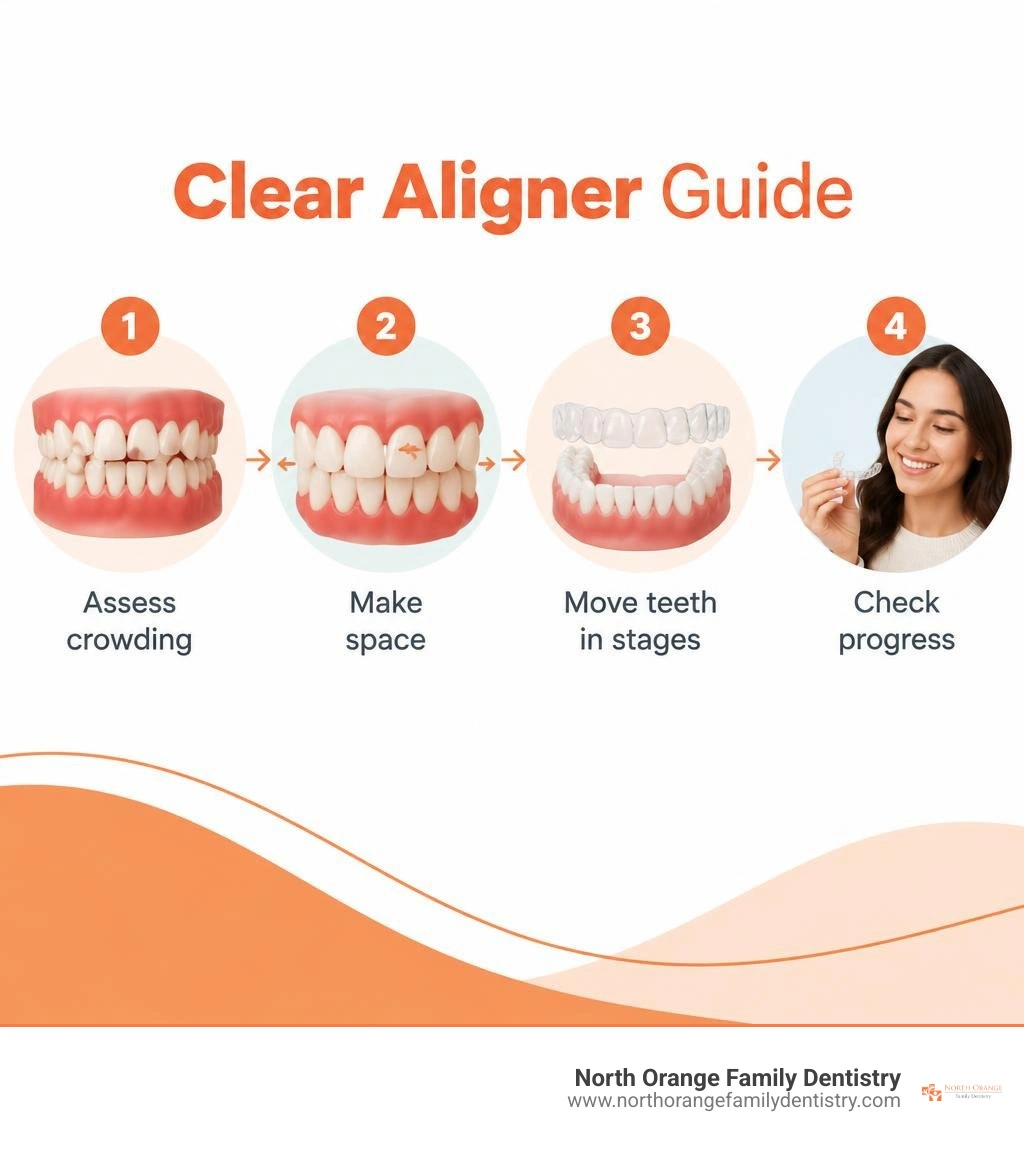
If you’re wondering, “can clear aligners fix crowded teeth?” Yes, often. They work best for mild to moderate crowding. Start with a dental exam to find out how much space your teeth need and whether aligners can move them safely. Severe crowding may need a more involved treatment plan.
At North Orange Family Dentistry, we can assess your teeth and bite to help you decide whether Invisalign is a good fit. This guide explains what aligners can do, where their limits are, and what to expect during treatment.
Essential can clear aligners fix crowded teeth terms:
Understanding Dental Crowding: Causes and Oral Health Risks
Dental crowding occurs when there is insufficient room along the dental arch for all permanent teeth to erupt in harmonious alignment. This condition is remarkably common, affecting approximately 24% of women and 14% of men. When the jaw cannot accommodate the full width of the teeth, they overlap, twist, rotate, or get displaced inward (lingually) or outward (buccally).
According to a clinical review on orthodontic malocclusion, the vast majority of bite discrepancies arise during childhood and mixed dentition (NBK592395). Understanding the biological foundations of crowding helps determine whether invisible orthodontic trays provide the best corrective pathway.
Root Causes of Arch Discrepancies and Misalignment
A crowded smile is rarely caused by a single factor. Several anatomical and developmental variables contribute to dental crowding:
- Discrepancy Between Jaw Size and Tooth Width: An inherited mismatch between a narrow jaw and wider teeth is the most frequent cause.
- Early Loss of Primary Teeth: When baby teeth are lost prematurely due to decay or injury, neighboring teeth drift forward, blocking space for adult teeth.
- Myofunctional Habits: Childhood thumb-sucking, prolonged pacifier usage, or tongue-thrusting alter bone development and narrow the palate.
- Mesial Drift: As we age, our teeth naturally shift forward toward the midline, causing gradual crowding in adulthood even for patients who had braces as teenagers.
Oral Health Complications of Untreated Crowded Teeth
Crowded teeth are not just a cosmetic concern; overlapping enamel creates tight, inaccessible crevices that trap food particles and bacteria. Using aligners for crooked teeth helps resolve chronic health risks associated with untreated malocclusion, including:
- Plaque Accumulation and Periodontal Disease: Overlapping teeth make flossing difficult, leading to gingival inflammation and gum infections.
- Uneven Enamel Wear: Misaligned teeth meet unnaturally during chewing, causing premature chipping, fractures, and enamel erosion.
- Temporomandibular Joint (TMJ) Stress: An improper bite places irregular strain on jaw joints and facial muscles, contributing to chronic tension and headaches.
- Chewing and Digestive Inefficiency: Poor alignment prevents proper food breakdown, which can impact nutrition and digestion.
Can Clear Aligners Fix Crowded Teeth? Efficacy and Limits
Clear aligners have revolutionized modern orthodontics. Made of medical-grade, BPA-free thermoformed plastic, these custom trays apply continuous, gentle micro-forces to guide teeth into alignment. However, their clinical success depends heavily on the severity of the arch space deficiency.
When evaluating whether clear aligners are suitable, clinicians divide crowding into clinical severity tiers:
- Mild Crowding (under 3 mm of space deficiency): Minor overlaps or slight rotations, routinely fixed with basic aligner therapy.
- Moderate Crowding (3 mm to 6 mm): Noticeable overlapping requiring arch expansion or interproximal reduction (IPR).
- Severe Crowding (greater than 6 mm): Significant overlaps often accompanied by skeletal discrepancies or tooth impactions, occasionally requiring extractions or hybrid mechanics.
According to a comprehensive systematic review on clear aligners in complex malocclusion, aligners achieve satisfactory overall alignment across various cases, but specific tooth movements require precise planning to avoid unintended tipping (Jaber et al., 2023).
How Can Clear Aligners Fix Crowded Teeth in Mild to Moderate Cases?
For mild-to-moderate crowding (less than 6 mm), clear aligners are highly effective without requiring tooth extractions. Clinicians generate space through three primary non-invasive techniques:
- Arch Expansion: Aligners gently widen the dental arch outward, creating space along the perimeter for crowded anterior teeth to unravel.
- Incisor Proclination: Tipping slightly retroclined front teeth forward opens up arch length.
- Interproximal Reduction (IPR): Removing microscopic slivers of enamel between select teeth (usually 0.2 mm to 0.5 mm) frees critical millimeters of space.
A retrospective cohort study on mandibular crowding predictability demonstrates that clear aligners resolve up to 91.4% of lower anterior incisor crowding. However, movement predictability drops as crowding increases, requiring experienced clinical oversight to manage torque and rotational control.
Can Clear Aligners Fix Crowded Teeth That Require Premolar Extractions?
When crowding exceeds 6 mm to 8 mm, attempting to align teeth without creating space can push incisors too far forward, leading to unstable bites and gum recession. In these severe cases, extracting premolars may be necessary.
Can clear aligners handle extraction spaces? Yes, but with specific biomechanical considerations:
- Treatment Duration: In extraction cases, clear aligner therapy can take longer because closing large gaps with plastic trays requires careful anchorage control.
- PAR Score Reductions: In a clinical evaluation of 36 severe crowding cases treated with extraction and aligners, patients achieved a mean Peer Assessment Rating (PAR) score reduction of 28.39 points, with 88.9% showing substantial improvement.
- Anchorage Control: Aligners naturally tend to tip adjacent molars forward into the gap (averaging 5.86° more mesial tip than digitally simulated). Skilled providers compensate by programming counter-tipping forces and using composite attachments.
Step-by-Step Process: How Aligners Correct Crowding
Correcting crowded teeth with clear aligners follows an organized, digital workflow:
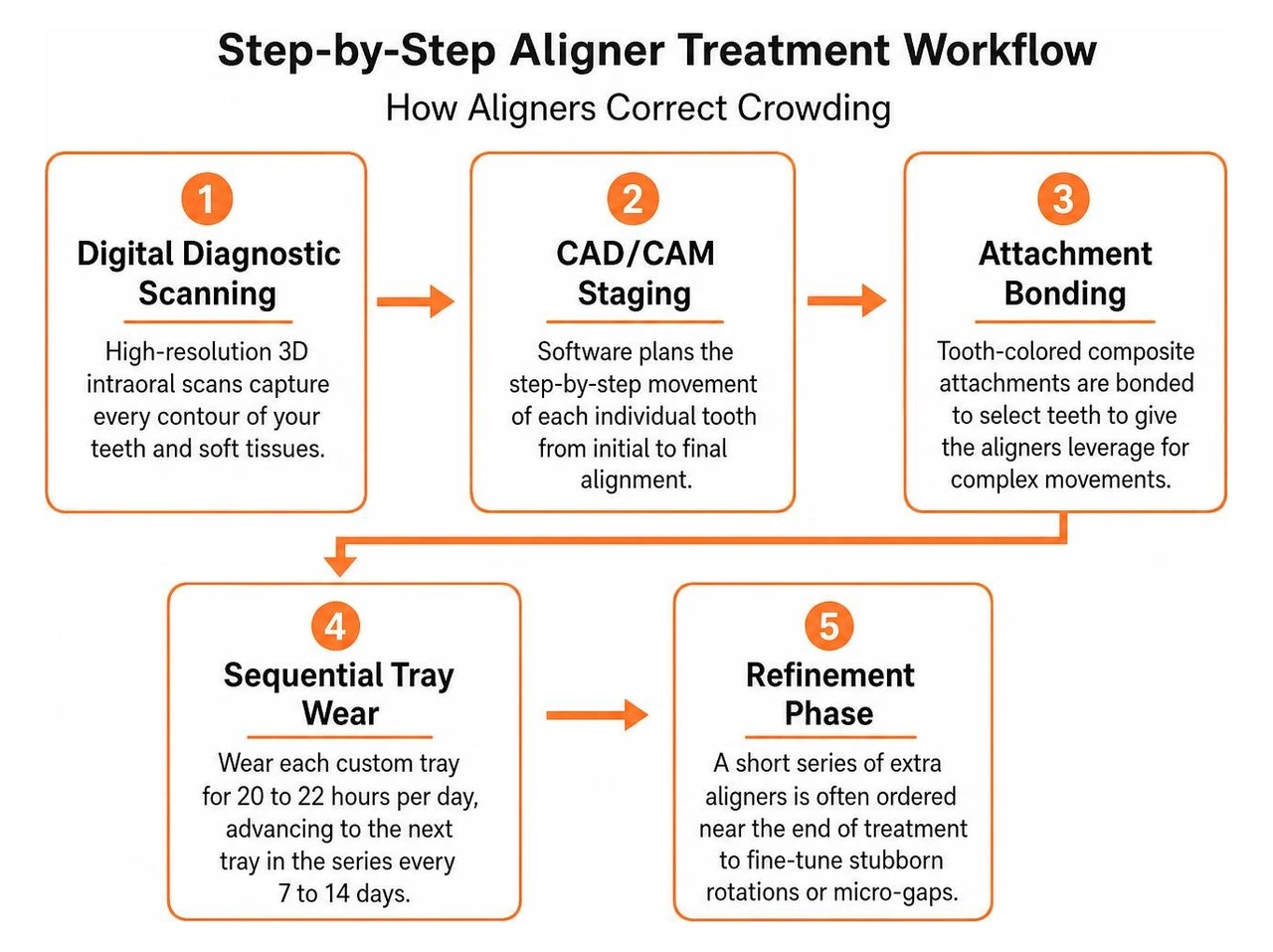
- Digital Diagnostic Scanning: High-resolution 3D intraoral scans capture every contour of your teeth and soft tissues, eliminating messy putty impressions.
- CAD/CAM Staging: Sophisticated software plans the step-by-step movement of each individual tooth from its initial crowded position to its final alignment.
- Attachment Bonding: Tooth-colored composite attachments (small aesthetic shapes) are bonded to select teeth to give the aligners leverage for complex movements.
- Sequential Tray Wear: Patients wear each custom tray for 20 to 22 hours per day, advancing to the next tray in the series every 7 to 14 days.
- Refinement Phase: A short series of extra aligners is often ordered near the end of treatment to fine-tune stubborn rotations or micro-gaps.
- Retention: Once active movement ends, clear retainers protect your investment by keeping teeth stable in their new positions.
Biomechanical Staging and Tooth Movement Sequence
Aligners cannot move every crowded tooth at the same moment. Doing so would produce chaotic, opposing forces. As detailed in research on biomechanical staging for complex aligner movement, clinicians stage tooth movements in sequential phases (Mehta et al., 2021).

In crowded arches, treatment often begins with sequential distalization—moving the rear molars backward one by one to create room before retracting canines and aligning front teeth. Velocity control is strictly programmed; linear movement is typically limited to 0.2 mm to 0.3 mm per tray, and rotations are capped at 1° to 2° per tray to prevent the plastic from slipping.
Movement Predictability: Rotations, Intrusion, and Tipping
Not every orthodontic movement responds to plastic trays equally:
- Rotational Accuracy: Aligners work well for tipping and minor bodily translation, but rotational accuracy can be lower than 51% for round teeth like maxillary lateral incisors and canines.
- Torquing Movements: Digital accuracy for root torquing ranges from 56% to 72.9%. Power ridges and custom attachments are essential to prevent unwanted crown-tipping.
- Vertical Intrusion: Intrusion of anterior teeth achieves approximately 33% efficiency, requiring slight overcorrection in digital software.
Critical Success Factors for Aligner Therapy
The success of clear aligner treatment depends on both clinical planning and patient daily habits:
- Daily Wear Time (22 Hours): Aligners only move teeth when they are worn. Removing trays for more than 2 hours a day delays progress and leads to ill-fitting aligners.
- Optimized Attachments: Custom-shaped composite dots act as handles, allowing the smooth plastic to grip teeth for complex rotations and root movements.
- Precise Interproximal Reduction (IPR): Creating exact, calculated space between teeth allows tight contact points to slide past each other safely.
- Diligent Oral Hygiene: Aligners seal saliva away from teeth. Brushing and flossing after meals prevents trapped sugars from causing decay during treatment.
Frequently Asked Questions About Clear Aligners for Crowded Teeth
How long does it take for clear aligners to fix crowded teeth?
Mild crowding can often be resolved in as little as 6 to 9 months. Moderate crowding typically requires 12 to 18 months, while complex cases involving extractions or severe bite correction may take 20 to 30 months, including refinement phases.
Are clear aligners effective for crowded teeth?
Yes, clear aligners are highly effective for crowded teeth, especially mild to moderate cases. They can improve alignment while offering removable convenience, invisible aesthetics, and easier oral hygiene maintenance.
What is interproximal reduction (IPR) and is it necessary for crowding?
IPR is a safe, painless procedure where a dentist polishes away tiny amounts of outer enamel (typically fractions of a millimeter) between crowded teeth. It creates the necessary space to unravel crowding without needing tooth extractions or overly expanding the jaw.
Conclusion
Clear aligners offer a comfortable, discreet, and highly predictable solution for correcting crowded teeth. By addressing arch crowding early, you not only transform your smile's appearance but also safeguard your long-term oral health against gum disease, uneven enamel wear, and bite dysfunction.
At North Orange Family Dentistry in Lewis Center, Ohio, Dr. Kyle Bogan and our experienced dental team leverage advanced digital imaging and personalized treatment planning to help you achieve a straight, healthy smile. In addition to clear aligner therapy, our practice provides advanced laser treatments for periodontal wellness and TMJ relief, same-day emergency dental appointments for urgent needs, and a Dental Wellness Plan designed to keep comprehensive care accessible for uninsured individuals and families.
If you are ready to explore how aligners can correct your crowded smile, schedule your personalized Invisalign consultation with our Lewis Center team today.
References
NBK592395.Jaber ST, Hajeer MY, Sultan K. "Treatment Effectiveness of Clear Aligners in Correcting Complicated and Severe Malocclusion Cases Compared to Fixed Orthodontic Appliances: A Systematic Review.." Cureus, 2023. PMCID PMC10148732.Mehta S, Patel D, Yadav S. "Staging Orthodontic Aligners for Complex Orthodontic Tooth Movement.." Turkish journal of orthodontics, 2021. PMCID PMC8940221.
Can Clear Aligners Fix Crowded Teeth?
If you’re wondering, “can clear aligners fix crowded teeth?” Yes, often. They work best for mild to moderate crowding. Start with a dental exam to find out how much space your teeth need and whether aligners can move them safely. Severe crowding may need a more involved treatment plan.
At North Orange Family Dentistry, we can assess your teeth and bite to help you decide whether Invisalign is a good fit. This guide explains what aligners can do, where their limits are, and what to expect during treatment.
Essential can clear aligners fix crowded teeth terms:
Understanding Dental Crowding: Causes and Oral Health Risks
Dental crowding occurs when there is insufficient room along the dental arch for all permanent teeth to erupt in harmonious alignment. This condition is remarkably common, affecting approximately 24% of women and 14% of men. When the jaw cannot accommodate the full width of the teeth, they overlap, twist, rotate, or get displaced inward (lingually) or outward (buccally).
According to a clinical review on orthodontic malocclusion, the vast majority of bite discrepancies arise during childhood and mixed dentition (NBK592395). Understanding the biological foundations of crowding helps determine whether invisible orthodontic trays provide the best corrective pathway.
Root Causes of Arch Discrepancies and Misalignment
A crowded smile is rarely caused by a single factor. Several anatomical and developmental variables contribute to dental crowding:
- Discrepancy Between Jaw Size and Tooth Width: An inherited mismatch between a narrow jaw and wider teeth is the most frequent cause.
- Early Loss of Primary Teeth: When baby teeth are lost prematurely due to decay or injury, neighboring teeth drift forward, blocking space for adult teeth.
- Myofunctional Habits: Childhood thumb-sucking, prolonged pacifier usage, or tongue-thrusting alter bone development and narrow the palate.
- Mesial Drift: As we age, our teeth naturally shift forward toward the midline, causing gradual crowding in adulthood even for patients who had braces as teenagers.
Oral Health Complications of Untreated Crowded Teeth
Crowded teeth are not just a cosmetic concern; overlapping enamel creates tight, inaccessible crevices that trap food particles and bacteria. Using aligners for crooked teeth helps resolve chronic health risks associated with untreated malocclusion, including:
- Plaque Accumulation and Periodontal Disease: Overlapping teeth make flossing difficult, leading to gingival inflammation and gum infections.
- Uneven Enamel Wear: Misaligned teeth meet unnaturally during chewing, causing premature chipping, fractures, and enamel erosion.
- Temporomandibular Joint (TMJ) Stress: An improper bite places irregular strain on jaw joints and facial muscles, contributing to chronic tension and headaches.
- Chewing and Digestive Inefficiency: Poor alignment prevents proper food breakdown, which can impact nutrition and digestion.
Can Clear Aligners Fix Crowded Teeth? Efficacy and Limits
Clear aligners have revolutionized modern orthodontics. Made of medical-grade, BPA-free thermoformed plastic, these custom trays apply continuous, gentle micro-forces to guide teeth into alignment. However, their clinical success depends heavily on the severity of the arch space deficiency.
When evaluating whether clear aligners are suitable, clinicians divide crowding into clinical severity tiers:
- Mild Crowding (under 3 mm of space deficiency): Minor overlaps or slight rotations, routinely fixed with basic aligner therapy.
- Moderate Crowding (3 mm to 6 mm): Noticeable overlapping requiring arch expansion or interproximal reduction (IPR).
- Severe Crowding (greater than 6 mm): Significant overlaps often accompanied by skeletal discrepancies or tooth impactions, occasionally requiring extractions or hybrid mechanics.
According to a comprehensive systematic review on clear aligners in complex malocclusion, aligners achieve satisfactory overall alignment across various cases, but specific tooth movements require precise planning to avoid unintended tipping (Jaber et al., 2023).
How Can Clear Aligners Fix Crowded Teeth in Mild to Moderate Cases?
For mild-to-moderate crowding (less than 6 mm), clear aligners are highly effective without requiring tooth extractions. Clinicians generate space through three primary non-invasive techniques:
- Arch Expansion: Aligners gently widen the dental arch outward, creating space along the perimeter for crowded anterior teeth to unravel.
- Incisor Proclination: Tipping slightly retroclined front teeth forward opens up arch length.
- Interproximal Reduction (IPR): Removing microscopic slivers of enamel between select teeth (usually 0.2 mm to 0.5 mm) frees critical millimeters of space.
A retrospective cohort study on mandibular crowding predictability demonstrates that clear aligners resolve up to 91.4% of lower anterior incisor crowding. However, movement predictability drops as crowding increases, requiring experienced clinical oversight to manage torque and rotational control.
Can Clear Aligners Fix Crowded Teeth That Require Premolar Extractions?
When crowding exceeds 6 mm to 8 mm, attempting to align teeth without creating space can push incisors too far forward, leading to unstable bites and gum recession. In these severe cases, extracting premolars may be necessary.
Can clear aligners handle extraction spaces? Yes, but with specific biomechanical considerations:
- Treatment Duration: In extraction cases, clear aligner therapy can take longer because closing large gaps with plastic trays requires careful anchorage control.
- PAR Score Reductions: In a clinical evaluation of 36 severe crowding cases treated with extraction and aligners, patients achieved a mean Peer Assessment Rating (PAR) score reduction of 28.39 points, with 88.9% showing substantial improvement.
- Anchorage Control: Aligners naturally tend to tip adjacent molars forward into the gap (averaging 5.86° more mesial tip than digitally simulated). Skilled providers compensate by programming counter-tipping forces and using composite attachments.
Step-by-Step Process: How Aligners Correct Crowding
Correcting crowded teeth with clear aligners follows an organized, digital workflow:
- Digital Diagnostic Scanning: High-resolution 3D intraoral scans capture every contour of your teeth and soft tissues, eliminating messy putty impressions.
- CAD/CAM Staging: Sophisticated software plans the step-by-step movement of each individual tooth from its initial crowded position to its final alignment.
- Attachment Bonding: Tooth-colored composite attachments (small aesthetic shapes) are bonded to select teeth to give the aligners leverage for complex movements.
- Sequential Tray Wear: Patients wear each custom tray for 20 to 22 hours per day, advancing to the next tray in the series every 7 to 14 days.
- Refinement Phase: A short series of extra aligners is often ordered near the end of treatment to fine-tune stubborn rotations or micro-gaps.
- Retention: Once active movement ends, clear retainers protect your investment by keeping teeth stable in their new positions.
Biomechanical Staging and Tooth Movement Sequence
Aligners cannot move every crowded tooth at the same moment. Doing so would produce chaotic, opposing forces. As detailed in research on biomechanical staging for complex aligner movement, clinicians stage tooth movements in sequential phases (Mehta et al., 2021).
In crowded arches, treatment often begins with sequential distalization—moving the rear molars backward one by one to create room before retracting canines and aligning front teeth. Velocity control is strictly programmed; linear movement is typically limited to 0.2 mm to 0.3 mm per tray, and rotations are capped at 1° to 2° per tray to prevent the plastic from slipping.
Movement Predictability: Rotations, Intrusion, and Tipping
Not every orthodontic movement responds to plastic trays equally:
- Rotational Accuracy: Aligners work well for tipping and minor bodily translation, but rotational accuracy can be lower than 51% for round teeth like maxillary lateral incisors and canines.
- Torquing Movements: Digital accuracy for root torquing ranges from 56% to 72.9%. Power ridges and custom attachments are essential to prevent unwanted crown-tipping.
- Vertical Intrusion: Intrusion of anterior teeth achieves approximately 33% efficiency, requiring slight overcorrection in digital software.
Critical Success Factors for Aligner Therapy
The success of clear aligner treatment depends on both clinical planning and patient daily habits:
- Daily Wear Time (22 Hours): Aligners only move teeth when they are worn. Removing trays for more than 2 hours a day delays progress and leads to ill-fitting aligners.
- Optimized Attachments: Custom-shaped composite dots act as handles, allowing the smooth plastic to grip teeth for complex rotations and root movements.
- Precise Interproximal Reduction (IPR): Creating exact, calculated space between teeth allows tight contact points to slide past each other safely.
- Diligent Oral Hygiene: Aligners seal saliva away from teeth. Brushing and flossing after meals prevents trapped sugars from causing decay during treatment.
Frequently Asked Questions About Clear Aligners for Crowded Teeth
How long does it take for clear aligners to fix crowded teeth?
Mild crowding can often be resolved in as little as 6 to 9 months. Moderate crowding typically requires 12 to 18 months, while complex cases involving extractions or severe bite correction may take 20 to 30 months, including refinement phases.
Are clear aligners effective for crowded teeth?
Yes, clear aligners are highly effective for crowded teeth, especially mild to moderate cases. They can improve alignment while offering removable convenience, invisible aesthetics, and easier oral hygiene maintenance.
What is interproximal reduction (IPR) and is it necessary for crowding?
IPR is a safe, painless procedure where a dentist polishes away tiny amounts of outer enamel (typically fractions of a millimeter) between crowded teeth. It creates the necessary space to unravel crowding without needing tooth extractions or overly expanding the jaw.
Conclusion
Clear aligners offer a comfortable, discreet, and highly predictable solution for correcting crowded teeth. By addressing arch crowding early, you not only transform your smile's appearance but also safeguard your long-term oral health against gum disease, uneven enamel wear, and bite dysfunction.
At North Orange Family Dentistry in Lewis Center, Ohio, Dr. Kyle Bogan and our experienced dental team leverage advanced digital imaging and personalized treatment planning to help you achieve a straight, healthy smile. In addition to clear aligner therapy, our practice provides advanced laser treatments for periodontal wellness and TMJ relief, same-day emergency dental appointments for urgent needs, and a Dental Wellness Plan designed to keep comprehensive care accessible for uninsured individuals and families.
If you are ready to explore how aligners can correct your crowded smile, schedule your personalized Invisalign consultation with our Lewis Center team today.
References
NBK592395.Jaber ST, Hajeer MY, Sultan K. "Treatment Effectiveness of Clear Aligners in Correcting Complicated and Severe Malocclusion Cases Compared to Fixed Orthodontic Appliances: A Systematic Review.." Cureus, 2023. PMCID PMC10148732.Mehta S, Patel D, Yadav S. "Staging Orthodontic Aligners for Complex Orthodontic Tooth Movement.." Turkish journal of orthodontics, 2021. PMCID PMC8940221.
Contact Us
Have any questions? Want to learn more?

