
Crown Jewels or Just Caps? Weighing the Advantages of Dental Crowns
Discover advantages and disadvantages of dental crowns. Explore types, costs, alternatives, and care at North Orange Family Dentistry.


Understanding Your Options: Are Dental Crowns Right for You?
The advantages and disadvantages of dental crowns are important to understand before making a decision about your tooth restoration. Let's break down what you need to know:
Key Advantages:
- Protection and strength - Crowns shield weak, cracked, or damaged teeth from further harm
- Long-lasting durability - With proper care, crowns typically last 5-15 years (some materials last 30+ years)
- Natural appearance - Modern crowns match your natural teeth in color, shape, and size
- Functional restoration - They restore full chewing ability and support after root canals or large fillings
- Versatility - Crowns can anchor bridges, cover implants, and improve smile aesthetics
Key Disadvantages:
- Irreversible tooth preparation - Your dentist must remove tooth enamel permanently to fit the crown
- Potential sensitivity - Some patients experience temporary sensitivity to hot or cold temperatures
- Investment required - Crowns cost more upfront than fillings, though they last much longer
- Possible complications - Crowns can occasionally chip, loosen, or require adjustment
- Multiple visits - Traditional crowns typically require two dental appointments
If you're facing a decision about tooth restoration, dental crowns offer a proven solution that balances durability with aesthetics. They're one of the most reliable options in restorative dentistry—but like any treatment, they're not perfect for every situation.
As Dr. Kyle Bogan, I've placed countless crowns throughout my career and helped families in Delaware and Lewis Center understand the advantages and disadvantages of dental crowns for their unique situations. My goal is always to ensure you have the information needed to make the best choice for your oral health and budget.
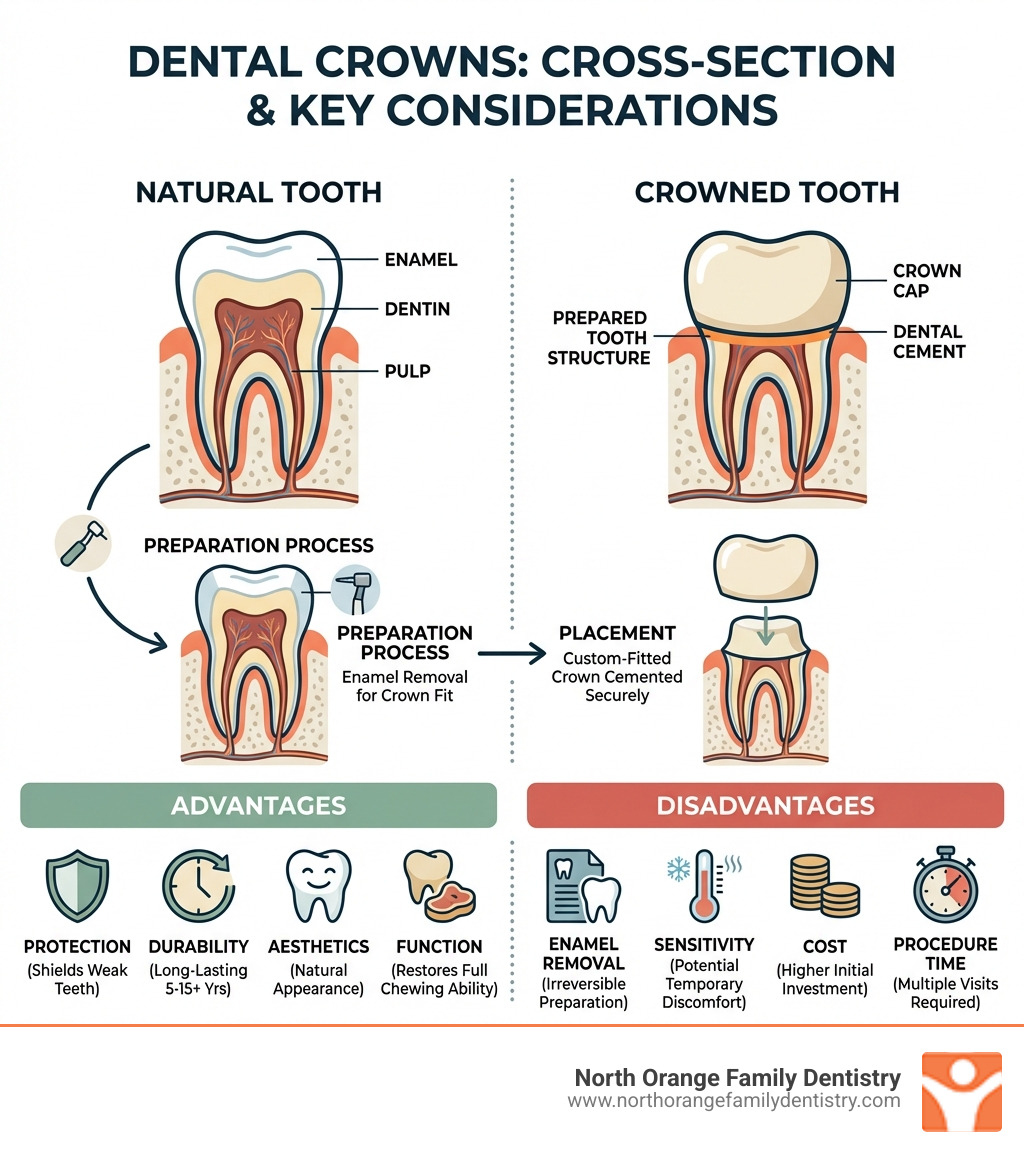
The Core Debate: Advantages and Disadvantages of Dental Crowns
When we talk about restorative dentistry, the dental crown is often the "gold standard." Think of a crown as a custom-fitted helmet for your tooth. While a filling goes into a tooth to plug a hole, a crown goes over the tooth to protect everything underneath.
At North Orange Family Dentistry, we see patients every day who are weighing the advantages and disadvantages of dental crowns. Is it worth the investment? Will it look natural? How long will it actually last? These are all valid questions. The core debate usually centers on the trade-off between sacrificing a bit of natural tooth structure to gain long-term structural integrity.

Key Advantages of Dental Crowns for Oral Health
The crown of tooth is the visible part that does all the hard work—chewing, grinding, and helping you speak clearly. When that structure is compromised by decay or injury, the advantages of a crown become clear:
- Superior Protection: According to the ADA's MouthHealthy, crowns are essential for strengthening weak teeth. If you have a cracked tooth, a crown holds it together, preventing the fracture from spreading to the root.
- Aesthetic Enhancement: We can custom-craft dental crowns to match the exact shade, translucency, and shape of your surrounding teeth. This is especially helpful for teeth that are severely discolored or misshapen.
- Durability and Longevity: While a filling might need replacement every few years, a well-maintained crown can last 10 to 15 years, and in some cases, even a lifetime.
- Functional Restoration: Unlike dentures, which can sometimes slip, crowns are cemented permanently. This restores your full bite force, allowing you to enjoy your favorite foods without worry.
- Essential Root Canal Support: After a root canal, a tooth becomes more brittle. A crown provides the necessary "hug" to keep that tooth functional for decades.
Potential Disadvantages of Dental Crowns to Consider
We believe in full transparency. While crowns are a fantastic tool, there are potential downsides that patients should consider:
- Tooth Preparation and Enamel Removal: To make room for the crown so it doesn't look bulky, we must remove a small amount of your natural enamel. This process is irreversible.
- Temperature Sensitivity: Because we are working close to the nerve of the tooth, some patients experience mild sensitivity to hot or cold substances immediately after the procedure. This usually fades, but for some, it can persist.
- The Financial Investment: The cost of crown tooth is higher than a standard composite filling. However, many patients view the average cost of dental crowns as a long-term investment that prevents more expensive extractions or implants later.
- Risk of Chipping or Loosening: Depending on the material, porcelain can chip if you bite down on something exceptionally hard (like ice or popcorn kernels). Additionally, dental cement can occasionally wash out, requiring the crown to be re-cemented.
How Material Choice Impacts Advantages and Disadvantages
Not all crowns are created equal. The material you choose significantly shifts the balance of the advantages and disadvantages of dental crowns.
- Porcelain-Fused-to-Metal (PFM): These have a metal core for strength and a porcelain coating for aesthetics. They are very durable but can sometimes show a dark metal line at the gumline if the gums recede.
- Zirconia: Known for being "indestructible," zirconia crowns are metal-free and incredibly strong. They are an excellent choice for back molars where chewing forces are highest.
- All-Ceramic/Porcelain: These offer the best aesthetic results and are the top choice for front teeth. However, they can be more brittle than zirconia or metal.
- Gold Alloys: Gold is the most "biocompatible" material. It expands and contracts at the same rate as your natural teeth and is incredibly gentle on the opposing teeth. The only disadvantage? The porcelain tooth cap cost is often lower, and most people don't want a "gold tooth" in their smile line.
Making the Right Choice for Your Smile
Choosing a crown isn't just a clinical decision; it's a personal one. At North Orange Family Dentistry, we take the time to sit down with you in our Lewis Center office to discuss your goals. Are you looking for the most "invisible" restoration, or are you looking for the one that will last the next 40 years?
The Procedure and Longevity: What to Expect
The process for getting a dental crown typically involves two visits.
- The Preparation: We numb the area, reshape the tooth, and take a digital impression. We then place a temporary crown to protect your tooth while the lab crafts your permanent one.
- The Placement: About two weeks later, you return to our office. We check the fit, shade, and your bite before permanently cementing the crown.
According to the Cleveland Clinic, crowns last between 5 and 15 years on average. However, statistics show that gold crowns can last 30+ years, while all-resin crowns (often used as temporaries) may only last 3 to 5 years. Understanding dental crown services means knowing that your home care—brushing and flossing—is the biggest factor in how long that investment lasts.
Alternatives to Traditional Crowns Offered at North Orange Family Dentistry
We don't believe in a one-size-fits-all approach. Sometimes, a crown isn't the best answer. Here is everything you need to know about other options:
- Porcelain Veneers: If the issue is purely cosmetic (chips or stains), veneers are thinner and require less tooth removal than a full crown.
- Dental Bonding: For small repairs, we can use tooth-colored resin to sculpt the tooth back to health. This is a faster, more affordable tooth crown alternative for minor damage.
- Inlays and Onlays: Often called "partial crowns," these are used when the damage is too big for a filling but doesn't require a full crown.
- Endosteal Dental Implants: If a tooth is too damaged to save, we may recommend an implant. This involves placing a titanium post into the jawbone. At North Orange Family Dentistry, a single tooth implant typically costs about $4,500. It is a lifetime solution that doesn't require altering the surrounding teeth.
Affordable Care and Maintenance
We know that dental work can be a stretch for the family budget. To help make these services more affordable, we offer the North Orange Family Dentistry Dental Wellness Plan.
This plan is specifically designed for individuals and families in the Lewis Center and Delaware, OH areas who do not have traditional dental insurance. It allows you to get your necessary yearly dental care—including cleanings and exams—for a discounted price, and provides significant savings on restorative treatments like dental crowns.
To keep your crown in top shape:
- Floss daily: You can still get a cavity under a crown if you don't clean the gumline.
- Avoid hard objects: Don't use your teeth as tools to open packages (we've all been tempted!).
- Nightguards: If you grind your teeth at night, a custom nightguard is essential to prevent cracking your new crown.
Why Choose North Orange Family Dentistry?
When you walk into our office, you aren't just another patient on the schedule. We are proud to serve the Ohio community with a five-star patient experience that blends advanced technology with warm, personalized care.
Whether you need a routine cleaning or you're dealing with an emergency dental situation, we are here for you. In most cases, we can see emergency patients on the same day to get you out of pain and back to your life.
Our comprehensive services include:
- Invisalign: Straighten your smile without the "metal mouth" look.
- TMJ Pain Solutions: We feature advanced laser treatments for TMJ pain, providing relief where traditional methods might fail.
- Cosmetic Excellence: From teeth whitening to veneers and tooth bonding, we can design the smile of your dreams.
- Advanced Healing: Our lasers aren't just for TMJ; we use them for faster canker sore healing and effective periodontal disease treatment.
- Modern Restorations: From digital dentures to root canals and Botox for therapeutic or cosmetic use, we utilize the latest advances in the field.
Ready to discuss the advantages and disadvantages of dental crowns for your specific needs? We invite you to join our dental family in Lewis Center. Dr. Kyle Bogan and our highly awarded team are ready to help you achieve a healthy, confident smile that lasts a lifetime. Contact us today to schedule your consultation!
Understanding Your Options: Are Dental Crowns Right for You?
The advantages and disadvantages of dental crowns are important to understand before making a decision about your tooth restoration. Let's break down what you need to know:
Key Advantages:
- Protection and strength - Crowns shield weak, cracked, or damaged teeth from further harm
- Long-lasting durability - With proper care, crowns typically last 5-15 years (some materials last 30+ years)
- Natural appearance - Modern crowns match your natural teeth in color, shape, and size
- Functional restoration - They restore full chewing ability and support after root canals or large fillings
- Versatility - Crowns can anchor bridges, cover implants, and improve smile aesthetics
Key Disadvantages:
- Irreversible tooth preparation - Your dentist must remove tooth enamel permanently to fit the crown
- Potential sensitivity - Some patients experience temporary sensitivity to hot or cold temperatures
- Investment required - Crowns cost more upfront than fillings, though they last much longer
- Possible complications - Crowns can occasionally chip, loosen, or require adjustment
- Multiple visits - Traditional crowns typically require two dental appointments
If you're facing a decision about tooth restoration, dental crowns offer a proven solution that balances durability with aesthetics. They're one of the most reliable options in restorative dentistry—but like any treatment, they're not perfect for every situation.
As Dr. Kyle Bogan, I've placed countless crowns throughout my career and helped families in Delaware and Lewis Center understand the advantages and disadvantages of dental crowns for their unique situations. My goal is always to ensure you have the information needed to make the best choice for your oral health and budget.
The Core Debate: Advantages and Disadvantages of Dental Crowns
When we talk about restorative dentistry, the dental crown is often the "gold standard." Think of a crown as a custom-fitted helmet for your tooth. While a filling goes into a tooth to plug a hole, a crown goes over the tooth to protect everything underneath.
At North Orange Family Dentistry, we see patients every day who are weighing the advantages and disadvantages of dental crowns. Is it worth the investment? Will it look natural? How long will it actually last? These are all valid questions. The core debate usually centers on the trade-off between sacrificing a bit of natural tooth structure to gain long-term structural integrity.
Key Advantages of Dental Crowns for Oral Health
The crown of tooth is the visible part that does all the hard work—chewing, grinding, and helping you speak clearly. When that structure is compromised by decay or injury, the advantages of a crown become clear:
- Superior Protection: According to the ADA's MouthHealthy, crowns are essential for strengthening weak teeth. If you have a cracked tooth, a crown holds it together, preventing the fracture from spreading to the root.
- Aesthetic Enhancement: We can custom-craft dental crowns to match the exact shade, translucency, and shape of your surrounding teeth. This is especially helpful for teeth that are severely discolored or misshapen.
- Durability and Longevity: While a filling might need replacement every few years, a well-maintained crown can last 10 to 15 years, and in some cases, even a lifetime.
- Functional Restoration: Unlike dentures, which can sometimes slip, crowns are cemented permanently. This restores your full bite force, allowing you to enjoy your favorite foods without worry.
- Essential Root Canal Support: After a root canal, a tooth becomes more brittle. A crown provides the necessary "hug" to keep that tooth functional for decades.
Potential Disadvantages of Dental Crowns to Consider
We believe in full transparency. While crowns are a fantastic tool, there are potential downsides that patients should consider:
- Tooth Preparation and Enamel Removal: To make room for the crown so it doesn't look bulky, we must remove a small amount of your natural enamel. This process is irreversible.
- Temperature Sensitivity: Because we are working close to the nerve of the tooth, some patients experience mild sensitivity to hot or cold substances immediately after the procedure. This usually fades, but for some, it can persist.
- The Financial Investment: The cost of crown tooth is higher than a standard composite filling. However, many patients view the average cost of dental crowns as a long-term investment that prevents more expensive extractions or implants later.
- Risk of Chipping or Loosening: Depending on the material, porcelain can chip if you bite down on something exceptionally hard (like ice or popcorn kernels). Additionally, dental cement can occasionally wash out, requiring the crown to be re-cemented.
How Material Choice Impacts Advantages and Disadvantages
Not all crowns are created equal. The material you choose significantly shifts the balance of the advantages and disadvantages of dental crowns.
- Porcelain-Fused-to-Metal (PFM): These have a metal core for strength and a porcelain coating for aesthetics. They are very durable but can sometimes show a dark metal line at the gumline if the gums recede.
- Zirconia: Known for being "indestructible," zirconia crowns are metal-free and incredibly strong. They are an excellent choice for back molars where chewing forces are highest.
- All-Ceramic/Porcelain: These offer the best aesthetic results and are the top choice for front teeth. However, they can be more brittle than zirconia or metal.
- Gold Alloys: Gold is the most "biocompatible" material. It expands and contracts at the same rate as your natural teeth and is incredibly gentle on the opposing teeth. The only disadvantage? The porcelain tooth cap cost is often lower, and most people don't want a "gold tooth" in their smile line.
Making the Right Choice for Your Smile
Choosing a crown isn't just a clinical decision; it's a personal one. At North Orange Family Dentistry, we take the time to sit down with you in our Lewis Center office to discuss your goals. Are you looking for the most "invisible" restoration, or are you looking for the one that will last the next 40 years?
The Procedure and Longevity: What to Expect
The process for getting a dental crown typically involves two visits.
- The Preparation: We numb the area, reshape the tooth, and take a digital impression. We then place a temporary crown to protect your tooth while the lab crafts your permanent one.
- The Placement: About two weeks later, you return to our office. We check the fit, shade, and your bite before permanently cementing the crown.
According to the Cleveland Clinic, crowns last between 5 and 15 years on average. However, statistics show that gold crowns can last 30+ years, while all-resin crowns (often used as temporaries) may only last 3 to 5 years. Understanding dental crown services means knowing that your home care—brushing and flossing—is the biggest factor in how long that investment lasts.
Alternatives to Traditional Crowns Offered at North Orange Family Dentistry
We don't believe in a one-size-fits-all approach. Sometimes, a crown isn't the best answer. Here is everything you need to know about other options:
- Porcelain Veneers: If the issue is purely cosmetic (chips or stains), veneers are thinner and require less tooth removal than a full crown.
- Dental Bonding: For small repairs, we can use tooth-colored resin to sculpt the tooth back to health. This is a faster, more affordable tooth crown alternative for minor damage.
- Inlays and Onlays: Often called "partial crowns," these are used when the damage is too big for a filling but doesn't require a full crown.
- Endosteal Dental Implants: If a tooth is too damaged to save, we may recommend an implant. This involves placing a titanium post into the jawbone. At North Orange Family Dentistry, a single tooth implant typically costs about $4,500. It is a lifetime solution that doesn't require altering the surrounding teeth.
Affordable Care and Maintenance
We know that dental work can be a stretch for the family budget. To help make these services more affordable, we offer the North Orange Family Dentistry Dental Wellness Plan.
This plan is specifically designed for individuals and families in the Lewis Center and Delaware, OH areas who do not have traditional dental insurance. It allows you to get your necessary yearly dental care—including cleanings and exams—for a discounted price, and provides significant savings on restorative treatments like dental crowns.
To keep your crown in top shape:
- Floss daily: You can still get a cavity under a crown if you don't clean the gumline.
- Avoid hard objects: Don't use your teeth as tools to open packages (we've all been tempted!).
- Nightguards: If you grind your teeth at night, a custom nightguard is essential to prevent cracking your new crown.
Why Choose North Orange Family Dentistry?
When you walk into our office, you aren't just another patient on the schedule. We are proud to serve the Ohio community with a five-star patient experience that blends advanced technology with warm, personalized care.
Whether you need a routine cleaning or you're dealing with an emergency dental situation, we are here for you. In most cases, we can see emergency patients on the same day to get you out of pain and back to your life.
Our comprehensive services include:
- Invisalign: Straighten your smile without the "metal mouth" look.
- TMJ Pain Solutions: We feature advanced laser treatments for TMJ pain, providing relief where traditional methods might fail.
- Cosmetic Excellence: From teeth whitening to veneers and tooth bonding, we can design the smile of your dreams.
- Advanced Healing: Our lasers aren't just for TMJ; we use them for faster canker sore healing and effective periodontal disease treatment.
- Modern Restorations: From digital dentures to root canals and Botox for therapeutic or cosmetic use, we utilize the latest advances in the field.
Ready to discuss the advantages and disadvantages of dental crowns for your specific needs? We invite you to join our dental family in Lewis Center. Dr. Kyle Bogan and our highly awarded team are ready to help you achieve a healthy, confident smile that lasts a lifetime. Contact us today to schedule your consultation!
Contact Us
Have any questions? Want to learn more?

