
What to expect after wisdom tooth extraction
Learn how to manage swelling after wisdom extraction: timelines, tips, and when to call your dentist for smooth recovery.


What to Expect With Swelling After Wisdom Extraction
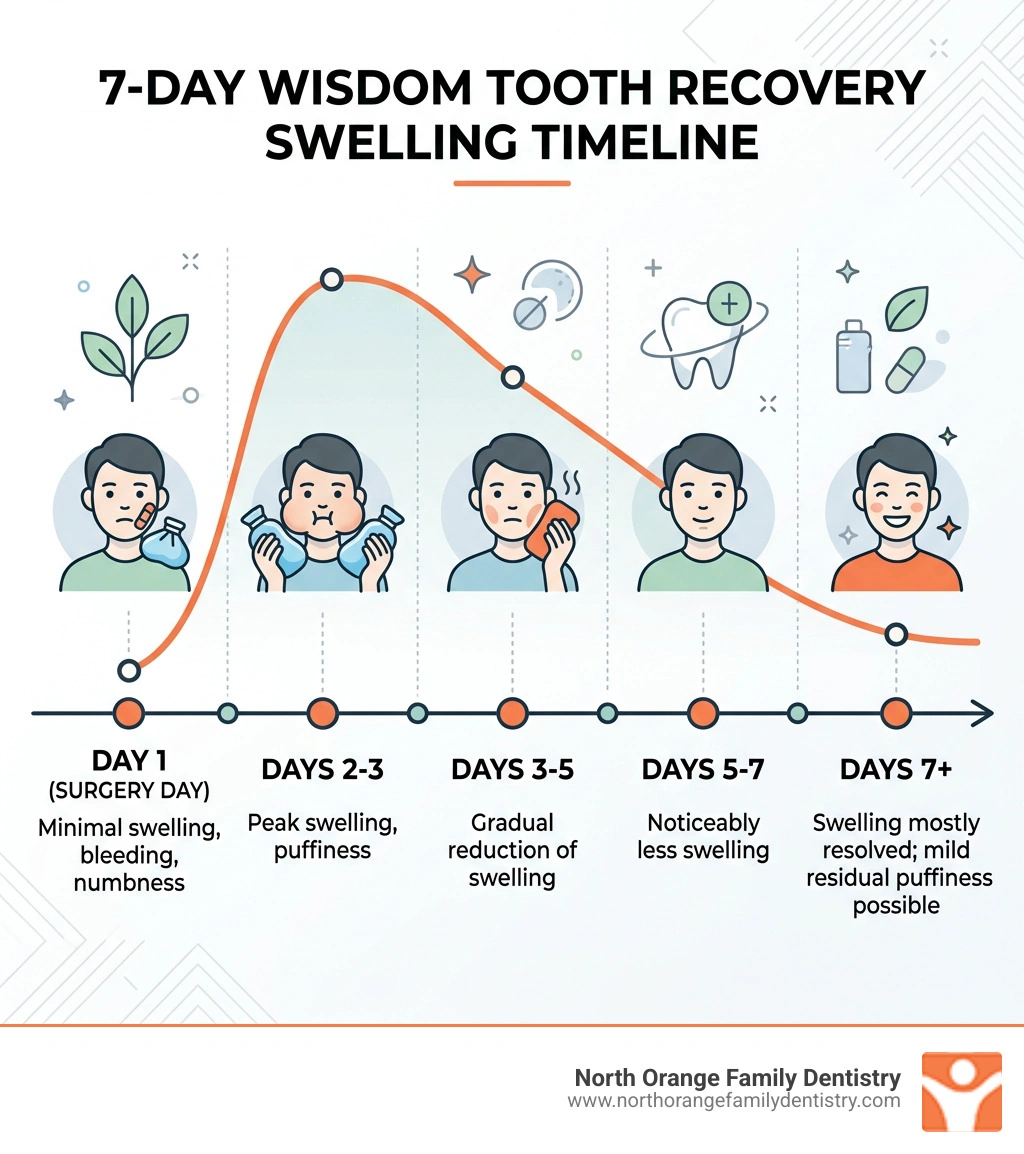
Swelling after wisdom extraction is completely normal and affects almost every patient. Here's a quick overview of what to expect:
- Day of surgery: Minimal swelling, some bleeding and numbness
- Days 1-3: Swelling increases and peaks around 48-72 hours
- Days 3-5: Swelling begins to gradually reduce
- Days 5-7: Noticeably less puffy for most patients
- Days 7-14: Swelling mostly resolved; mild residual puffiness possible
- 2-4 weeks: Full tissue healing complete
Getting a wisdom tooth removed is one of the most common dental procedures out there. But knowing it's common doesn't make the recovery any less uncomfortable, especially when you wake up on day two looking like a chipmunk.
The good news? That puffiness is your body doing exactly what it's supposed to do.
Swelling is a natural part of the healing process. When a tooth is removed, your body sends extra blood flow, white blood cells, and immune response to the area to start repairing the tissue. That rush of fluid is what causes the puffiness in your cheeks and jaw.
For most people, swelling peaks around 48 to 72 hours after surgery and then gradually improves. By the end of the first week, the majority of swelling is gone. More complex procedures, like removing impacted wisdom teeth, can mean a longer or more pronounced swelling period.
This guide walks you through everything you need to know — what's normal, how to manage it, what to avoid, and when to call your dentist.
Swelling after wisdom extraction terminology:
Understanding Swelling After Wisdom Extraction
When we talk about swelling after wisdom extraction, we are really talking about "edema." This is a fancy medical term for fluid trapped in your body's tissues. While it might feel like your face is expanding at an alarming rate, it is actually a highly coordinated biological defense mechanism.

Why the Face Becomes Puffy
The primary cause of facial puffiness is surgical trauma. Even with the most gentle hands—like those of our oral surgery expert Dr. Blaine Griffiths—the act of removing a tooth involves manipulating the gum tissue and sometimes the underlying bone.
According to scientific research on the body's inflammatory response to extraction, the body releases "inflammatory mediators" like prostaglandins. These chemicals cause your blood vessels to dilate (vasodilation) and become more permeable. This allows white blood cells and healing fluids to leak into the interstitial spaces between your cells.
If your wisdom teeth were "impacted"—meaning they were stuck under the bone or growing at an odd angle—we may have had to remove a small amount of bone to reach them. This extra step increases the level of trauma to the tissue, which naturally leads to a more significant inflammatory response. If you are experiencing emergency wisdom tooth pain before your surgery, the area may already be slightly inflamed, which can contribute to the post-operative puffiness.
Factors Affecting Swelling Severity
Not everyone swells the same way. You might have a friend who looked perfectly normal the next day, while you feel like you're hiding a golf ball in your cheek. Several factors influence this:
- Complexity of the Extraction: Simple extractions (where the tooth has fully erupted) cause much less swelling than surgical extractions of bony impactions.
- Number of Teeth Removed: Taking out all four wisdom teeth at once typically results in more overall swelling than removing just one.
- Patient Age: Younger patients (late teens to early 20s) often have more elastic tissues and may heal slightly differently than older adults.
- Individual Biology: Some people simply have a more robust inflammatory response than others.
The Normal Timeline for Post-Operative Recovery
Understanding the timeline helps take the "scare factor" out of recovery. Many patients worry when they wake up on the second or third day feeling more swollen than they did immediately after surgery. This is actually exactly what we expect to see.
| Stage | What to Expect |
|---|---|
| Day 1 | Minimal swelling; the focus is on controlling bleeding and protecting the blood clot. |
| Days 2-3 | Peak Inflammation. Swelling reaches its maximum. You may also see some bruising. |
| Days 4-5 | Swelling begins to subside. Jaw stiffness (trismus) may still be present. |
| Days 7-10 | Most external swelling is gone. Residual puffiness may linger deep in the tissue. |
| Days 14+ | Swelling is typically fully resolved. Gums continue to close over the socket. |
Scientific research on post-extraction swelling duration suggests that while the visible puffiness usually resolves within a week, it can take up to two weeks for all internal tissue changes to return to baseline.
Managing Swelling After Wisdom Extraction in the First 48 Hours
The first two days are your "golden window" for minimizing puffiness. The goal here is vasoconstriction—shrinking the blood vessels to limit the amount of fluid that leaks into your tissues.
- Cold Compression: Apply ice packs to the outside of your face for 20 minutes on, then 20 minutes off. Do this as much as possible during waking hours for the first 24 to 48 hours.
- Keep Your Head Elevated: Gravity is your friend! When resting or sleeping, use 2-3 pillows to keep your head above your heart. This prevents fluid from "pooling" in your facial tissues.
- Immediate Care: For more tips, check out our guide on how to get instant relief from wisdom tooth pain.
Long-Term Care for Swelling After Wisdom Extraction
After the first 48 hours, the "peak" has passed, and your strategy should shift from preventing swelling to draining it.
- Switch to Moist Heat: After the 48-hour mark, ice is no longer effective. Switch to warm, moist compresses. This improves circulation and promotes lymphatic drainage, helping your body "wash away" the accumulated fluid.
- Salt Water Rinses: Starting 24 hours after surgery, gently rinse with warm salt water (1/2 teaspoon of salt in a cup of water). This keeps the site clean and can soothe irritated tissues. If you're worried about infection, read more about dental abscess self-care.
Effective Techniques to Reduce Facial Puffiness
Beyond ice and heat, there are several clinical and home-based strategies we recommend to keep you comfortable.
Medication and Hydration
- NSAIDs: Non-steroidal anti-inflammatory drugs like ibuprofen are the gold standard for swelling after wisdom extraction. They work by inhibiting the enzymes that produce prostaglandins. We often recommend taking these on a schedule (as directed by our doctors) rather than waiting for pain to start.
- Hydration: Drink plenty of water. When you're dehydrated, your body may actually hold onto more fluid, which doesn't help your puffiness.
- Comfort First: We believe in pain-free dental care, so we will provide you with a specific medication plan tailored to your health history.
Dietary Choices That Support Healing
What you eat matters just as much as what you don't eat. Stick to a soft food diet for the first few days.
- Mashed Avocado & Hummus: Great sources of healthy fats and nutrients.
- Chamomile Tea: Known for mild anti-inflammatory properties (just make sure it's lukewarm, not hot!).
- Protein Smoothies: Excellent for nutrition, but never use a straw. The suction can dislodge the blood clot.
- Lukewarm Soups: Broths and blended vegetable soups are perfect.
For more detailed advice, see our resource on tooth pain relief.
The Role of Rest and Stress Management
Did you know that stress can actually slow down your healing? High levels of cortisol (the stress hormone) can increase systemic inflammation.
- Deep Breathing: Take slow, rhythmic breaths to keep your heart rate down.
- Avoid Exertion: This is your "get out of jail free" card for chores. Strenuous activity raises your blood pressure, which can lead to increased swelling, throbbing, and even secondary bleeding at the extraction site.
Activities and Habits to Avoid to Prevent Complications
To ensure a smooth recovery, there are a few things you absolutely must avoid. These are designed to protect the blood clot that forms in the socket—this clot is the "scaffolding" for new bone and tissue growth.
Smoking and Oral Hygiene Risks
If you smoke or vape, you need to stop for at least 72 hours (ideally a full week). Nicotine constricts blood vessels and reduces the oxygen levels in your blood, which significantly impairs healing. Furthermore, the "sucking" motion of smoking can cause a "dry socket" (alveolar osteitis), where the blood clot is pulled out, exposing the bone. This is incredibly painful and will definitely worsen your swelling after wisdom extraction.
- No Vigorous Rinsing: For the first 24 hours, don't spit or rinse forcefully.
- No Tongue Probing: We know it's tempting to "explore" the area with your tongue, but please leave it alone! You risk introducing bacteria or disturbing the stitches.
- Ohio Residents: If you suspect a complication, contact an emergency dentist in Ohio immediately.
Physical Activity Restrictions
We recommend no heavy lifting or intense exercise for at least 3 to 5 days. If you feel a "throbbing" sensation in your jaw when you move, that’s your body telling you to slow down. High blood pressure at the surgical site can cause the blood clot to pop out or cause fluid to rush back into the tissues, undoing all your hard work with the ice packs.
When to Contact Your Dentist or Oral Surgeon
While we expect you to be puffy and a bit sore, there are "red flags" that indicate you might be developing a complication like an infection or dry socket.
Identifying Post-Operative Infection
Infection usually doesn't show up until a few days or even two weeks after surgery. Watch for:
- Fever: A temperature higher than 101°F.
- Pus: Any yellow or green discharge from the socket.
- Worsening Symptoms: If your swelling was getting better but suddenly gets worse after Day 3 or 4.
- Spreading Redness: Redness that moves down your neck or toward your ear.
- Bad Taste/Odor: A persistent foul taste that doesn't go away with gentle rinsing.
For a full list of concerns, read about dental abscess symptoms.
Signs of a Dislodged Blood Clot (Dry Socket)
Dry socket is the most common complication after wisdom tooth removal. It usually happens between Day 3 and Day 5.
- Severe Pain: Pain that radiates toward your ear or eye and isn't relieved by medication.
- Visible Bone: If you look in the mirror and see a "dry" looking white or grey hole instead of a dark blood clot.
- Sudden Escalation: You were feeling okay, and suddenly the pain becomes unbearable.
Frequently Asked Questions about Wisdom Tooth Recovery
Is it normal for swelling to be worse on one side or extend to the neck?
Yes! It is very common for one side to be more swollen, especially if that tooth was more difficult to remove. Gravity also plays a role; if you sleep on your left side, you might find the left side of your face is puffier in the morning. Sometimes, swelling and even minor bruising can travel down into the neck or under the chin. This is normal and will resolve as the fluid is reabsorbed.
How long does it take for the extraction site to fully heal?
While the visible swelling after wisdom extraction is gone in a week or two, the "hole" in your gums can take 2 to 4 weeks to fully close. Beneath the surface, your jawbone is still working hard to fill in the socket with new bone—a process that actually takes several months to complete.
What should I do if I have an emergency after my procedure?
At North Orange Family Dentistry, we understand that emergencies don't always happen during convenient times. We offer same-day emergency dental appointments most of the time. If you are experiencing uncontrolled bleeding, difficulty breathing, or severe swelling that is closing your eye or making it hard to swallow, call us right away.
For those in the Delaware County area, we are your go-to emergency dentist in Lewis Center.
Conclusion
Recovering from wisdom tooth surgery takes a little patience and a lot of rest. While swelling after wisdom extraction can be a nuisance, following these steps will help you get back to your normal routine as quickly as possible.
At North Orange Family Dentistry, Dr. Kyle Bogan and our entire team are dedicated to providing a five-star dental experience for every member of your family. Whether you are 6 or 106, we use advanced technology—like laser treatments for faster healing—to ensure your comfort.
If you don't have dental insurance, don't let that stop you from getting the care you need. Our in-house Dental Wellness Plan is designed specifically for families and individuals without insurance, allowing you to get your necessary yearly care and discounts on procedures for a simple, affordable price.
Ready to experience a different kind of dental care? Schedule a consultation at North Orange Family Dentistry today. We look forward to seeing your (soon-to-be unswollen) smile!
What to Expect With Swelling After Wisdom Extraction
Swelling after wisdom extraction is completely normal and affects almost every patient. Here's a quick overview of what to expect:
- Day of surgery: Minimal swelling, some bleeding and numbness
- Days 1-3: Swelling increases and peaks around 48-72 hours
- Days 3-5: Swelling begins to gradually reduce
- Days 5-7: Noticeably less puffy for most patients
- Days 7-14: Swelling mostly resolved; mild residual puffiness possible
- 2-4 weeks: Full tissue healing complete
Getting a wisdom tooth removed is one of the most common dental procedures out there. But knowing it's common doesn't make the recovery any less uncomfortable, especially when you wake up on day two looking like a chipmunk.
The good news? That puffiness is your body doing exactly what it's supposed to do.
Swelling is a natural part of the healing process. When a tooth is removed, your body sends extra blood flow, white blood cells, and immune response to the area to start repairing the tissue. That rush of fluid is what causes the puffiness in your cheeks and jaw.
For most people, swelling peaks around 48 to 72 hours after surgery and then gradually improves. By the end of the first week, the majority of swelling is gone. More complex procedures, like removing impacted wisdom teeth, can mean a longer or more pronounced swelling period.
This guide walks you through everything you need to know — what's normal, how to manage it, what to avoid, and when to call your dentist.
Swelling after wisdom extraction terminology:
Understanding Swelling After Wisdom Extraction
When we talk about swelling after wisdom extraction, we are really talking about "edema." This is a fancy medical term for fluid trapped in your body's tissues. While it might feel like your face is expanding at an alarming rate, it is actually a highly coordinated biological defense mechanism.
Why the Face Becomes Puffy
The primary cause of facial puffiness is surgical trauma. Even with the most gentle hands—like those of our oral surgery expert Dr. Blaine Griffiths—the act of removing a tooth involves manipulating the gum tissue and sometimes the underlying bone.
According to scientific research on the body's inflammatory response to extraction, the body releases "inflammatory mediators" like prostaglandins. These chemicals cause your blood vessels to dilate (vasodilation) and become more permeable. This allows white blood cells and healing fluids to leak into the interstitial spaces between your cells.
If your wisdom teeth were "impacted"—meaning they were stuck under the bone or growing at an odd angle—we may have had to remove a small amount of bone to reach them. This extra step increases the level of trauma to the tissue, which naturally leads to a more significant inflammatory response. If you are experiencing emergency wisdom tooth pain before your surgery, the area may already be slightly inflamed, which can contribute to the post-operative puffiness.
Factors Affecting Swelling Severity
Not everyone swells the same way. You might have a friend who looked perfectly normal the next day, while you feel like you're hiding a golf ball in your cheek. Several factors influence this:
- Complexity of the Extraction: Simple extractions (where the tooth has fully erupted) cause much less swelling than surgical extractions of bony impactions.
- Number of Teeth Removed: Taking out all four wisdom teeth at once typically results in more overall swelling than removing just one.
- Patient Age: Younger patients (late teens to early 20s) often have more elastic tissues and may heal slightly differently than older adults.
- Individual Biology: Some people simply have a more robust inflammatory response than others.
The Normal Timeline for Post-Operative Recovery
Understanding the timeline helps take the "scare factor" out of recovery. Many patients worry when they wake up on the second or third day feeling more swollen than they did immediately after surgery. This is actually exactly what we expect to see.
| Stage | What to Expect |
|---|---|
| Day 1 | Minimal swelling; the focus is on controlling bleeding and protecting the blood clot. |
| Days 2-3 | Peak Inflammation. Swelling reaches its maximum. You may also see some bruising. |
| Days 4-5 | Swelling begins to subside. Jaw stiffness (trismus) may still be present. |
| Days 7-10 | Most external swelling is gone. Residual puffiness may linger deep in the tissue. |
| Days 14+ | Swelling is typically fully resolved. Gums continue to close over the socket. |
Scientific research on post-extraction swelling duration suggests that while the visible puffiness usually resolves within a week, it can take up to two weeks for all internal tissue changes to return to baseline.
Managing Swelling After Wisdom Extraction in the First 48 Hours
The first two days are your "golden window" for minimizing puffiness. The goal here is vasoconstriction—shrinking the blood vessels to limit the amount of fluid that leaks into your tissues.
- Cold Compression: Apply ice packs to the outside of your face for 20 minutes on, then 20 minutes off. Do this as much as possible during waking hours for the first 24 to 48 hours.
- Keep Your Head Elevated: Gravity is your friend! When resting or sleeping, use 2-3 pillows to keep your head above your heart. This prevents fluid from "pooling" in your facial tissues.
- Immediate Care: For more tips, check out our guide on how to get instant relief from wisdom tooth pain.
Long-Term Care for Swelling After Wisdom Extraction
After the first 48 hours, the "peak" has passed, and your strategy should shift from preventing swelling to draining it.
- Switch to Moist Heat: After the 48-hour mark, ice is no longer effective. Switch to warm, moist compresses. This improves circulation and promotes lymphatic drainage, helping your body "wash away" the accumulated fluid.
- Salt Water Rinses: Starting 24 hours after surgery, gently rinse with warm salt water (1/2 teaspoon of salt in a cup of water). This keeps the site clean and can soothe irritated tissues. If you're worried about infection, read more about dental abscess self-care.
Effective Techniques to Reduce Facial Puffiness
Beyond ice and heat, there are several clinical and home-based strategies we recommend to keep you comfortable.
Medication and Hydration
- NSAIDs: Non-steroidal anti-inflammatory drugs like ibuprofen are the gold standard for swelling after wisdom extraction. They work by inhibiting the enzymes that produce prostaglandins. We often recommend taking these on a schedule (as directed by our doctors) rather than waiting for pain to start.
- Hydration: Drink plenty of water. When you're dehydrated, your body may actually hold onto more fluid, which doesn't help your puffiness.
- Comfort First: We believe in pain-free dental care, so we will provide you with a specific medication plan tailored to your health history.
Dietary Choices That Support Healing
What you eat matters just as much as what you don't eat. Stick to a soft food diet for the first few days.
- Mashed Avocado & Hummus: Great sources of healthy fats and nutrients.
- Chamomile Tea: Known for mild anti-inflammatory properties (just make sure it's lukewarm, not hot!).
- Protein Smoothies: Excellent for nutrition, but never use a straw. The suction can dislodge the blood clot.
- Lukewarm Soups: Broths and blended vegetable soups are perfect.
For more detailed advice, see our resource on tooth pain relief.
The Role of Rest and Stress Management
Did you know that stress can actually slow down your healing? High levels of cortisol (the stress hormone) can increase systemic inflammation.
- Deep Breathing: Take slow, rhythmic breaths to keep your heart rate down.
- Avoid Exertion: This is your "get out of jail free" card for chores. Strenuous activity raises your blood pressure, which can lead to increased swelling, throbbing, and even secondary bleeding at the extraction site.
Activities and Habits to Avoid to Prevent Complications
To ensure a smooth recovery, there are a few things you absolutely must avoid. These are designed to protect the blood clot that forms in the socket—this clot is the "scaffolding" for new bone and tissue growth.
Smoking and Oral Hygiene Risks
If you smoke or vape, you need to stop for at least 72 hours (ideally a full week). Nicotine constricts blood vessels and reduces the oxygen levels in your blood, which significantly impairs healing. Furthermore, the "sucking" motion of smoking can cause a "dry socket" (alveolar osteitis), where the blood clot is pulled out, exposing the bone. This is incredibly painful and will definitely worsen your swelling after wisdom extraction.
- No Vigorous Rinsing: For the first 24 hours, don't spit or rinse forcefully.
- No Tongue Probing: We know it's tempting to "explore" the area with your tongue, but please leave it alone! You risk introducing bacteria or disturbing the stitches.
- Ohio Residents: If you suspect a complication, contact an emergency dentist in Ohio immediately.
Physical Activity Restrictions
We recommend no heavy lifting or intense exercise for at least 3 to 5 days. If you feel a "throbbing" sensation in your jaw when you move, that’s your body telling you to slow down. High blood pressure at the surgical site can cause the blood clot to pop out or cause fluid to rush back into the tissues, undoing all your hard work with the ice packs.
When to Contact Your Dentist or Oral Surgeon
While we expect you to be puffy and a bit sore, there are "red flags" that indicate you might be developing a complication like an infection or dry socket.
Identifying Post-Operative Infection
Infection usually doesn't show up until a few days or even two weeks after surgery. Watch for:
- Fever: A temperature higher than 101°F.
- Pus: Any yellow or green discharge from the socket.
- Worsening Symptoms: If your swelling was getting better but suddenly gets worse after Day 3 or 4.
- Spreading Redness: Redness that moves down your neck or toward your ear.
- Bad Taste/Odor: A persistent foul taste that doesn't go away with gentle rinsing.
For a full list of concerns, read about dental abscess symptoms.
Signs of a Dislodged Blood Clot (Dry Socket)
Dry socket is the most common complication after wisdom tooth removal. It usually happens between Day 3 and Day 5.
- Severe Pain: Pain that radiates toward your ear or eye and isn't relieved by medication.
- Visible Bone: If you look in the mirror and see a "dry" looking white or grey hole instead of a dark blood clot.
- Sudden Escalation: You were feeling okay, and suddenly the pain becomes unbearable.
Frequently Asked Questions about Wisdom Tooth Recovery
Is it normal for swelling to be worse on one side or extend to the neck?
Yes! It is very common for one side to be more swollen, especially if that tooth was more difficult to remove. Gravity also plays a role; if you sleep on your left side, you might find the left side of your face is puffier in the morning. Sometimes, swelling and even minor bruising can travel down into the neck or under the chin. This is normal and will resolve as the fluid is reabsorbed.
How long does it take for the extraction site to fully heal?
While the visible swelling after wisdom extraction is gone in a week or two, the "hole" in your gums can take 2 to 4 weeks to fully close. Beneath the surface, your jawbone is still working hard to fill in the socket with new bone—a process that actually takes several months to complete.
What should I do if I have an emergency after my procedure?
At North Orange Family Dentistry, we understand that emergencies don't always happen during convenient times. We offer same-day emergency dental appointments most of the time. If you are experiencing uncontrolled bleeding, difficulty breathing, or severe swelling that is closing your eye or making it hard to swallow, call us right away.
For those in the Delaware County area, we are your go-to emergency dentist in Lewis Center.
Conclusion
Recovering from wisdom tooth surgery takes a little patience and a lot of rest. While swelling after wisdom extraction can be a nuisance, following these steps will help you get back to your normal routine as quickly as possible.
At North Orange Family Dentistry, Dr. Kyle Bogan and our entire team are dedicated to providing a five-star dental experience for every member of your family. Whether you are 6 or 106, we use advanced technology—like laser treatments for faster healing—to ensure your comfort.
If you don't have dental insurance, don't let that stop you from getting the care you need. Our in-house Dental Wellness Plan is designed specifically for families and individuals without insurance, allowing you to get your necessary yearly care and discounts on procedures for a simple, affordable price.
Ready to experience a different kind of dental care? Schedule a consultation at North Orange Family Dentistry today. We look forward to seeing your (soon-to-be unswollen) smile!
Contact Us
Have any questions? Want to learn more?

