
New Teeth Implants and Why Your Mouth Will Thank You
Discover new teeth implants: benefits, process, recovery & costs at North Orange Family Dentistry. Restore your smile today!


Why New Teeth Implants Could Be the Best Decision You Make for Your Smile
New teeth implants are titanium posts surgically placed into your jawbone to replace missing tooth roots — giving you a stable, natural-looking tooth that can last 20 years or more.
Here's a quick overview of what you need to know:
TopicQuick AnswerWhat they areTitanium posts fused to the jawbone, topped with a custom crownWho they're forMost adults with good health and adequate jawbone densityHow long they last20+ years with proper careSuccess rateOver 95%Healing time3 to 9 months for full osseointegrationOne-day optionPossible in some cases, depending on bone health
Losing a tooth isn't just a cosmetic problem. It's a health problem.
When a tooth goes missing, the jawbone underneath it starts to shrink. Surrounding teeth can shift. Your bite changes. Over time, your face shape can even be affected. For busy parents in the Lewis Center and Delaware area, dealing with all of that on top of daily life is the last thing you need.
That's where new teeth implants come in. They're not just a replacement — they're the closest thing to growing a real tooth back. Unlike dentures or bridges, implants sit right in the bone. They stimulate it. They protect it. And they feel and function like the real thing.
The development of dental implants is widely recognized as one of the biggest advances in dentistry over the last 40 years — and the results speak for themselves.
I'm Dr. Kyle Bogan, a Fellow in both the International College of Dentists and the Academy of General Dentistry, and I've helped many patients in the Marion and Central Ohio area reclaim their smiles with new teeth implants. In this guide, I'll walk you through everything you need to know — from how implants work to what recovery actually looks like — so you can decide with confidence.
Simple New teeth implants word guide:
Understanding New Teeth Implants and How They Work
To understand why new teeth implants are so revolutionary, we have to look beneath the gum line. A natural tooth isn't just the white part you see when you smile; it has a root buried deep in the jawbone. When that root is gone, the bone loses its purpose and begins to resorb or "melt away."
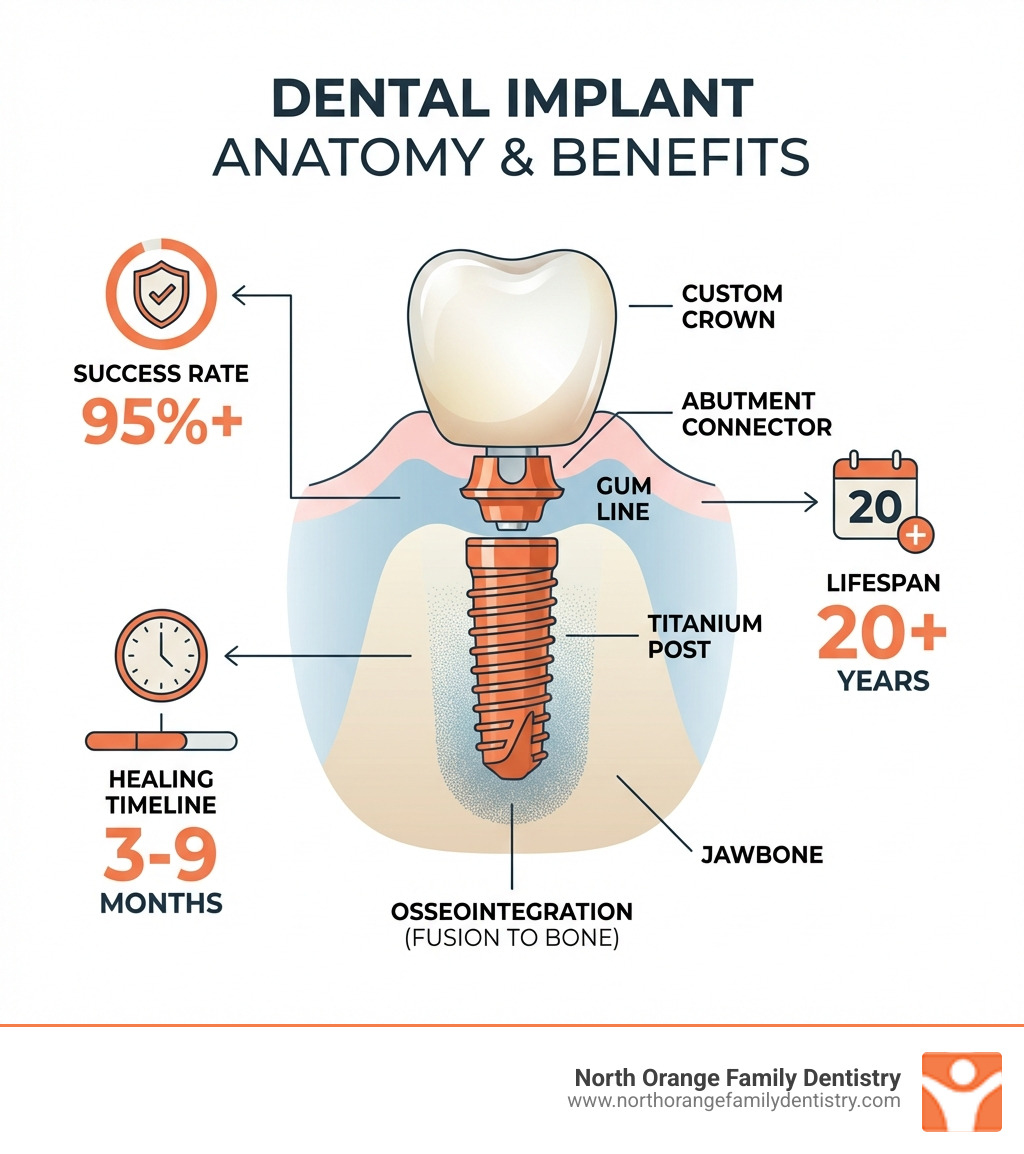
A dental implant is essentially an artificial root. We use small posts made of titanium—a material chosen for its incredible biocompatibility. This means your body doesn't see it as a foreign object; instead, it welcomes it. According to scientific research on dental implant surgery, the magic happens through a process called osseointegration.
Osseointegration comes from the Greek osteon (bone) and the Latin integrare (to make whole). Over several months, your jawbone actually grows into and fuses with the surface of the titanium post. This creates a bond so strong that the implant becomes a permanent part of your anatomy. Once this fusion is complete, the implant provides a rock-solid foundation for a custom-made crown, bridge, or denture. You can find more info about dental implants and how they anchor your smile on our resource page.
The Benefits of Choosing New Teeth Implants Over Dentures
If you’ve ever used traditional dentures, you know the "slip and slide" struggle. Even the best-fitting dentures can wobble when you're enjoying a steak or laughing at a joke. New teeth implants change the game entirely.
- Bite Force: Traditional dentures only provide a fraction of your original biting power. Because implants are anchored in the bone, they restore nearly 100% of your natural bite force. You can go back to eating apples, nuts, and corn on the cob without a second thought.
- Jawbone Stimulation: This is the biggest health benefit. Dentures don't stop bone loss; in fact, the pressure they put on the gums can sometimes accelerate it. Implants act like natural roots, "telling" the bone to stay strong and dense.
- Facial Structure: When you lose bone in your jaw, the lower third of your face can begin to collapse, leading to premature wrinkles and a "sunken" look. Implants preserve your natural facial contours.
- Stability and Confidence: There is no need for messy adhesives. Implants don't move. They don't click. They just stay put.
For a deeper dive into these differences, check out our guide to dental implants or read more info about dentures vs implants to see which path is right for your lifestyle.
Who is a Candidate for New Teeth Implants?
We often tell our patients in Lewis Center that age is rarely a barrier to getting new teeth implants—but health is. To be a good candidate, you generally need:
- Adequate Jawbone Density: There needs to be enough "soil" (bone) to hold the "anchor" (implant). If you've been missing a tooth for a long time, you might have some bone loss, but don't worry—we can often perform a bone graft to rebuild that foundation.
- Healthy Gums: Periodontal disease can threaten the stability of an implant, so we ensure your gums are in top shape before we begin.
- Good Overall Health: Chronic conditions like uncontrolled diabetes or leukemia can slow down the healing process. According to scientific research on dental implant safety, disclose your full medical history to your dental team.
- Non-Smoking Status (Ideally): Smoking constricts blood flow to the gums, which can significantly interfere with osseointegration and increase the risk of implant failure. If you do smoke, we'll discuss a plan to help you pause during the critical healing phases.
The Journey to a Restored Smile: Process and Recovery
Getting new teeth implants isn't a single "zap and you're done" event. It’s a journey that requires patience, but the destination—a lifetime of confident smiles—is well worth it.
Our process at North Orange Family Dentistry starts with a comprehensive consultation. We don't just look at the gap in your teeth; we look at your whole mouth using advanced 3D digital imaging (CBCT scans). This allows us to see your bone structure, nerve paths, and sinus cavities in high definition, ensuring we place the implant with mathematical precision. You can learn more info about affordable dental implants and our planning process on our website.
We know the word "surgery" can be intimidating. That’s why we prioritize your comfort. Most patients find that local anesthesia is more than enough to make the procedure painless, but we also offer sedation options for those who feel a bit more anxious.
The Step-by-Step Surgical Procedure
While every patient is unique, the typical roadmap for new teeth implants looks like this:
- Preparation: If a damaged tooth is still present, we gently extract it. If your jawbone is too thin, we may perform a bone graft at this stage.
- Implant Placement: Dr. Bogan makes a small incision in the gum to reach the bone. A precise space is created, and the titanium post is inserted. We then close the gum tissue over the implant to protect it while it heals.
- Osseointegration: This is the "waiting game" where your bone fuses to the implant.
- Abutment Attachment: Once the implant is secure, we attach a small connector piece called an abutment. This sits just above the gum line and acts as the "peg" for your new tooth.
- The Custom Crown: Finally, we place your beautiful, custom-designed ceramic crown. This is the part that looks and feels like a real tooth. You can find more info about dental implant crowns and how we match them to your natural smile in our resource library.
Healing and Osseointegration Timelines
Healing is a two-part process: the surface healing of your gums and the deep fusion of the bone.
Most patients are back to their normal routine within a day or two of the initial surgery, managing any minor discomfort with over-the-counter relievers. However, the osseointegration phase typically takes 3 to 9 months. During this time, we may provide a temporary restoration so you never have to go without a tooth in visible areas. We'll ask you to stick to a soft food diet for the first few weeks to ensure the implant isn't disturbed while it's trying to "take root."
Long-Term Care and Maintenance
One of the best things about new teeth implants is that they can't get cavities! However, the gums around them can still get infected if neglected (a condition called peri-implantitis). To make your investment last 20+ years, you should:
- Brush and Floss Daily: Treat your implant just like a natural tooth.
- Use Interdental Brushes: These tiny brushes help clean the nooks and crannies around the abutment.
- Attend Professional Cleanings: We have specialized tools to clean around implants without scratching the titanium.
- Avoid Hard Habits: Don't use your teeth as tools to open packages, and try to avoid chewing on ice or hard candy.
Investing in Your Smile at North Orange Family Dentistry
At North Orange Family Dentistry, we believe everyone in Lewis Center and Delaware, Ohio, deserves a smile they are proud to show off. Dr. Kyle Bogan and our team are dedicated to providing a five-star experience using the most advanced technology available.
We specialize in endosteal implants, which are the most common and successful type of new teeth implants used today. While costs can vary based on individual needs (such as whether bone grafting is required), the average cost for a single tooth implant, including the post and the crown, is approximately $4,500.
We understand that dental health is a significant investment. For our neighbors who do not have dental insurance, we offer the North Orange Dental Wellness Plan. This isn't a complex financing scheme or a high-interest credit card; it’s a simple membership for individuals or families that allows you to get your yearly preventative care and significant discounts on treatments like implants for a clear, discounted price. It’s our way of making high-quality dentistry accessible to our community.
Whether you're dealing with a recent tooth loss or you're tired of the limitations of a bridge, we are here to help. We even handle emergency dental situations—often seeing patients on the same day—because we know that tooth pain doesn't follow a schedule.
Ready to see if new teeth implants are the right choice for you? Schedule a consultation with us today in Lewis Center. Your mouth—and your confidence—will thank you!
Why New Teeth Implants Could Be the Best Decision You Make for Your Smile
New teeth implants are titanium posts surgically placed into your jawbone to replace missing tooth roots — giving you a stable, natural-looking tooth that can last 20 years or more.
Here's a quick overview of what you need to know:
TopicQuick AnswerWhat they areTitanium posts fused to the jawbone, topped with a custom crownWho they're forMost adults with good health and adequate jawbone densityHow long they last20+ years with proper careSuccess rateOver 95%Healing time3 to 9 months for full osseointegrationOne-day optionPossible in some cases, depending on bone health
Losing a tooth isn't just a cosmetic problem. It's a health problem.
When a tooth goes missing, the jawbone underneath it starts to shrink. Surrounding teeth can shift. Your bite changes. Over time, your face shape can even be affected. For busy parents in the Lewis Center and Delaware area, dealing with all of that on top of daily life is the last thing you need.
That's where new teeth implants come in. They're not just a replacement — they're the closest thing to growing a real tooth back. Unlike dentures or bridges, implants sit right in the bone. They stimulate it. They protect it. And they feel and function like the real thing.
The development of dental implants is widely recognized as one of the biggest advances in dentistry over the last 40 years — and the results speak for themselves.
I'm Dr. Kyle Bogan, a Fellow in both the International College of Dentists and the Academy of General Dentistry, and I've helped many patients in the Marion and Central Ohio area reclaim their smiles with new teeth implants. In this guide, I'll walk you through everything you need to know — from how implants work to what recovery actually looks like — so you can decide with confidence.
Simple New teeth implants word guide:
Understanding New Teeth Implants and How They Work
To understand why new teeth implants are so revolutionary, we have to look beneath the gum line. A natural tooth isn't just the white part you see when you smile; it has a root buried deep in the jawbone. When that root is gone, the bone loses its purpose and begins to resorb or "melt away."
A dental implant is essentially an artificial root. We use small posts made of titanium—a material chosen for its incredible biocompatibility. This means your body doesn't see it as a foreign object; instead, it welcomes it. According to scientific research on dental implant surgery, the magic happens through a process called osseointegration.
Osseointegration comes from the Greek osteon (bone) and the Latin integrare (to make whole). Over several months, your jawbone actually grows into and fuses with the surface of the titanium post. This creates a bond so strong that the implant becomes a permanent part of your anatomy. Once this fusion is complete, the implant provides a rock-solid foundation for a custom-made crown, bridge, or denture. You can find more info about dental implants and how they anchor your smile on our resource page.
The Benefits of Choosing New Teeth Implants Over Dentures
If you’ve ever used traditional dentures, you know the "slip and slide" struggle. Even the best-fitting dentures can wobble when you're enjoying a steak or laughing at a joke. New teeth implants change the game entirely.
- Bite Force: Traditional dentures only provide a fraction of your original biting power. Because implants are anchored in the bone, they restore nearly 100% of your natural bite force. You can go back to eating apples, nuts, and corn on the cob without a second thought.
- Jawbone Stimulation: This is the biggest health benefit. Dentures don't stop bone loss; in fact, the pressure they put on the gums can sometimes accelerate it. Implants act like natural roots, "telling" the bone to stay strong and dense.
- Facial Structure: When you lose bone in your jaw, the lower third of your face can begin to collapse, leading to premature wrinkles and a "sunken" look. Implants preserve your natural facial contours.
- Stability and Confidence: There is no need for messy adhesives. Implants don't move. They don't click. They just stay put.
For a deeper dive into these differences, check out our guide to dental implants or read more info about dentures vs implants to see which path is right for your lifestyle.
Who is a Candidate for New Teeth Implants?
We often tell our patients in Lewis Center that age is rarely a barrier to getting new teeth implants—but health is. To be a good candidate, you generally need:
- Adequate Jawbone Density: There needs to be enough "soil" (bone) to hold the "anchor" (implant). If you've been missing a tooth for a long time, you might have some bone loss, but don't worry—we can often perform a bone graft to rebuild that foundation.
- Healthy Gums: Periodontal disease can threaten the stability of an implant, so we ensure your gums are in top shape before we begin.
- Good Overall Health: Chronic conditions like uncontrolled diabetes or leukemia can slow down the healing process. According to scientific research on dental implant safety, disclose your full medical history to your dental team.
- Non-Smoking Status (Ideally): Smoking constricts blood flow to the gums, which can significantly interfere with osseointegration and increase the risk of implant failure. If you do smoke, we'll discuss a plan to help you pause during the critical healing phases.
The Journey to a Restored Smile: Process and Recovery
Getting new teeth implants isn't a single "zap and you're done" event. It’s a journey that requires patience, but the destination—a lifetime of confident smiles—is well worth it.
Our process at North Orange Family Dentistry starts with a comprehensive consultation. We don't just look at the gap in your teeth; we look at your whole mouth using advanced 3D digital imaging (CBCT scans). This allows us to see your bone structure, nerve paths, and sinus cavities in high definition, ensuring we place the implant with mathematical precision. You can learn more info about affordable dental implants and our planning process on our website.
We know the word "surgery" can be intimidating. That’s why we prioritize your comfort. Most patients find that local anesthesia is more than enough to make the procedure painless, but we also offer sedation options for those who feel a bit more anxious.
The Step-by-Step Surgical Procedure
While every patient is unique, the typical roadmap for new teeth implants looks like this:
- Preparation: If a damaged tooth is still present, we gently extract it. If your jawbone is too thin, we may perform a bone graft at this stage.
- Implant Placement: Dr. Bogan makes a small incision in the gum to reach the bone. A precise space is created, and the titanium post is inserted. We then close the gum tissue over the implant to protect it while it heals.
- Osseointegration: This is the "waiting game" where your bone fuses to the implant.
- Abutment Attachment: Once the implant is secure, we attach a small connector piece called an abutment. This sits just above the gum line and acts as the "peg" for your new tooth.
- The Custom Crown: Finally, we place your beautiful, custom-designed ceramic crown. This is the part that looks and feels like a real tooth. You can find more info about dental implant crowns and how we match them to your natural smile in our resource library.
Healing and Osseointegration Timelines
Healing is a two-part process: the surface healing of your gums and the deep fusion of the bone.
Most patients are back to their normal routine within a day or two of the initial surgery, managing any minor discomfort with over-the-counter relievers. However, the osseointegration phase typically takes 3 to 9 months. During this time, we may provide a temporary restoration so you never have to go without a tooth in visible areas. We'll ask you to stick to a soft food diet for the first few weeks to ensure the implant isn't disturbed while it's trying to "take root."
Long-Term Care and Maintenance
One of the best things about new teeth implants is that they can't get cavities! However, the gums around them can still get infected if neglected (a condition called peri-implantitis). To make your investment last 20+ years, you should:
- Brush and Floss Daily: Treat your implant just like a natural tooth.
- Use Interdental Brushes: These tiny brushes help clean the nooks and crannies around the abutment.
- Attend Professional Cleanings: We have specialized tools to clean around implants without scratching the titanium.
- Avoid Hard Habits: Don't use your teeth as tools to open packages, and try to avoid chewing on ice or hard candy.
Investing in Your Smile at North Orange Family Dentistry
At North Orange Family Dentistry, we believe everyone in Lewis Center and Delaware, Ohio, deserves a smile they are proud to show off. Dr. Kyle Bogan and our team are dedicated to providing a five-star experience using the most advanced technology available.
We specialize in endosteal implants, which are the most common and successful type of new teeth implants used today. While costs can vary based on individual needs (such as whether bone grafting is required), the average cost for a single tooth implant, including the post and the crown, is approximately $4,500.
We understand that dental health is a significant investment. For our neighbors who do not have dental insurance, we offer the North Orange Dental Wellness Plan. This isn't a complex financing scheme or a high-interest credit card; it’s a simple membership for individuals or families that allows you to get your yearly preventative care and significant discounts on treatments like implants for a clear, discounted price. It’s our way of making high-quality dentistry accessible to our community.
Whether you're dealing with a recent tooth loss or you're tired of the limitations of a bridge, we are here to help. We even handle emergency dental situations—often seeing patients on the same day—because we know that tooth pain doesn't follow a schedule.
Ready to see if new teeth implants are the right choice for you? Schedule a consultation with us today in Lewis Center. Your mouth—and your confidence—will thank you!
Contact Us
Have any questions? Want to learn more?

