
Reliable Free Dental Care Programs for Families and Seniors
Discover reliable free dental care programs for families and seniors, from community clinics to charity events. Get the care you need today.


Where to Find Free Dental Care for Your Family
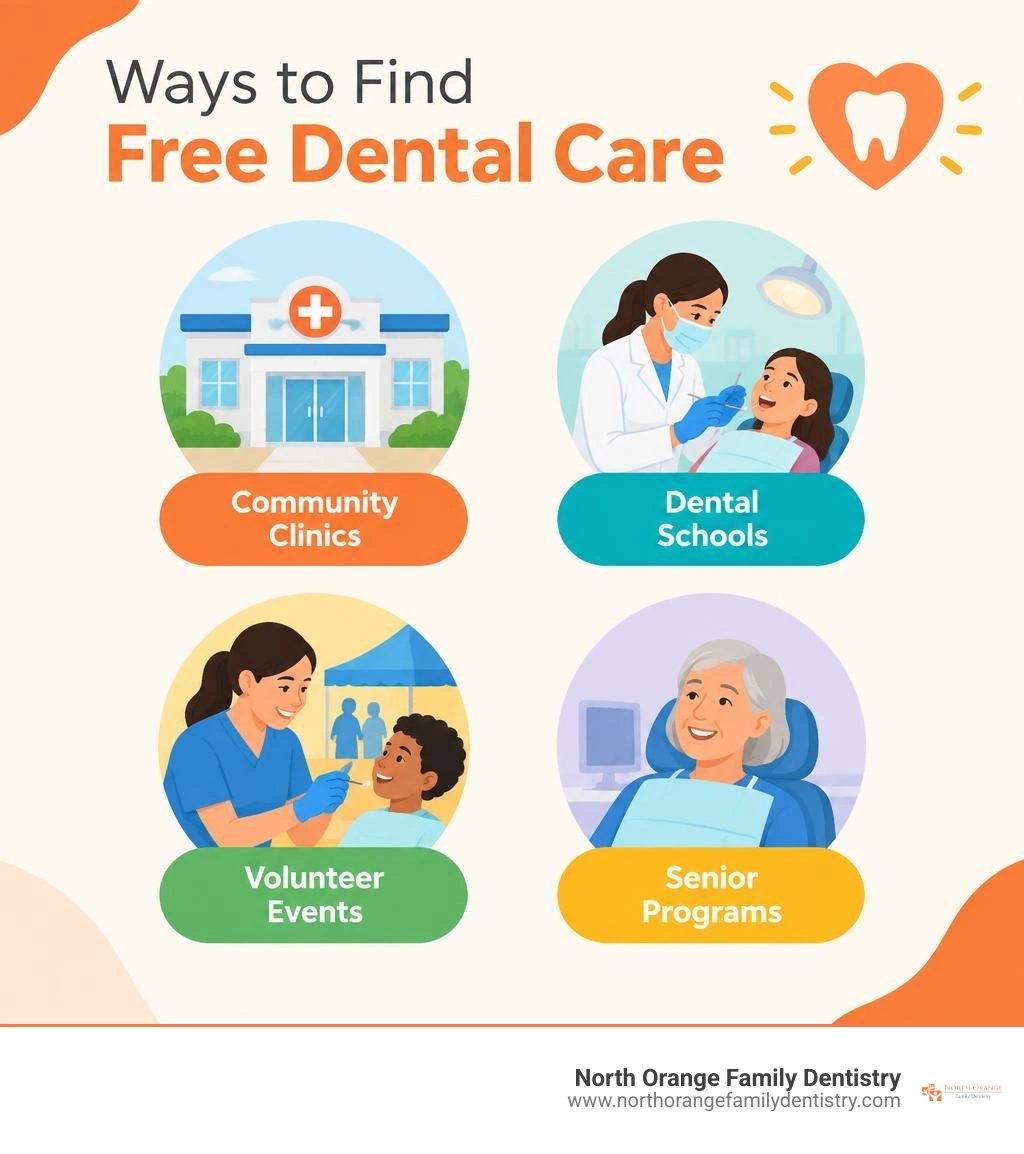
Start with a nearby community health center, dental school clinic, or volunteer dental event. Call before you go: some offer free dental care, while others charge reduced fees. Ask what services are available, who qualifies, and whether you need an appointment. Seniors who cannot afford treatment can also check eligibility for the Donated Dental Services program.
Free care can have long waits or cover only basic needs. If your family is uninsured and needs regular visits, North Orange Family Dentistry's Dental Wellness Plan offers discounted yearly care. It is not a free-care program.
Free dental care definitions:
For many families, the search for free dental care begins with a sudden toothache, a child's swollen gum, or a senior's broken denture. The good news is that safety-net programs exist in nearly every state, from sliding-scale community clinics to dental school training facilities and large volunteer events. The challenge is knowing where to look, what to bring, and how to prepare for long waits or limited service menus. This guide walks through the most reliable pathways to affordable oral health assistance, including eligibility requirements, common services, and practical strategies for navigating waitlists. While free programs can resolve urgent pain, they rarely replace the consistency of a dental home—a reality worth considering if your family needs ongoing preventive care.
Major Types of Free Dental Care Clinics and Programs
When oral health needs arise, understanding what happens if you cannot afford dental care can be alarming. Untreated tooth decay and gum infections do not simply disappear; they often progress into severe systemic issues, severe pain, or emergency room visits. Fortunately, several safety-net models provide essential relief across local communities.

Federally Qualified Health Centers and Dental School Clinics
Federally Qualified Health Centers (FQHCs) receive federal grant funding to provide comprehensive healthcare services in underserved regions. Under federal guidelines, these centers must offer sliding fee discount programs based on family size and household income, frequently providing care at nominal or zero cost to those at or below poverty guidelines. FQHCs routinely accept Medicaid and serve patients regardless of their insurance status.
Dental school clinics and dental hygiene programs provide another reliable path. At university clinics, licensed faculty dentists closely supervise student clinicians. Because these appointments serve as educational environments, treatments take a bit longer but are offered at substantial discounts compared to private practice fees, with some procedures fully subsidized for qualifying community members.
Specialized Community Programs for Immigrants and Underserved Groups
Nonprofit mission clinics and charitable health networks often provide direct aid to specific vulnerable populations. Programs like dedicated free immigrant dental care initiatives prioritize access for newcomer families who face language or systemic barriers. These clinics typically operate with licensed volunteer clinicians who provide confidential treatment without requiring complex paperwork or insurance verification. Similar dedicated charity clinics partner with community missions to support unhoused individuals and low-income families seeking emergency relief.
Beyond these core models, many county health departments maintain referral lists of local volunteer dentists, faith-based clinics, and seasonal mobile dental units. Some programs focus exclusively on children, while others serve adults with disabilities or chronic medical conditions. Calling 211 or your state dental association can help you identify which safety-net option best matches your household's circumstances.
National Programs and Large-Scale Charity Events
When local clinics have full rosters, national charity networks and massive pop-up dental clinics step in to provide relief for thousands of patients every year.
Donated Dental Services and Volunteer Dentist Networks
For older adults, medically compromised patients, and people living with permanent disabilities, the Dental Lifeline Network coordinates the Donated Dental Services (DDS) program. DDS operates a nationwide network of volunteer dentists and dental laboratories.
Through this initiative, private dentists volunteer their time, clinical skills, and materials to treat eligible patients directly in their private offices at no charge. The program focuses on comprehensive, medically necessary treatment—such as resolving severe oral infections before chemotherapy or cardiac surgery—to restore patients to pain-free, functional oral health.
Large-Scale Pop-Up Clinics and Charity Days
Charitable dental events transform civic arenas, gymnasiums, and fairgrounds into multi-chair mobile dental facilities. Annual initiatives like Mission of Mercy events, regional Give Kids a Smile days, and programs like Costa Cares Day mobilize hundreds of dental professionals to treat acute oral needs.
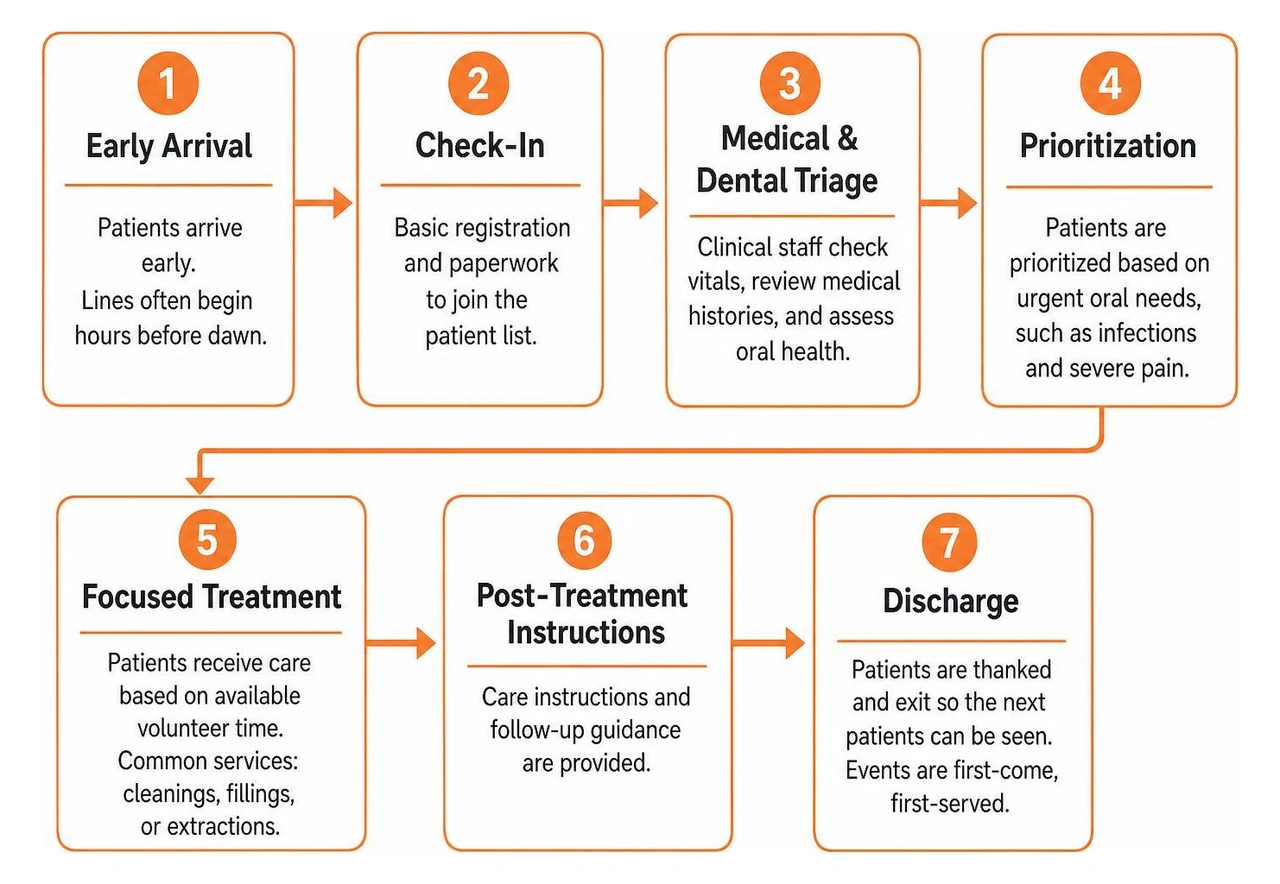
These events operate primarily on a first-come, first-served basis:
- Early Arrival: Lines frequently begin forming hours before dawn.
- Medical & Dental Triage: Clinical staff evaluate vitals, review medical histories, and prioritize urgent oral infections.
- Focused Treatment: Patients typically receive cleanings, fillings, or extractions on the day of the event.
Volunteer networks and pop-up clinics fill a critical gap, but they are not designed for longitudinal care. Patients who receive an extraction at a Mission of Mercy event, for example, may still need follow-up restorative work that the event cannot provide. Understanding this limitation helps families plan for both immediate relief and longer-term oral health stability.
Common Services, Eligibility, and Practical Access
Navigating charitable dental networks requires an understanding of what treatments are available and what paperwork is necessary. Patients looking for cheap dentist options without insurance will find that charity clinics usually prioritize emergency pain relief, basic restorative fillings, preventive cleanings, and simple extractions over cosmetic transformations.
Qualifying for Free Dental Care: Eligibility and Documents
Eligibility guidelines vary by organization, but gathering the appropriate documentation in advance ensures a smooth intake process:
- Proof of Income: Recent pay stubs, W-2 forms, unemployment statements, or tax returns.
- Proof of Residency: A utility bill, lease agreement, or driver's license confirming local residency.
- Government Assistance Documentation: Medicaid enrollment cards, Supplemental Security Income (SSI) award letters, or food assistance verification.
- Veteran Identification: Specific non-profit dental programs work alongside dental options for military veterans to fill gaps for those who do not qualify for comprehensive VA dental benefits.
How to Access Free Dental Care and Navigate Waitlists
To find active programs in Central Ohio and surrounding communities, explore the Ohio Dental Association access to care resources. Because demand for charitable care often exceeds provider capacity, waitlists can range from several weeks to over a year for non-urgent appointments.
When preparing for an appointment or a walk-in clinic day:
- Bring a current list of all daily medications and dosages.
- Pack water, snacks, and personal care items if attending an open-triage event.
- Confirm clinic policies regarding appointment confirmations and cancellation notices to avoid losing your spot.
It is also wise to call multiple programs rather than relying on a single clinic. Some FQHCs maintain cancellation lists that move faster than their standard waitlists, and dental school clinics may have shorter queues during summer or winter academic breaks. Persistence and flexibility with appointment times can significantly reduce how long your family waits for care.
Frequently Asked Questions About Affordable Dental Assistance
What dental procedures are typically covered by free clinics?
Most free programs and community clinics focus on essential healthcare: diagnostic X-rays, comprehensive oral evaluations, preventive hygiene cleanings, composite or amalgam fillings, and tooth extractions. Specialized, complex procedures such as multi-unit bridge placement or orthodontics are generally excluded.
Can I receive immediate emergency treatment at free dental events?
Yes. Large pop-up clinics prioritize acute pain, facial swelling, and severe dental abscesses during morning triage. However, because capacity is limited by the number of daily volunteers, arriving as early as possible is crucial.
Are dental implants and comprehensive cosmetic services offered for free?
Charity clinics and volunteer networks almost never cover elective cosmetic procedures, porcelain veneers, or dental implants due to high laboratory expenses and material costs. Their primary mission is eliminating active infection and restoring pain-free function.
Do free clinics provide ongoing preventive care for the whole family?
Some FQHCs and dental school clinics do offer routine cleanings and checkups on a sliding-scale basis, but appointment availability is often limited. For families who need consistent preventive visits without insurance, an in-house membership plan at a private practice may be a more predictable alternative to sporadic charity events.
Conclusion
Charitable clinics and volunteer events provide a critical lifeline when emergency tooth pain strikes and finances are tight. However, relying solely on sporadic charity events makes long-term preventive maintenance difficult. Maintaining a healthy smile requires regular checkups to stop small cavities before they turn into complex dental emergencies.
For families in Delaware County and the surrounding Lewis Center, Powell, and Orange communities seeking high-quality, predictable care without traditional insurance, explore our uninsured dental plan solutions. At North Orange Family Dentistry, Dr. Kyle Bogan and our team are dedicated to providing comfortable, five-star care. We provide advanced services including Invisalign clear aligners, laser treatments to relieve TMJ pain and treat periodontal disease, teeth whitening, durable endosteal dental implants (averaging about $4,500 per tooth), tooth bonding, aesthetic veneers, custom dental crowns, root canal therapy, comprehensive wellness checkups, and modern digital dentures.
If you encounter unexpected tooth discomfort, we provide emergency dental treatments and can see patients same-day most of the time, with our last appointment scheduled at 3:00 PM. Our in-house Dental Wellness Plan allows uninsured individuals and families to receive their yearly preventive dental care and treatments at an accessible, discounted rate. Contact our office today to schedule your family's next wellness visit!
Where to Find Free Dental Care for Your Family
Start with a nearby community health center, dental school clinic, or volunteer dental event. Call before you go: some offer free dental care, while others charge reduced fees. Ask what services are available, who qualifies, and whether you need an appointment. Seniors who cannot afford treatment can also check eligibility for the Donated Dental Services program.
Free care can have long waits or cover only basic needs. If your family is uninsured and needs regular visits, North Orange Family Dentistry's Dental Wellness Plan offers discounted yearly care. It is not a free-care program.
Free dental care definitions:
For many families, the search for free dental care begins with a sudden toothache, a child's swollen gum, or a senior's broken denture. The good news is that safety-net programs exist in nearly every state, from sliding-scale community clinics to dental school training facilities and large volunteer events. The challenge is knowing where to look, what to bring, and how to prepare for long waits or limited service menus. This guide walks through the most reliable pathways to affordable oral health assistance, including eligibility requirements, common services, and practical strategies for navigating waitlists. While free programs can resolve urgent pain, they rarely replace the consistency of a dental home—a reality worth considering if your family needs ongoing preventive care.
Major Types of Free Dental Care Clinics and Programs
When oral health needs arise, understanding what happens if you cannot afford dental care can be alarming. Untreated tooth decay and gum infections do not simply disappear; they often progress into severe systemic issues, severe pain, or emergency room visits. Fortunately, several safety-net models provide essential relief across local communities.
Federally Qualified Health Centers and Dental School Clinics
Federally Qualified Health Centers (FQHCs) receive federal grant funding to provide comprehensive healthcare services in underserved regions. Under federal guidelines, these centers must offer sliding fee discount programs based on family size and household income, frequently providing care at nominal or zero cost to those at or below poverty guidelines. FQHCs routinely accept Medicaid and serve patients regardless of their insurance status.
Dental school clinics and dental hygiene programs provide another reliable path. At university clinics, licensed faculty dentists closely supervise student clinicians. Because these appointments serve as educational environments, treatments take a bit longer but are offered at substantial discounts compared to private practice fees, with some procedures fully subsidized for qualifying community members.
Specialized Community Programs for Immigrants and Underserved Groups
Nonprofit mission clinics and charitable health networks often provide direct aid to specific vulnerable populations. Programs like dedicated free immigrant dental care initiatives prioritize access for newcomer families who face language or systemic barriers. These clinics typically operate with licensed volunteer clinicians who provide confidential treatment without requiring complex paperwork or insurance verification. Similar dedicated charity clinics partner with community missions to support unhoused individuals and low-income families seeking emergency relief.
Beyond these core models, many county health departments maintain referral lists of local volunteer dentists, faith-based clinics, and seasonal mobile dental units. Some programs focus exclusively on children, while others serve adults with disabilities or chronic medical conditions. Calling 211 or your state dental association can help you identify which safety-net option best matches your household's circumstances.
National Programs and Large-Scale Charity Events
When local clinics have full rosters, national charity networks and massive pop-up dental clinics step in to provide relief for thousands of patients every year.
Donated Dental Services and Volunteer Dentist Networks
For older adults, medically compromised patients, and people living with permanent disabilities, the Dental Lifeline Network coordinates the Donated Dental Services (DDS) program. DDS operates a nationwide network of volunteer dentists and dental laboratories.
Through this initiative, private dentists volunteer their time, clinical skills, and materials to treat eligible patients directly in their private offices at no charge. The program focuses on comprehensive, medically necessary treatment—such as resolving severe oral infections before chemotherapy or cardiac surgery—to restore patients to pain-free, functional oral health.
Large-Scale Pop-Up Clinics and Charity Days
Charitable dental events transform civic arenas, gymnasiums, and fairgrounds into multi-chair mobile dental facilities. Annual initiatives like Mission of Mercy events, regional Give Kids a Smile days, and programs like Costa Cares Day mobilize hundreds of dental professionals to treat acute oral needs.
These events operate primarily on a first-come, first-served basis:
- Early Arrival: Lines frequently begin forming hours before dawn.
- Medical & Dental Triage: Clinical staff evaluate vitals, review medical histories, and prioritize urgent oral infections.
- Focused Treatment: Patients typically receive cleanings, fillings, or extractions on the day of the event.
Volunteer networks and pop-up clinics fill a critical gap, but they are not designed for longitudinal care. Patients who receive an extraction at a Mission of Mercy event, for example, may still need follow-up restorative work that the event cannot provide. Understanding this limitation helps families plan for both immediate relief and longer-term oral health stability.
Common Services, Eligibility, and Practical Access
Navigating charitable dental networks requires an understanding of what treatments are available and what paperwork is necessary. Patients looking for cheap dentist options without insurance will find that charity clinics usually prioritize emergency pain relief, basic restorative fillings, preventive cleanings, and simple extractions over cosmetic transformations.
Qualifying for Free Dental Care: Eligibility and Documents
Eligibility guidelines vary by organization, but gathering the appropriate documentation in advance ensures a smooth intake process:
- Proof of Income: Recent pay stubs, W-2 forms, unemployment statements, or tax returns.
- Proof of Residency: A utility bill, lease agreement, or driver's license confirming local residency.
- Government Assistance Documentation: Medicaid enrollment cards, Supplemental Security Income (SSI) award letters, or food assistance verification.
- Veteran Identification: Specific non-profit dental programs work alongside dental options for military veterans to fill gaps for those who do not qualify for comprehensive VA dental benefits.
How to Access Free Dental Care and Navigate Waitlists
To find active programs in Central Ohio and surrounding communities, explore the Ohio Dental Association access to care resources. Because demand for charitable care often exceeds provider capacity, waitlists can range from several weeks to over a year for non-urgent appointments.
When preparing for an appointment or a walk-in clinic day:
- Bring a current list of all daily medications and dosages.
- Pack water, snacks, and personal care items if attending an open-triage event.
- Confirm clinic policies regarding appointment confirmations and cancellation notices to avoid losing your spot.
It is also wise to call multiple programs rather than relying on a single clinic. Some FQHCs maintain cancellation lists that move faster than their standard waitlists, and dental school clinics may have shorter queues during summer or winter academic breaks. Persistence and flexibility with appointment times can significantly reduce how long your family waits for care.
Frequently Asked Questions About Affordable Dental Assistance
What dental procedures are typically covered by free clinics?
Most free programs and community clinics focus on essential healthcare: diagnostic X-rays, comprehensive oral evaluations, preventive hygiene cleanings, composite or amalgam fillings, and tooth extractions. Specialized, complex procedures such as multi-unit bridge placement or orthodontics are generally excluded.
Can I receive immediate emergency treatment at free dental events?
Yes. Large pop-up clinics prioritize acute pain, facial swelling, and severe dental abscesses during morning triage. However, because capacity is limited by the number of daily volunteers, arriving as early as possible is crucial.
Are dental implants and comprehensive cosmetic services offered for free?
Charity clinics and volunteer networks almost never cover elective cosmetic procedures, porcelain veneers, or dental implants due to high laboratory expenses and material costs. Their primary mission is eliminating active infection and restoring pain-free function.
Do free clinics provide ongoing preventive care for the whole family?
Some FQHCs and dental school clinics do offer routine cleanings and checkups on a sliding-scale basis, but appointment availability is often limited. For families who need consistent preventive visits without insurance, an in-house membership plan at a private practice may be a more predictable alternative to sporadic charity events.
Conclusion
Charitable clinics and volunteer events provide a critical lifeline when emergency tooth pain strikes and finances are tight. However, relying solely on sporadic charity events makes long-term preventive maintenance difficult. Maintaining a healthy smile requires regular checkups to stop small cavities before they turn into complex dental emergencies.
For families in Delaware County and the surrounding Lewis Center, Powell, and Orange communities seeking high-quality, predictable care without traditional insurance, explore our uninsured dental plan solutions. At North Orange Family Dentistry, Dr. Kyle Bogan and our team are dedicated to providing comfortable, five-star care. We provide advanced services including Invisalign clear aligners, laser treatments to relieve TMJ pain and treat periodontal disease, teeth whitening, durable endosteal dental implants (averaging about $4,500 per tooth), tooth bonding, aesthetic veneers, custom dental crowns, root canal therapy, comprehensive wellness checkups, and modern digital dentures.
If you encounter unexpected tooth discomfort, we provide emergency dental treatments and can see patients same-day most of the time, with our last appointment scheduled at 3:00 PM. Our in-house Dental Wellness Plan allows uninsured individuals and families to receive their yearly preventive dental care and treatments at an accessible, discounted rate. Contact our office today to schedule your family's next wellness visit!
Contact Us
Have any questions? Want to learn more?

