
The Best Dental Insurance for Your New Smile
Discover how dental insurance that covers Invisalign works, compare top providers, and learn steps to maximize your orthodontic benefits.



Why Finding Dental Insurance That Covers Invisalign Is Worth the Research
If you're looking for dental insurance that covers Invisalign, here's the short answer: yes, it exists — and several major insurance providers include Invisalign under their standard orthodontic benefits.
Quick answer for common searches:
| Insurance Provider | Covers Invisalign? | Typical Lifetime Maximum |
|---|---|---|
| Delta Dental | Yes (where ortho benefit applies) | $1,000 - $3,500 |
| Cigna (Dental 1500) | Yes | $1,000 |
| MetLife (PPO) | Yes (partial) | $1,000 - $2,500 |
| Humana | Some plans (discounts available) | Varies by plan |
| UnitedHealthcare | Some plans | Varies by plan |
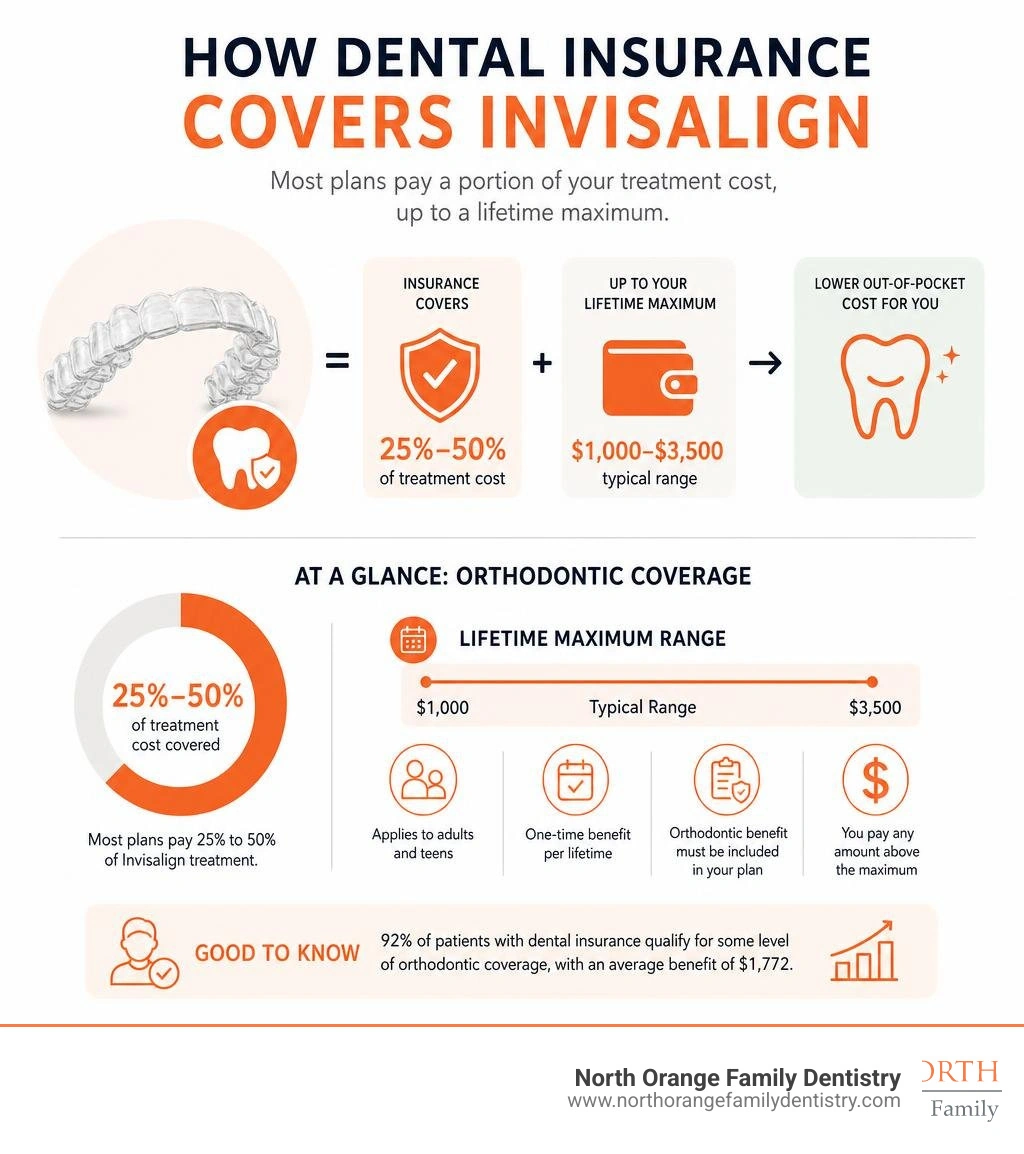
Most plans that include orthodontic coverage will pay 25% to 50% of your Invisalign treatment cost, up to a lifetime maximum. That means a significant portion of the cost can be offset — but the details vary a lot from plan to plan.
Invisalign has become one of the most popular ways adults and teens straighten their teeth. The clear, removable aligners are discreet and comfortable. But the cost can feel like a barrier, especially without knowing what your insurance actually covers.
The good news: 92% of U.S. patients with dental insurance qualify for some level of orthodontic coverage, according to Invisalign's own data — with an average benefit of around $1,772.
This guide breaks down which plans cover Invisalign, how much they typically pay, and what to watch out for before you start treatment.
How Dental Insurance Handles Invisalign and Orthodontic Coverage
Understanding how insurance companies view clear aligners is the first step to maximizing your benefits. Historically, some insurers tried to label clear aligners as purely cosmetic procedures. Today, however, the industry widely recognizes Clear Aligners as a legitimate orthodontic treatment.
When you look at your dental policy, you won't usually see a line item specifically for "Invisalign." Instead, Invisalign is covered under your plan's general orthodontic benefits. If your policy covers traditional metal braces, it will typically cover clear aligners at the same rate. This standard is supported by major resources like Does Insurance Cover Invisalign? Invisalign with Insurance | Invisalign.com.
However, dental insurance operates differently than medical insurance. Rather than having an annual deductible followed by unlimited coverage, orthodontic benefits almost always feature a lifetime maximum. This is a one-time cap on what the insurance will pay for orthodontic work. Once you exhaust this limit (which typically ranges from $1,000 to $3,500), the insurance will not pay for any future orthodontic treatments, even if you switch plans or start a new year.
How to Choose Dental Insurance That Covers Invisalign
If you are shopping for a new policy specifically to help pay for clear aligners, you must look closely at the fine print. Not all dental policies include orthodontic coverage. To find the right fit, consult a comprehensive Dental Insurance Guide to understand the difference between basic preventive plans and premium orthodontic coverage.
When comparing Dental Plans That Cover Invisalign, keep these three factors in mind:
- Waiting Periods: Many individual plans require you to hold the policy for 12 months before major orthodontic benefits kick in.
- Age Restrictions: Many standard family plans cut off orthodontic coverage for dependents once they reach age 19. If you are an adult seeking treatment, you must verify that the plan includes adult orthodontic coverage.
- Percentage of Coinsurance: Most plans cover 50% of the cost up to the lifetime maximum, meaning you are responsible for the remaining balance.
Is Employer-Sponsored Dental Insurance That Covers Invisalign Better Than Individual Plans?
As a general rule, group dental coverage provided by an employer is superior to individual policies purchased directly. Group plans often waive waiting periods, meaning you can start your Invisalign treatment immediately. They also tend to have higher lifetime maximums and lower monthly premiums because the employer subsidizes the cost and the insurance risk is spread across many employees.
If you do not have access to group coverage, you can still find quality Ohio Dental Insurance Plans that offer individual orthodontic riders. For example, exploring Individual Dental Insurance Plans in Ohio | Anthem can help you find plans tailored to families and individuals in the Lewis Center and Delaware areas who need orthodontic benefits but must purchase insurance independently.
Finding Dental Insurance That Covers Invisalign: Top Providers Compared
To help you navigate your options, let's look at how the top national dental insurance providers handle Invisalign coverage.
Delta Dental Invisalign Coverage
Delta Dental is one of the largest providers in the country, and they are highly supportive of clear aligner technology. Under many of their plans, Invisalign is covered as a standard orthodontic benefit.
For those purchasing individual coverage, the Orthodontic Coverage for Braces, Clear Aligners and More| Delta Dental – Plus Ortho | Delta Dental Of Washington is a prime example of a plan designed specifically for orthodontia. It covers 50% of aligners or braces with lifetime maximums that frequently reach up to $3,500 for premier group plans, though individual plans often cap the lifetime benefit closer to $1,500.
Cigna Invisalign Coverage
Cigna offers excellent orthodontic coverage, particularly through its popular Cigna Dental 1500 plan. According to clinical reviews, such as those published in Does Cigna Dental Cover Invisalign? - Journal of Dental Clinics, the Dental 1500 plan provides a $1,000 lifetime maximum benefit specifically for orthodontic treatments, which includes Invisalign. Cigna also boasts a massive network of dentists, making it easy to find an in-network provider close to home in Delaware County.
MetLife Invisalign Coverage
MetLife Dental PPO plans are highly regarded for their flexibility. If you have a MetLife PPO plan with orthodontic coverage, it will typically pay for Invisalign aligners when performed by a licensed provider. Lifetime orthodontic maximums for MetLife plans generally fall between $1,000 and $2,500. However, be cautious of MetLife DHMO plans, as they often exclude clear aligners entirely or limit coverage strictly to traditional metal braces.
Humana and UnitedHealthcare Invisalign Coverage
Humana and UnitedHealthcare (UHC) both offer selective coverage for Invisalign. Humana often provides orthodontic discount programs rather than direct coinsurance on their budget-friendly plans, though higher-tier plans do include standard orthodontic benefits.
UnitedHealthcare plans vary widely by employer, but many of their premier plans cover Invisalign similarly to braces. When reviewing plan summaries, look for documents like the Adult Dental Optima 2000 Enhanced Orthodontia Small Group Benefit Highlights to see exactly how cost-sharing and lifetime limits are structured.
For a deeper dive into these providers, you can read our Invisalign Insurance Guide 2026 or check out our general resource on Does Insurance Cover Invisalign.
Key Factors That Affect Your Invisalign Insurance Coverage

Even if you have a plan from one of the major providers listed above, several underlying factors can prevent you from receiving your benefits.
Age Limits and Dependent Coverage
This is the most common reason Invisalign claims are denied. Many dental insurance plans limit orthodontic coverage to children under the age of 19. If you are an adult looking to straighten your smile, you must ensure your plan includes an "adult orthodontic rider." Without this specific rider, your insurance will cover your cleanings and fillings but will pay nothing toward your clear aligners.
Waiting Periods and Pre-Existing Conditions
If you purchase a new individual dental plan today, you will likely face a waiting period (often 12 months) before the insurance will pay for orthodontic care. This prevents people from buying insurance, immediately getting Invisalign, and then cancelling the policy.
Additionally, if you have already started your Invisalign treatment before your insurance policy becomes active, it is considered a "treatment in progress" and is generally excluded from coverage. To learn more about managing these out-of-pocket dynamics, review our guides on the Average Price of Invisalign and How Much Is Invisalign Out of Pocket.
How to Verify and Maximize Your Invisalign Benefits
Navigating insurance paperwork can feel like trying to read ancient hieroglyphics. However, taking a few systematic steps before your first aligner fitting can save you thousands of dollars.
Steps to Verify Your Coverage
We recommend following these steps to ensure you don't get stuck with unexpected bills:
- Request a Predetermination of Benefits: Before starting treatment, our administrative team can submit a pre-treatment estimate (predetermination) to your insurer. The insurance company will send back an official document detailing exactly what they will pay and what your out-of-pocket responsibility will be.
- Verify CDT Codes: Ensure your provider uses the correct Current Dental Terminology (CDT) codes for clear aligners (typically D8080 for teens or D8090 for adults) rather than codes for traditional braces, as some strict plans require exact coding.
- Coordinate Dual Coverage: If you are covered under both your own dental plan and a spouse's plan, you can coordinate benefits to cover a larger portion of the cost.
For a comprehensive walkthrough of the entire aligner process, check out our Invisalign Complete Guide 2026 and see if your bite alignment issues qualify as Invisalign for Mild Cases.
Frequently Asked Questions about Invisalign Insurance
Does dental insurance cover Invisalign the same as other orthodontic treatments?
Yes. Most modern dental insurance plans treat Invisalign exactly the same as traditional metal braces. If your plan includes orthodontic coverage, those benefits can be applied directly to clear aligners, provided they are administered by a licensed, in-network dentist or orthodontist.
Can I use my HSA or FSA to pay for Invisalign out-of-pocket costs?
Absolutely! Both Health Savings Accounts (HSAs) and Flexible Spending Accounts (FSAs) allow you to use pre-tax dollars to pay for dental treatments, including Invisalign. This can effectively reduce your out-of-pocket costs by 25% to 35% depending on your tax bracket. You can combine your HSA/FSA funds with your primary dental insurance to cover the remaining balance.
What should I do if my dental insurance denies my Invisalign claim?
If your claim is denied, the first step is to review the Explanation of Benefits (EOB) to find the denial code. Common reasons include missing documentation, age limits, or the insurer claiming the treatment is "cosmetic." You can work with our office to submit an appeal, providing diagnostic X-rays, 3D scans, and a letter of medical necessity from Dr. Bogan to prove the treatment is required to correct bite issues, prevent tooth wear, or improve oral function.
What if I do not have dental insurance to cover my Invisalign treatment?
If you do not have dental insurance, we have designed a solution to keep your care affordable. At North Orange Family Dentistry, we offer an in-house Dental Wellness Plan for individuals and families without insurance. This plan allows you to receive your yearly preventive dental care at a discounted price and provides significant savings on other treatments, including Invisalign. To maintain complete transparency and protect our patients, we focus entirely on our Dental Wellness Plan and do not endorse external financing or third-party payment plans.
Conclusion
Finding dental insurance that covers Invisalign takes a little bit of homework, but the financial savings are well worth the effort. By choosing a plan with strong orthodontic benefits, verifying your coverage beforehand, and utilizing tax-free HSA or FSA dollars, you can make clear aligner treatment highly affordable.
If you are ready to take the next step toward a straighter, healthier smile, we are here to help. At North Orange Family Dentistry, Dr. Kyle Bogan and our highly experienced team provide world-class care in our state-of-the-art facility in Delaware, Ohio.
In addition to being a premier provider of North Orange Family Dentistry Invisalign Services, we feature advanced laser treatments for TMJ pain, canker sore healing, and periodontal care. We also understand that dental needs don't always follow a schedule, which is why we offer same-day emergency dental appointments most of the time.
Whether you have top-tier dental insurance or need to take advantage of our in-house Dental Wellness Plan, we are committed to delivering a five-star dental experience that fits your family's budget. Contact us today to schedule your consultation!
Why Finding Dental Insurance That Covers Invisalign Is Worth the Research
If you're looking for dental insurance that covers Invisalign, here's the short answer: yes, it exists — and several major insurance providers include Invisalign under their standard orthodontic benefits.
Quick answer for common searches:
| Insurance Provider | Covers Invisalign? | Typical Lifetime Maximum |
|---|---|---|
| Delta Dental | Yes (where ortho benefit applies) | $1,000 - $3,500 |
| Cigna (Dental 1500) | Yes | $1,000 |
| MetLife (PPO) | Yes (partial) | $1,000 - $2,500 |
| Humana | Some plans (discounts available) | Varies by plan |
| UnitedHealthcare | Some plans | Varies by plan |
Most plans that include orthodontic coverage will pay 25% to 50% of your Invisalign treatment cost, up to a lifetime maximum. That means a significant portion of the cost can be offset — but the details vary a lot from plan to plan.
Invisalign has become one of the most popular ways adults and teens straighten their teeth. The clear, removable aligners are discreet and comfortable. But the cost can feel like a barrier, especially without knowing what your insurance actually covers.
The good news: 92% of U.S. patients with dental insurance qualify for some level of orthodontic coverage, according to Invisalign's own data — with an average benefit of around $1,772.
This guide breaks down which plans cover Invisalign, how much they typically pay, and what to watch out for before you start treatment.
How Dental Insurance Handles Invisalign and Orthodontic Coverage
Understanding how insurance companies view clear aligners is the first step to maximizing your benefits. Historically, some insurers tried to label clear aligners as purely cosmetic procedures. Today, however, the industry widely recognizes Clear Aligners as a legitimate orthodontic treatment.
When you look at your dental policy, you won't usually see a line item specifically for "Invisalign." Instead, Invisalign is covered under your plan's general orthodontic benefits. If your policy covers traditional metal braces, it will typically cover clear aligners at the same rate. This standard is supported by major resources like Does Insurance Cover Invisalign? Invisalign with Insurance | Invisalign.com.
However, dental insurance operates differently than medical insurance. Rather than having an annual deductible followed by unlimited coverage, orthodontic benefits almost always feature a lifetime maximum. This is a one-time cap on what the insurance will pay for orthodontic work. Once you exhaust this limit (which typically ranges from $1,000 to $3,500), the insurance will not pay for any future orthodontic treatments, even if you switch plans or start a new year.
How to Choose Dental Insurance That Covers Invisalign
If you are shopping for a new policy specifically to help pay for clear aligners, you must look closely at the fine print. Not all dental policies include orthodontic coverage. To find the right fit, consult a comprehensive Dental Insurance Guide to understand the difference between basic preventive plans and premium orthodontic coverage.
When comparing Dental Plans That Cover Invisalign, keep these three factors in mind:
- Waiting Periods: Many individual plans require you to hold the policy for 12 months before major orthodontic benefits kick in.
- Age Restrictions: Many standard family plans cut off orthodontic coverage for dependents once they reach age 19. If you are an adult seeking treatment, you must verify that the plan includes adult orthodontic coverage.
- Percentage of Coinsurance: Most plans cover 50% of the cost up to the lifetime maximum, meaning you are responsible for the remaining balance.
Is Employer-Sponsored Dental Insurance That Covers Invisalign Better Than Individual Plans?
As a general rule, group dental coverage provided by an employer is superior to individual policies purchased directly. Group plans often waive waiting periods, meaning you can start your Invisalign treatment immediately. They also tend to have higher lifetime maximums and lower monthly premiums because the employer subsidizes the cost and the insurance risk is spread across many employees.
If you do not have access to group coverage, you can still find quality Ohio Dental Insurance Plans that offer individual orthodontic riders. For example, exploring Individual Dental Insurance Plans in Ohio | Anthem can help you find plans tailored to families and individuals in the Lewis Center and Delaware areas who need orthodontic benefits but must purchase insurance independently.
Finding Dental Insurance That Covers Invisalign: Top Providers Compared
To help you navigate your options, let's look at how the top national dental insurance providers handle Invisalign coverage.
Delta Dental Invisalign Coverage
Delta Dental is one of the largest providers in the country, and they are highly supportive of clear aligner technology. Under many of their plans, Invisalign is covered as a standard orthodontic benefit.
For those purchasing individual coverage, the Orthodontic Coverage for Braces, Clear Aligners and More| Delta Dental – Plus Ortho | Delta Dental Of Washington is a prime example of a plan designed specifically for orthodontia. It covers 50% of aligners or braces with lifetime maximums that frequently reach up to $3,500 for premier group plans, though individual plans often cap the lifetime benefit closer to $1,500.
Cigna Invisalign Coverage
Cigna offers excellent orthodontic coverage, particularly through its popular Cigna Dental 1500 plan. According to clinical reviews, such as those published in Does Cigna Dental Cover Invisalign? - Journal of Dental Clinics, the Dental 1500 plan provides a $1,000 lifetime maximum benefit specifically for orthodontic treatments, which includes Invisalign. Cigna also boasts a massive network of dentists, making it easy to find an in-network provider close to home in Delaware County.
MetLife Invisalign Coverage
MetLife Dental PPO plans are highly regarded for their flexibility. If you have a MetLife PPO plan with orthodontic coverage, it will typically pay for Invisalign aligners when performed by a licensed provider. Lifetime orthodontic maximums for MetLife plans generally fall between $1,000 and $2,500. However, be cautious of MetLife DHMO plans, as they often exclude clear aligners entirely or limit coverage strictly to traditional metal braces.
Humana and UnitedHealthcare Invisalign Coverage
Humana and UnitedHealthcare (UHC) both offer selective coverage for Invisalign. Humana often provides orthodontic discount programs rather than direct coinsurance on their budget-friendly plans, though higher-tier plans do include standard orthodontic benefits.
UnitedHealthcare plans vary widely by employer, but many of their premier plans cover Invisalign similarly to braces. When reviewing plan summaries, look for documents like the Adult Dental Optima 2000 Enhanced Orthodontia Small Group Benefit Highlights to see exactly how cost-sharing and lifetime limits are structured.
For a deeper dive into these providers, you can read our Invisalign Insurance Guide 2026 or check out our general resource on Does Insurance Cover Invisalign.
Key Factors That Affect Your Invisalign Insurance Coverage
Even if you have a plan from one of the major providers listed above, several underlying factors can prevent you from receiving your benefits.
Age Limits and Dependent Coverage
This is the most common reason Invisalign claims are denied. Many dental insurance plans limit orthodontic coverage to children under the age of 19. If you are an adult looking to straighten your smile, you must ensure your plan includes an "adult orthodontic rider." Without this specific rider, your insurance will cover your cleanings and fillings but will pay nothing toward your clear aligners.
Waiting Periods and Pre-Existing Conditions
If you purchase a new individual dental plan today, you will likely face a waiting period (often 12 months) before the insurance will pay for orthodontic care. This prevents people from buying insurance, immediately getting Invisalign, and then cancelling the policy.
Additionally, if you have already started your Invisalign treatment before your insurance policy becomes active, it is considered a "treatment in progress" and is generally excluded from coverage. To learn more about managing these out-of-pocket dynamics, review our guides on the Average Price of Invisalign and How Much Is Invisalign Out of Pocket.
How to Verify and Maximize Your Invisalign Benefits
Navigating insurance paperwork can feel like trying to read ancient hieroglyphics. However, taking a few systematic steps before your first aligner fitting can save you thousands of dollars.
Steps to Verify Your Coverage
We recommend following these steps to ensure you don't get stuck with unexpected bills:
- Request a Predetermination of Benefits: Before starting treatment, our administrative team can submit a pre-treatment estimate (predetermination) to your insurer. The insurance company will send back an official document detailing exactly what they will pay and what your out-of-pocket responsibility will be.
- Verify CDT Codes: Ensure your provider uses the correct Current Dental Terminology (CDT) codes for clear aligners (typically D8080 for teens or D8090 for adults) rather than codes for traditional braces, as some strict plans require exact coding.
- Coordinate Dual Coverage: If you are covered under both your own dental plan and a spouse's plan, you can coordinate benefits to cover a larger portion of the cost.
For a comprehensive walkthrough of the entire aligner process, check out our Invisalign Complete Guide 2026 and see if your bite alignment issues qualify as Invisalign for Mild Cases.
Frequently Asked Questions about Invisalign Insurance
Does dental insurance cover Invisalign the same as other orthodontic treatments?
Yes. Most modern dental insurance plans treat Invisalign exactly the same as traditional metal braces. If your plan includes orthodontic coverage, those benefits can be applied directly to clear aligners, provided they are administered by a licensed, in-network dentist or orthodontist.
Can I use my HSA or FSA to pay for Invisalign out-of-pocket costs?
Absolutely! Both Health Savings Accounts (HSAs) and Flexible Spending Accounts (FSAs) allow you to use pre-tax dollars to pay for dental treatments, including Invisalign. This can effectively reduce your out-of-pocket costs by 25% to 35% depending on your tax bracket. You can combine your HSA/FSA funds with your primary dental insurance to cover the remaining balance.
What should I do if my dental insurance denies my Invisalign claim?
If your claim is denied, the first step is to review the Explanation of Benefits (EOB) to find the denial code. Common reasons include missing documentation, age limits, or the insurer claiming the treatment is "cosmetic." You can work with our office to submit an appeal, providing diagnostic X-rays, 3D scans, and a letter of medical necessity from Dr. Bogan to prove the treatment is required to correct bite issues, prevent tooth wear, or improve oral function.
What if I do not have dental insurance to cover my Invisalign treatment?
If you do not have dental insurance, we have designed a solution to keep your care affordable. At North Orange Family Dentistry, we offer an in-house Dental Wellness Plan for individuals and families without insurance. This plan allows you to receive your yearly preventive dental care at a discounted price and provides significant savings on other treatments, including Invisalign. To maintain complete transparency and protect our patients, we focus entirely on our Dental Wellness Plan and do not endorse external financing or third-party payment plans.
Conclusion
Finding dental insurance that covers Invisalign takes a little bit of homework, but the financial savings are well worth the effort. By choosing a plan with strong orthodontic benefits, verifying your coverage beforehand, and utilizing tax-free HSA or FSA dollars, you can make clear aligner treatment highly affordable.
If you are ready to take the next step toward a straighter, healthier smile, we are here to help. At North Orange Family Dentistry, Dr. Kyle Bogan and our highly experienced team provide world-class care in our state-of-the-art facility in Delaware, Ohio.
In addition to being a premier provider of North Orange Family Dentistry Invisalign Services, we feature advanced laser treatments for TMJ pain, canker sore healing, and periodontal care. We also understand that dental needs don't always follow a schedule, which is why we offer same-day emergency dental appointments most of the time.
Whether you have top-tier dental insurance or need to take advantage of our in-house Dental Wellness Plan, we are committed to delivering a five-star dental experience that fits your family's budget. Contact us today to schedule your consultation!
Contact Us
Have any questions? Want to learn more?

