
How Much Is Dental Bonding Without Insurance? A Pricey Smile Guide
Discover how much is dental bonding without insurance: $100–$600/tooth avg. Compare veneers, costs by state, FAQs & savings tips!



Is a Better Smile Really Within Reach? What to Know Before You Search
How much is dental bonding without insurance is one of the most common questions people ask before booking a cosmetic dental appointment — and for good reason. Without a clear price in mind, it's hard to know if you can afford it or where to even start.
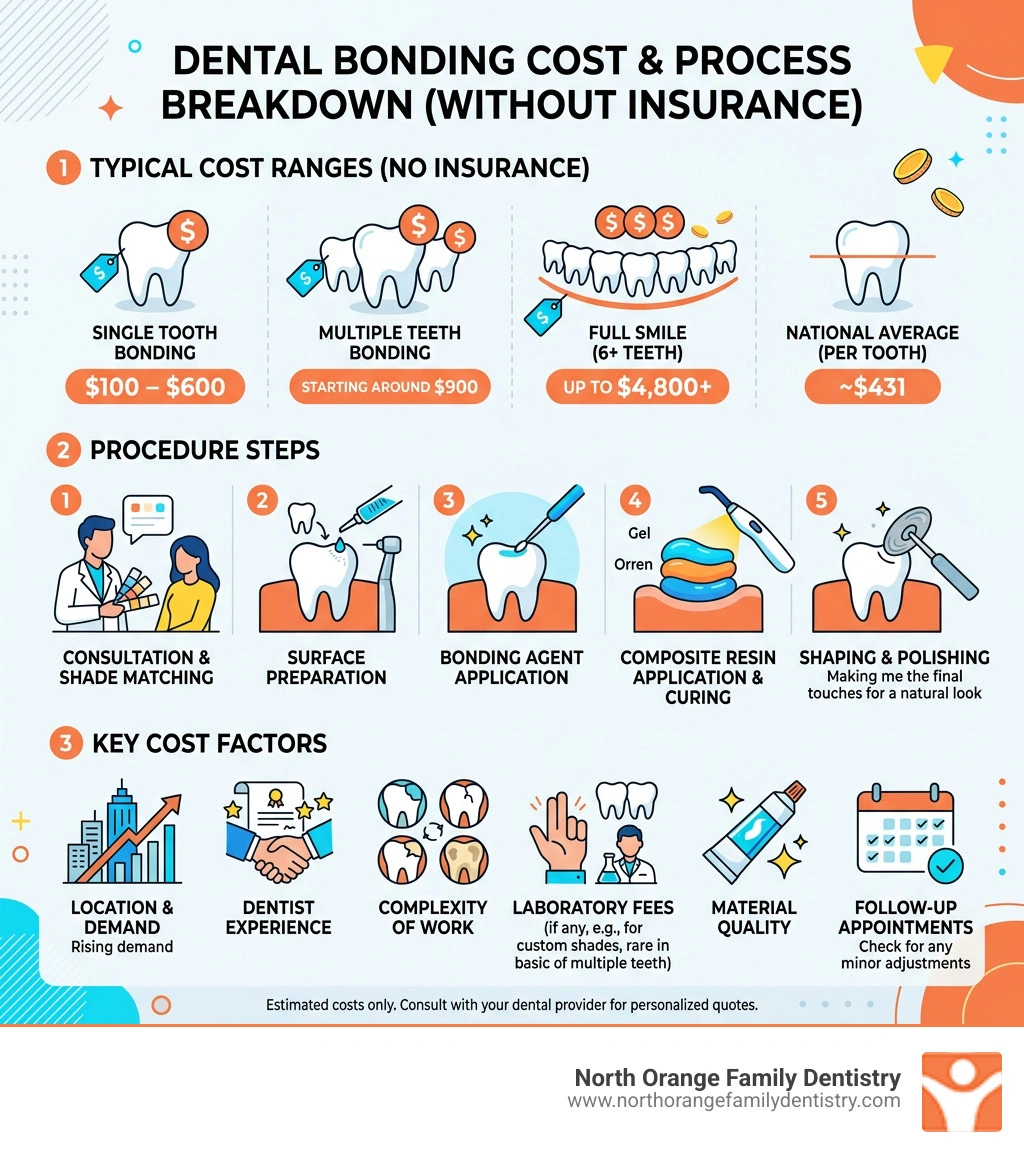
Here's the quick answer: without insurance, dental bonding often costs $100 to $600 per tooth. If you are bonding multiple teeth, treatment may start around $900, while a larger smile update involving six or more teeth can reach $4,800 or more. The national average is roughly $431 per tooth, though your exact cost depends on location, dentist experience, and how much work each tooth needs.
More than half of Americans are unhappy with how their teeth look. Many assume fixing a chipped, gapped, or discolored tooth means an expensive, time-consuming procedure. But dental bonding is often the simplest and most affordable option for minor smile improvements — usually done in a single visit, with little to no discomfort.
At North Orange Family Dentistry, we believe cost should never be a mystery. This guide walks you through exactly what you can expect to pay, what drives the price up or down, and how to make the most of your investment.
Basic how much is dental bonding without insurance glossary:
How Much Is Dental Bonding Without Insurance?

When we talk about the price of a smile makeover, dental bonding is consistently the most budget-friendly entry point. If you are browsing for composite bonding prices, you will find that most dentists charge between $100 and $600 per tooth. While the national average sits around $431, many patients find that a single tooth restoration for a small chip can be on the lower end of that spectrum.
However, the total cost depends heavily on the goal of the treatment. For example, dental bonding for a gap between two front teeth involves applying material to both teeth to create a symmetrical look, which effectively doubles the single-tooth price. For those looking at more extensive work, such as a "full smile" restoration involving six or more teeth, the total can reach $4,800 or more.
It is helpful to understand that dental bonding uses a tooth-colored composite resin—the same material used for dental fillings. Because the procedure is performed directly in the office without the need for a third-party laboratory, we can keep the costs significantly lower than other cosmetic options. You can learn more about the cost of dental bonding without insurance and how it fits into a modern restorative plan by reviewing clinical overviews of the procedure.
Why the cost of dental bonding without insurance varies by region
Geography plays a surprisingly large role in what you will see on your final bill. Just as the price of a gallon of milk or a monthly mortgage payment changes based on where you live, dental overhead varies by state.
In our neck of the woods, the dental bonding cost in Ohio averages about $378 per tooth. This is notably more affordable than high-cost-of-living areas like California, where the average jumps to $639. On the other hand, states like Alabama represent the lower end of the national scale at approximately $338. When you visit us in Lewis Center or Delaware, Ohio, you’re benefiting from a regional cost structure that is generally lower than the national average while still receiving top-tier clinical care.
Hidden expenses: How much is dental bonding without insurance including exams?
When calculating how much is dental bonding without insurance, it is vital to look beyond the price per tooth. Most dental offices require a preliminary exam to ensure your teeth and gums are healthy enough for cosmetic work.
A standard dental exam and professional cleaning average about $203 nationally. If you haven't been to the dentist in a while, we may also need digital X-rays to check for underlying decay. Applying bonding over a tooth with an active infection is a recipe for trouble, often leading to more expensive treatments like a root canal down the road. Therefore, your first visit might include:
- A comprehensive oral exam
- Digital X-rays
- A professional cleaning to remove bacteria and plaque
Factors That Influence the Final Price Tag
No two smiles are identical, and neither are the quotes for bonding. Several specific factors will determine where you land within that $100–$600 range.
- Number of Teeth: This is the most obvious factor. However, many practices offer a slight "per-tooth" discount if you are having multiple teeth bonded during the same appointment, as it reduces the setup time and materials wasted.
- Tooth Location: Bonding a front tooth for aesthetic reasons often requires more artistry and time than filling a small chip on a less visible tooth. The dentist must meticulously layer the resin to mimic the natural translucency of your enamel.
- Complexity of the Issue: Closing a large gap between teeth or completely reshaping a misshapen tooth requires more composite material and more time for sculpting and polishing than a minor chip.
- Dentist Experience: You are paying for the "eye" of the clinician. A Fellow of the Academy of General Dentistry, like Dr. Kyle Bogan, has undergone extensive additional training to ensure cosmetic results look natural and last as long as possible.
- Quality of Resin: Not all composite resins are created equal. High-end materials offer better stain resistance and a more lifelike appearance, which may carry a slightly higher price tag but offer better long-term value.
Understanding what is dental bonding and how these factors interact can help you set a realistic budget for your dentist bonding appointment.
Comparing the Cost: Dental Bonding vs. Veneers and Crowns
If you are weighing your options, it is important to see how bonding stacks up against its "big siblings" in cosmetic dentistry.
Dental bonding is usually the lowest-cost option, often ranging from $100 to $600 per tooth. It is minimally invasive, usually requires little to no enamel removal, and may be reversible depending on the case. Bonding typically lasts 3 to 10 years and offers moderate stain resistance.
Porcelain veneers cost more upfront, commonly around $1,000 to $2,500 per tooth, but they are more durable and stain-resistant. Veneers usually last 10 to 20 years, though they require enamel removal and are not reversible.
Dental crowns are also a higher-cost option, often around $1,200 to $2,500 per tooth. They require more significant tooth shaping, but they can last 15 years or longer and may be the better choice when a tooth has major structural damage.
While the dental bonding vs veneers cost shows that bonding is significantly cheaper upfront, porcelain veneers are more durable and resistant to coffee or wine stains. Bonding is the "conservative" choice—it requires almost no removal of your natural tooth structure, making it a great gentle dental bonding option for those who are nervous about permanent alterations. However, if the tooth has significant structural damage, a dental crown may be the only way to save the tooth, even if it costs more.
Maximizing Your Investment: Durability and Aftercare
Once you've invested in your smile, you'll want to make it last. While bonding isn't permanent, it is quite durable. Most patients can expect their bonding to last between 3 and 10 years.
To get the most out of your bonding-teeth cost, follow these aftercare tips:
- Avoid "Staining" Habits: Composite resin is more porous than natural enamel. If you drink a lot of coffee, tea, or red wine, your bonding may discolor over time. Using a straw can help!
- Ditch the Hard Stuff: Don't chew on ice, popcorn kernels, or your fingernails. Bonding is strong, but it can chip under extreme pressure.
- Use the Right Tools: Switch to a non-abrasive toothpaste and an alcohol-free mouthwash. Harsh chemicals and abrasive "whitening" pastes can dull the polish of your bonded teeth.
- Oral Hygiene is Key: Brush twice a day and floss daily. Even though the resin can't decay, the tooth underneath it can!
If you ever notice a rough edge or a small chip, don't panic. Unlike veneers, dental bonding can often be repaired or "touched up" by adding a bit more resin.
Making Dental Care Affordable Without Insurance
We understand that how much is dental bonding without insurance can still feel like a hurdle. At North Orange Family Dentistry, we believe everyone deserves a five-star smile, regardless of their insurance status.
For our patients in Delaware and Lewis Center who do not have traditional dental insurance, we offer an in-house Dental Wellness Plan. This isn't insurance—it's better. It is a membership-based plan that allows you to get your yearly preventive care (like cleanings and exams) at a fixed rate, while also providing significant discounts on procedures like dental bonding, teeth whitening, and even Invisalign.
By joining the wellness plan, you can turn a large out-of-pocket expense into a manageable, discounted part of your health routine. It’s our way of ensuring that "bonding on a budget" is a reality for our community.
Frequently Asked Questions about Dental Bonding
Does dental insurance ever cover the cost of bonding?
While insurance often views bonding as a "cosmetic" procedure (and therefore won't pay for it), there are exceptions. If the bonding is used for a restorative necessity, such as filling a cavity or repairing a tooth damaged in an accident, many plans will cover 50% to 80% of the cost after your deductible is met. If you're using it just to close a small gap or change the shape of a healthy tooth, expect to pay the full amount out of pocket.
Can dental bonding be used on molars?
Generally, bonding on molars is not recommended for large-scale repairs. Your back teeth endure immense pressure from chewing (up to 200 pounds of force!). Composite resin is excellent for front teeth, but for molars, it is more likely to chip or wear down quickly. For back teeth, we usually recommend dental crowns or onlays which are designed to handle that heavy lifting.
Is the dental bonding procedure painful?
Not at all! In fact, dental bonding is usually painless. Because we aren't removing enamel or getting close to the tooth's nerve, anesthesia is rarely even needed. It is a non-invasive process where we simply "etch" the surface of the tooth (it feels like a electric toothbrush) and then apply the resin. Most patients walk out of our office feeling great and ready to show off their new smile immediately.
Conclusion
At North Orange Family Dentistry, we are proud to serve families across Delaware, Lewis Center, Powell, and the greater Columbus area. Led by Dr. Kyle Bogan—one of the top 3% of dentists worldwide as an FICD fellow—our team is dedicated to providing advanced care that fits your life.
Whether you need a quick fix for a chipped tooth or are interested in our cutting-edge laser treatments for TMJ and gum health, we are here to help. If you're worried about the cost, ask us about our Dental Wellness Plan to see how we make professional care accessible for everyone.
Ready to see what bonding can do for you? Schedule your consultation for tooth bonding today and let’s get you the smile you deserve. If you have an urgent issue, we offer same-day emergency dental appointments most of the time!
Is a Better Smile Really Within Reach? What to Know Before You Search
How much is dental bonding without insurance is one of the most common questions people ask before booking a cosmetic dental appointment — and for good reason. Without a clear price in mind, it's hard to know if you can afford it or where to even start.
Here's the quick answer: without insurance, dental bonding often costs $100 to $600 per tooth. If you are bonding multiple teeth, treatment may start around $900, while a larger smile update involving six or more teeth can reach $4,800 or more. The national average is roughly $431 per tooth, though your exact cost depends on location, dentist experience, and how much work each tooth needs.
More than half of Americans are unhappy with how their teeth look. Many assume fixing a chipped, gapped, or discolored tooth means an expensive, time-consuming procedure. But dental bonding is often the simplest and most affordable option for minor smile improvements — usually done in a single visit, with little to no discomfort.
At North Orange Family Dentistry, we believe cost should never be a mystery. This guide walks you through exactly what you can expect to pay, what drives the price up or down, and how to make the most of your investment.
Basic how much is dental bonding without insurance glossary:
How Much Is Dental Bonding Without Insurance?
When we talk about the price of a smile makeover, dental bonding is consistently the most budget-friendly entry point. If you are browsing for composite bonding prices, you will find that most dentists charge between $100 and $600 per tooth. While the national average sits around $431, many patients find that a single tooth restoration for a small chip can be on the lower end of that spectrum.
However, the total cost depends heavily on the goal of the treatment. For example, dental bonding for a gap between two front teeth involves applying material to both teeth to create a symmetrical look, which effectively doubles the single-tooth price. For those looking at more extensive work, such as a "full smile" restoration involving six or more teeth, the total can reach $4,800 or more.
It is helpful to understand that dental bonding uses a tooth-colored composite resin—the same material used for dental fillings. Because the procedure is performed directly in the office without the need for a third-party laboratory, we can keep the costs significantly lower than other cosmetic options. You can learn more about the cost of dental bonding without insurance and how it fits into a modern restorative plan by reviewing clinical overviews of the procedure.
Why the cost of dental bonding without insurance varies by region
Geography plays a surprisingly large role in what you will see on your final bill. Just as the price of a gallon of milk or a monthly mortgage payment changes based on where you live, dental overhead varies by state.
In our neck of the woods, the dental bonding cost in Ohio averages about $378 per tooth. This is notably more affordable than high-cost-of-living areas like California, where the average jumps to $639. On the other hand, states like Alabama represent the lower end of the national scale at approximately $338. When you visit us in Lewis Center or Delaware, Ohio, you’re benefiting from a regional cost structure that is generally lower than the national average while still receiving top-tier clinical care.
Hidden expenses: How much is dental bonding without insurance including exams?
When calculating how much is dental bonding without insurance, it is vital to look beyond the price per tooth. Most dental offices require a preliminary exam to ensure your teeth and gums are healthy enough for cosmetic work.
A standard dental exam and professional cleaning average about $203 nationally. If you haven't been to the dentist in a while, we may also need digital X-rays to check for underlying decay. Applying bonding over a tooth with an active infection is a recipe for trouble, often leading to more expensive treatments like a root canal down the road. Therefore, your first visit might include:
- A comprehensive oral exam
- Digital X-rays
- A professional cleaning to remove bacteria and plaque
Factors That Influence the Final Price Tag
No two smiles are identical, and neither are the quotes for bonding. Several specific factors will determine where you land within that $100–$600 range.
- Number of Teeth: This is the most obvious factor. However, many practices offer a slight "per-tooth" discount if you are having multiple teeth bonded during the same appointment, as it reduces the setup time and materials wasted.
- Tooth Location: Bonding a front tooth for aesthetic reasons often requires more artistry and time than filling a small chip on a less visible tooth. The dentist must meticulously layer the resin to mimic the natural translucency of your enamel.
- Complexity of the Issue: Closing a large gap between teeth or completely reshaping a misshapen tooth requires more composite material and more time for sculpting and polishing than a minor chip.
- Dentist Experience: You are paying for the "eye" of the clinician. A Fellow of the Academy of General Dentistry, like Dr. Kyle Bogan, has undergone extensive additional training to ensure cosmetic results look natural and last as long as possible.
- Quality of Resin: Not all composite resins are created equal. High-end materials offer better stain resistance and a more lifelike appearance, which may carry a slightly higher price tag but offer better long-term value.
Understanding what is dental bonding and how these factors interact can help you set a realistic budget for your dentist bonding appointment.
Comparing the Cost: Dental Bonding vs. Veneers and Crowns
If you are weighing your options, it is important to see how bonding stacks up against its "big siblings" in cosmetic dentistry.
Dental bonding is usually the lowest-cost option, often ranging from $100 to $600 per tooth. It is minimally invasive, usually requires little to no enamel removal, and may be reversible depending on the case. Bonding typically lasts 3 to 10 years and offers moderate stain resistance.
Porcelain veneers cost more upfront, commonly around $1,000 to $2,500 per tooth, but they are more durable and stain-resistant. Veneers usually last 10 to 20 years, though they require enamel removal and are not reversible.
Dental crowns are also a higher-cost option, often around $1,200 to $2,500 per tooth. They require more significant tooth shaping, but they can last 15 years or longer and may be the better choice when a tooth has major structural damage.
While the dental bonding vs veneers cost shows that bonding is significantly cheaper upfront, porcelain veneers are more durable and resistant to coffee or wine stains. Bonding is the "conservative" choice—it requires almost no removal of your natural tooth structure, making it a great gentle dental bonding option for those who are nervous about permanent alterations. However, if the tooth has significant structural damage, a dental crown may be the only way to save the tooth, even if it costs more.
Maximizing Your Investment: Durability and Aftercare
Once you've invested in your smile, you'll want to make it last. While bonding isn't permanent, it is quite durable. Most patients can expect their bonding to last between 3 and 10 years.
To get the most out of your bonding-teeth cost, follow these aftercare tips:
- Avoid "Staining" Habits: Composite resin is more porous than natural enamel. If you drink a lot of coffee, tea, or red wine, your bonding may discolor over time. Using a straw can help!
- Ditch the Hard Stuff: Don't chew on ice, popcorn kernels, or your fingernails. Bonding is strong, but it can chip under extreme pressure.
- Use the Right Tools: Switch to a non-abrasive toothpaste and an alcohol-free mouthwash. Harsh chemicals and abrasive "whitening" pastes can dull the polish of your bonded teeth.
- Oral Hygiene is Key: Brush twice a day and floss daily. Even though the resin can't decay, the tooth underneath it can!
If you ever notice a rough edge or a small chip, don't panic. Unlike veneers, dental bonding can often be repaired or "touched up" by adding a bit more resin.
Making Dental Care Affordable Without Insurance
We understand that how much is dental bonding without insurance can still feel like a hurdle. At North Orange Family Dentistry, we believe everyone deserves a five-star smile, regardless of their insurance status.
For our patients in Delaware and Lewis Center who do not have traditional dental insurance, we offer an in-house Dental Wellness Plan. This isn't insurance—it's better. It is a membership-based plan that allows you to get your yearly preventive care (like cleanings and exams) at a fixed rate, while also providing significant discounts on procedures like dental bonding, teeth whitening, and even Invisalign.
By joining the wellness plan, you can turn a large out-of-pocket expense into a manageable, discounted part of your health routine. It’s our way of ensuring that "bonding on a budget" is a reality for our community.
Frequently Asked Questions about Dental Bonding
Does dental insurance ever cover the cost of bonding?
While insurance often views bonding as a "cosmetic" procedure (and therefore won't pay for it), there are exceptions. If the bonding is used for a restorative necessity, such as filling a cavity or repairing a tooth damaged in an accident, many plans will cover 50% to 80% of the cost after your deductible is met. If you're using it just to close a small gap or change the shape of a healthy tooth, expect to pay the full amount out of pocket.
Can dental bonding be used on molars?
Generally, bonding on molars is not recommended for large-scale repairs. Your back teeth endure immense pressure from chewing (up to 200 pounds of force!). Composite resin is excellent for front teeth, but for molars, it is more likely to chip or wear down quickly. For back teeth, we usually recommend dental crowns or onlays which are designed to handle that heavy lifting.
Is the dental bonding procedure painful?
Not at all! In fact, dental bonding is usually painless. Because we aren't removing enamel or getting close to the tooth's nerve, anesthesia is rarely even needed. It is a non-invasive process where we simply "etch" the surface of the tooth (it feels like a electric toothbrush) and then apply the resin. Most patients walk out of our office feeling great and ready to show off their new smile immediately.
Conclusion
At North Orange Family Dentistry, we are proud to serve families across Delaware, Lewis Center, Powell, and the greater Columbus area. Led by Dr. Kyle Bogan—one of the top 3% of dentists worldwide as an FICD fellow—our team is dedicated to providing advanced care that fits your life.
Whether you need a quick fix for a chipped tooth or are interested in our cutting-edge laser treatments for TMJ and gum health, we are here to help. If you're worried about the cost, ask us about our Dental Wellness Plan to see how we make professional care accessible for everyone.
Ready to see what bonding can do for you? Schedule your consultation for tooth bonding today and let’s get you the smile you deserve. If you have an urgent issue, we offer same-day emergency dental appointments most of the time!
Contact Us
Have any questions? Want to learn more?

