
How to Fix a Broken Bonded Tooth on a Budget
Fix a bonded tooth broke on a budget with same-day bonding repair and long-term options at North Orange Family Dentistry.


What Happens When Your Bonded Tooth Breaks (And What to Do Next)
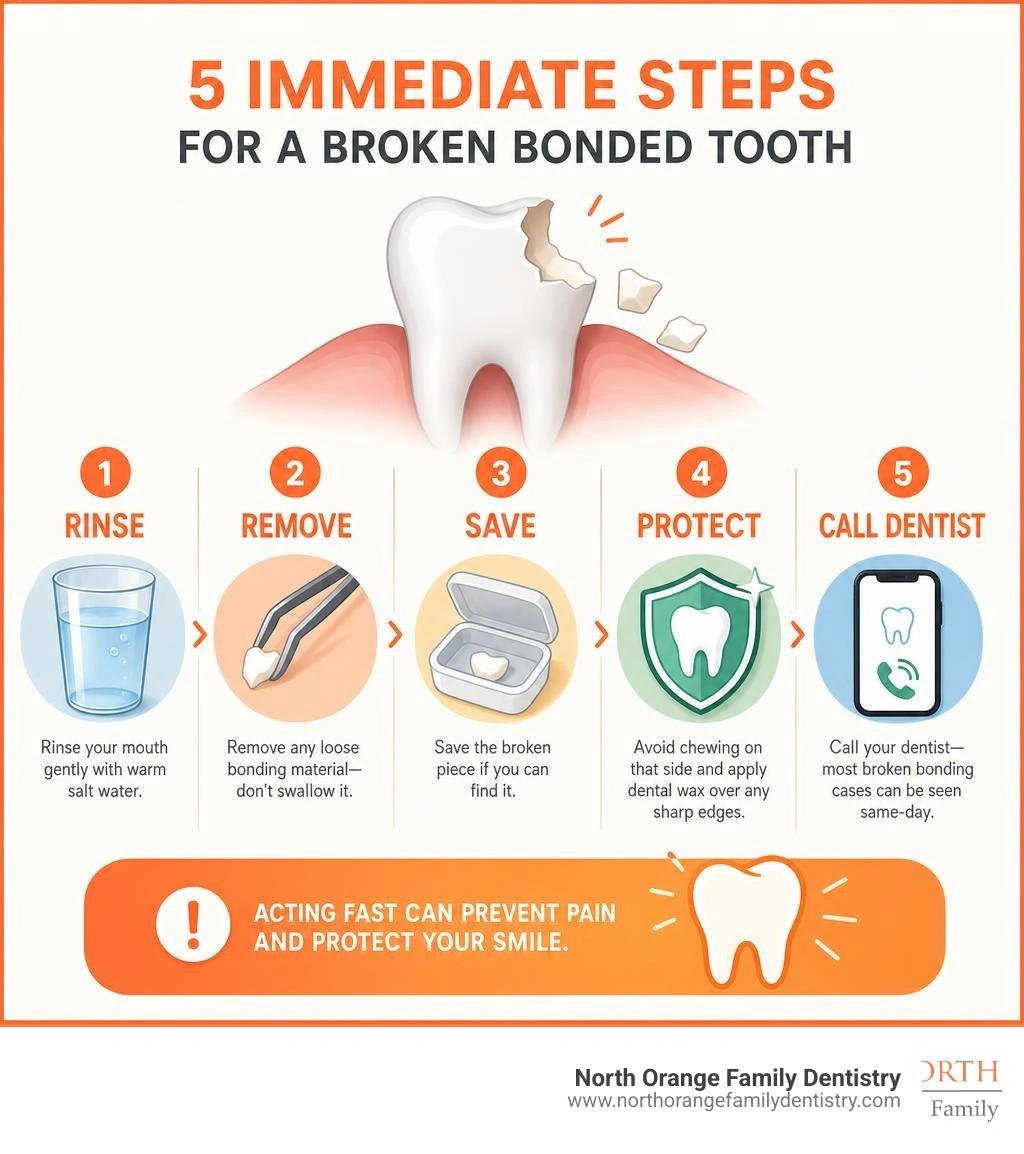
If your bonded tooth broke, you're probably feeling a mix of panic and pain right now. Here's the short answer on what to do:
Quick action steps if your dental bonding breaks:
- Rinse your mouth gently with warm salt water
- Remove any loose bonding material — don't swallow it
- Save the broken piece if you can find it
- Avoid chewing on that side of your mouth
- Apply dental wax over any sharp edges to protect your gum and tongue
- Call your dentist — most broken bonding cases can be seen same-day
Dental bonding is one of the most popular and affordable ways to repair a chipped or damaged tooth. It looks natural, it's quick, and it doesn't require removing healthy enamel. But composite resin — the material used in bonding — is less durable than a crown or porcelain veneer. According to Cleveland Clinic, bonding typically lasts between 3 and 10 years before it needs a touch-up or full replacement.
When bonding breaks, the tooth underneath is still damaged and exposed. That means bacteria can get in, sensitivity can spike, and what started as a cosmetic issue can turn into a bigger dental problem. Acting fast matters.
The good news? Most broken bonding is fixable — and often more affordable than you'd expect.
This guide walks you through exactly what to do, what your repair options are, and how to protect your smile going forward — without breaking your budget.
Bonded tooth broke vocab to learn:
What to Do When Your Bonded Tooth Broke

Taking the right steps immediately after your bonded tooth broke can mean the difference between a quick, budget-friendly patch and a more expensive restorative procedure.
First, do not panic. While a broken restoration can feel incredibly sharp to your tongue, we can easily handle this. Your primary goal is to protect the exposed tooth structure from bacteria and prevent sharp edges from slicing up your cheeks or tongue.
Start by gently rinsing your mouth with warm salt water. This simple step cleanses the area and reduces the risk of an early infection. If the tooth has a jagged edge, head to your local pharmacy and grab some over-the-counter dental wax. Mold a small piece of this wax over the sharp area to create a smooth barrier. For temporary discomfort, over-the-counter pain relievers like ibuprofen can help manage any mild aches.
Most importantly, you need to seek professional care. At North Orange Family Dentistry, we offer same-day emergency dental appointments most of the time to get you out of pain and restore your smile quickly. Delaying treatment allows bacteria to seep into the microscopic spaces of your natural tooth, which can lead to deeper decay or even root canal issues.
For a complete breakdown of what to expect when managing a damaged tooth, explore our Broken Tooth Repair Complete Guide. To better understand the risks of leaving a broken restoration untreated, you can also read about What Happens if Bonding Breaks or Chips?.
Immediate Steps If Your Front Bonded Tooth Broke
When a front bonded tooth breaks, the concern is usually highly cosmetic. After all, your smile is one of the first things people notice.
If your front tooth bonding breaks and you manage to find the fractured fragment, keep it! If the fragment is natural tooth structure rather than just old composite resin, we might be able to reattach it.
Scientific studies, such as the research on Natural Crown Bonding of Anterior Fractured Teeth at Different Levels of Complexity, highlight that natural tooth fragment reattachment is a highly conservative and beautiful treatment option. To give this the best chance of success, keep the fragment hydrated. Placing the broken piece in a small container of clean water or saline solution prevents it from drying out, which preserves its natural color and improves its bonding strength.
Even though simple reattachment only recovers about 35% to 37% of a tooth's original, intact fracture resistance, it remains an incredibly cost-effective, conservative, and natural-looking first line of defense for front teeth.
Long-Term Options If Your Back Bonded Tooth Broke
Your back teeth (molars and premolars) are the workhorses of your mouth. They endure massive chewing forces every single day. Because of this, dental bonding on a back tooth is much more susceptible to breaking.
If your back bonding fails, a simple resin touch-up might not cut it for the long haul. Under heavy biting pressure, a repeated repair is likely to chip again. In these cases, we often recommend long-term solutions like dental crowns. A crown completely caps and protects the remaining tooth structure, distributing the force of your bite evenly and preventing the tooth from splitting.
If you have recently experienced a failure on a tooth that already has restorative work, you may want to read our guide on dealing with a Broken Tooth After Filling.
Why Dental Bonding Chips or Fails
To prevent future dental emergencies, it helps to understand why your bonded tooth broke in the first place. Composite resin is a versatile mixture of plastic and fine glass particles. While it is strong enough for daily use, it is not as hard as natural tooth enamel.
Here are the most common culprits behind bonding failures:
- Excessive Chewing Force: Biting down on hard foods like ice, popcorn kernels, hard candy, or nuts can easily snap the resin.
- Teeth Grinding (Bruxism): Clenching or grinding your teeth at night places immense, continuous stress on your dental work, leading to premature wear and fracture.
- Accidental Trauma: A sudden impact during sports or an accidental fall is a leading cause of broken front teeth.
- Craze Lines and Underlying Weakness: Small, shallow cracks in your natural enamel (craze lines) can expand over time, weakening the bond between your natural tooth and the composite material.
- Vertical Root Fractures: If a crack starts deep in the root of the tooth and travels upward, it can cause the bonding material on the surface to loosen and fall out entirely.
To learn more about the expected lifespan of this treatment, check out our resource on How Long Does Dental Bonding Last?. If you suspect your bonding has detached completely, you can read more about how and why this happens in Can Dental Bonding Fall Out of a Tooth?.
Budget-Friendly Treatment Options for Repairing Damaged Teeth
We believe that high-quality dental care should fit comfortably into your family's budget. If your bonding is damaged, we have several options to restore your smile without breaking the bank.
- Direct Bonding Repair: If the damage is minor, we can simply roughen the existing composite material and apply a fresh layer of resin. This is the fastest and most economical option, usually completed in under an hour.
- Bonding Replacement: If the old bonding is completely worn out or heavily stained, we will gently remove the old material and place a brand-new, color-matched composite restoration.
- Dental Crowns: For moderate to severe fractures, especially on back teeth, a crown provides the durability you need. While it requires a higher initial investment than bonding, its long lifespan makes it highly cost-effective.
- Porcelain Veneers: Best suited for front teeth, veneers are thin porcelain shells that cover the front of your teeth. They are highly stain-resistant and can last up to 15 years.
- Endosteal Dental Implants: If the underlying tooth is completely split or severely decayed, extraction and replacement with a dental implant may be necessary. At North Orange Family Dentistry, we place high-quality endosteal dental implants, with the average cost of a single-tooth implant being about $4500.
For patients without dental insurance, we offer an in-house Dental Wellness Plan. This plan is designed to help individuals and families get the preventive and restorative care they need at a discounted price, making your treatment highly affordable.
To explore the typical financial expectations of these treatments, check out our guide on Broken Tooth Repair Cost. Additionally, clinical research on the Shear bond strength evaluation of adhesive and tooth preparation combinations used in reattachment of fractured teeth shows that using advanced preparation designs and high-quality adhesive cements significantly improves the longevity of your repair.
| Restoration Option | Average Lifespan | Best Suited For | Key Financial Advantage |
|---|---|---|---|
| Dental Bonding | 3–10 Years | Front teeth, minor chips, cosmetic gaps | Lowest upfront cost, completed in one visit |
| Porcelain Veneers | 10–15 Years | Front teeth, cosmetic makeovers | Long-lasting, highly stain-resistant |
| Dental Crowns | 10–15+ Years | Back teeth, major structural fractures | Protects weak teeth from splitting |
Frequently Asked Questions About Broken Dental Bonding
How can I tell if my dental bonding is damaged?
You will usually feel a change in the texture of your tooth with your tongue. If you notice a sudden rough edge, a sharp surface, or a visible gap where the tooth used to look smooth, your bonding may be chipped. You might also experience sudden sensitivity to hot, cold, or sweet foods if the underlying dentin is exposed.
Can a broken bonded tooth be repaired at home?
No. While temporary dental wax or over-the-counter temporary filling kits can protect your tongue from sharp edges for a day or two, they cannot repair the tooth. Attempting to glue a fragment back on yourself or leaving the tooth exposed carries a massive risk of decay, infection, and permanent damage to your tooth's nerve. Always seek a professional evaluation.
How can I prevent my dental bonding from breaking again?
Maintain excellent daily oral hygiene by brushing twice daily and flossing around your restorations. Avoid biting directly into exceptionally hard foods, and never use your teeth as tools to open packages or bite your fingernails. If you suffer from nighttime teeth grinding, ask us about crafting a custom-fit nightguard to shield your teeth and bonding from heavy forces.
Conclusion
A bonded tooth broke emergency doesn't have to ruin your week or drain your wallet. At North Orange Family Dentistry, Dr. Kyle Bogan and our compassionate team are dedicated to providing comfortable, state-of-the-art care that fits your budget.
Located conveniently in Delaware, Ohio (serving the Lewis Center, Powell, and greater Columbus areas), we utilize cutting-edge technology to make your visit as smooth as possible. We even feature advanced laser treatments to help with TMJ pain, speed up canker sore healing, and treat periodontal disease comfortably.
If you don't have dental insurance, our in-house Dental Wellness Plan is the perfect way to access discounted, high-quality care for your entire family. Plus, with our same-day emergency appointments, we can get you smiling again in no time.
Ready to restore your smile? Explore our Tooth Bonding Services and schedule your appointment with us today!
What Happens When Your Bonded Tooth Breaks (And What to Do Next)
If your bonded tooth broke, you're probably feeling a mix of panic and pain right now. Here's the short answer on what to do:
Quick action steps if your dental bonding breaks:
- Rinse your mouth gently with warm salt water
- Remove any loose bonding material — don't swallow it
- Save the broken piece if you can find it
- Avoid chewing on that side of your mouth
- Apply dental wax over any sharp edges to protect your gum and tongue
- Call your dentist — most broken bonding cases can be seen same-day
Dental bonding is one of the most popular and affordable ways to repair a chipped or damaged tooth. It looks natural, it's quick, and it doesn't require removing healthy enamel. But composite resin — the material used in bonding — is less durable than a crown or porcelain veneer. According to Cleveland Clinic, bonding typically lasts between 3 and 10 years before it needs a touch-up or full replacement.
When bonding breaks, the tooth underneath is still damaged and exposed. That means bacteria can get in, sensitivity can spike, and what started as a cosmetic issue can turn into a bigger dental problem. Acting fast matters.
The good news? Most broken bonding is fixable — and often more affordable than you'd expect.
This guide walks you through exactly what to do, what your repair options are, and how to protect your smile going forward — without breaking your budget.
Bonded tooth broke vocab to learn:
What to Do When Your Bonded Tooth Broke
Taking the right steps immediately after your bonded tooth broke can mean the difference between a quick, budget-friendly patch and a more expensive restorative procedure.
First, do not panic. While a broken restoration can feel incredibly sharp to your tongue, we can easily handle this. Your primary goal is to protect the exposed tooth structure from bacteria and prevent sharp edges from slicing up your cheeks or tongue.
Start by gently rinsing your mouth with warm salt water. This simple step cleanses the area and reduces the risk of an early infection. If the tooth has a jagged edge, head to your local pharmacy and grab some over-the-counter dental wax. Mold a small piece of this wax over the sharp area to create a smooth barrier. For temporary discomfort, over-the-counter pain relievers like ibuprofen can help manage any mild aches.
Most importantly, you need to seek professional care. At North Orange Family Dentistry, we offer same-day emergency dental appointments most of the time to get you out of pain and restore your smile quickly. Delaying treatment allows bacteria to seep into the microscopic spaces of your natural tooth, which can lead to deeper decay or even root canal issues.
For a complete breakdown of what to expect when managing a damaged tooth, explore our Broken Tooth Repair Complete Guide. To better understand the risks of leaving a broken restoration untreated, you can also read about What Happens if Bonding Breaks or Chips?.
Immediate Steps If Your Front Bonded Tooth Broke
When a front bonded tooth breaks, the concern is usually highly cosmetic. After all, your smile is one of the first things people notice.
If your front tooth bonding breaks and you manage to find the fractured fragment, keep it! If the fragment is natural tooth structure rather than just old composite resin, we might be able to reattach it.
Scientific studies, such as the research on Natural Crown Bonding of Anterior Fractured Teeth at Different Levels of Complexity, highlight that natural tooth fragment reattachment is a highly conservative and beautiful treatment option. To give this the best chance of success, keep the fragment hydrated. Placing the broken piece in a small container of clean water or saline solution prevents it from drying out, which preserves its natural color and improves its bonding strength.
Even though simple reattachment only recovers about 35% to 37% of a tooth's original, intact fracture resistance, it remains an incredibly cost-effective, conservative, and natural-looking first line of defense for front teeth.
Long-Term Options If Your Back Bonded Tooth Broke
Your back teeth (molars and premolars) are the workhorses of your mouth. They endure massive chewing forces every single day. Because of this, dental bonding on a back tooth is much more susceptible to breaking.
If your back bonding fails, a simple resin touch-up might not cut it for the long haul. Under heavy biting pressure, a repeated repair is likely to chip again. In these cases, we often recommend long-term solutions like dental crowns. A crown completely caps and protects the remaining tooth structure, distributing the force of your bite evenly and preventing the tooth from splitting.
If you have recently experienced a failure on a tooth that already has restorative work, you may want to read our guide on dealing with a Broken Tooth After Filling.
Why Dental Bonding Chips or Fails
To prevent future dental emergencies, it helps to understand why your bonded tooth broke in the first place. Composite resin is a versatile mixture of plastic and fine glass particles. While it is strong enough for daily use, it is not as hard as natural tooth enamel.
Here are the most common culprits behind bonding failures:
- Excessive Chewing Force: Biting down on hard foods like ice, popcorn kernels, hard candy, or nuts can easily snap the resin.
- Teeth Grinding (Bruxism): Clenching or grinding your teeth at night places immense, continuous stress on your dental work, leading to premature wear and fracture.
- Accidental Trauma: A sudden impact during sports or an accidental fall is a leading cause of broken front teeth.
- Craze Lines and Underlying Weakness: Small, shallow cracks in your natural enamel (craze lines) can expand over time, weakening the bond between your natural tooth and the composite material.
- Vertical Root Fractures: If a crack starts deep in the root of the tooth and travels upward, it can cause the bonding material on the surface to loosen and fall out entirely.
To learn more about the expected lifespan of this treatment, check out our resource on How Long Does Dental Bonding Last?. If you suspect your bonding has detached completely, you can read more about how and why this happens in Can Dental Bonding Fall Out of a Tooth?.
Budget-Friendly Treatment Options for Repairing Damaged Teeth
We believe that high-quality dental care should fit comfortably into your family's budget. If your bonding is damaged, we have several options to restore your smile without breaking the bank.
- Direct Bonding Repair: If the damage is minor, we can simply roughen the existing composite material and apply a fresh layer of resin. This is the fastest and most economical option, usually completed in under an hour.
- Bonding Replacement: If the old bonding is completely worn out or heavily stained, we will gently remove the old material and place a brand-new, color-matched composite restoration.
- Dental Crowns: For moderate to severe fractures, especially on back teeth, a crown provides the durability you need. While it requires a higher initial investment than bonding, its long lifespan makes it highly cost-effective.
- Porcelain Veneers: Best suited for front teeth, veneers are thin porcelain shells that cover the front of your teeth. They are highly stain-resistant and can last up to 15 years.
- Endosteal Dental Implants: If the underlying tooth is completely split or severely decayed, extraction and replacement with a dental implant may be necessary. At North Orange Family Dentistry, we place high-quality endosteal dental implants, with the average cost of a single-tooth implant being about $4500.
For patients without dental insurance, we offer an in-house Dental Wellness Plan. This plan is designed to help individuals and families get the preventive and restorative care they need at a discounted price, making your treatment highly affordable.
To explore the typical financial expectations of these treatments, check out our guide on Broken Tooth Repair Cost. Additionally, clinical research on the Shear bond strength evaluation of adhesive and tooth preparation combinations used in reattachment of fractured teeth shows that using advanced preparation designs and high-quality adhesive cements significantly improves the longevity of your repair.
| Restoration Option | Average Lifespan | Best Suited For | Key Financial Advantage |
|---|---|---|---|
| Dental Bonding | 3–10 Years | Front teeth, minor chips, cosmetic gaps | Lowest upfront cost, completed in one visit |
| Porcelain Veneers | 10–15 Years | Front teeth, cosmetic makeovers | Long-lasting, highly stain-resistant |
| Dental Crowns | 10–15+ Years | Back teeth, major structural fractures | Protects weak teeth from splitting |
Frequently Asked Questions About Broken Dental Bonding
How can I tell if my dental bonding is damaged?
You will usually feel a change in the texture of your tooth with your tongue. If you notice a sudden rough edge, a sharp surface, or a visible gap where the tooth used to look smooth, your bonding may be chipped. You might also experience sudden sensitivity to hot, cold, or sweet foods if the underlying dentin is exposed.
Can a broken bonded tooth be repaired at home?
No. While temporary dental wax or over-the-counter temporary filling kits can protect your tongue from sharp edges for a day or two, they cannot repair the tooth. Attempting to glue a fragment back on yourself or leaving the tooth exposed carries a massive risk of decay, infection, and permanent damage to your tooth's nerve. Always seek a professional evaluation.
How can I prevent my dental bonding from breaking again?
Maintain excellent daily oral hygiene by brushing twice daily and flossing around your restorations. Avoid biting directly into exceptionally hard foods, and never use your teeth as tools to open packages or bite your fingernails. If you suffer from nighttime teeth grinding, ask us about crafting a custom-fit nightguard to shield your teeth and bonding from heavy forces.
Conclusion
A bonded tooth broke emergency doesn't have to ruin your week or drain your wallet. At North Orange Family Dentistry, Dr. Kyle Bogan and our compassionate team are dedicated to providing comfortable, state-of-the-art care that fits your budget.
Located conveniently in Delaware, Ohio (serving the Lewis Center, Powell, and greater Columbus areas), we utilize cutting-edge technology to make your visit as smooth as possible. We even feature advanced laser treatments to help with TMJ pain, speed up canker sore healing, and treat periodontal disease comfortably.
If you don't have dental insurance, our in-house Dental Wellness Plan is the perfect way to access discounted, high-quality care for your entire family. Plus, with our same-day emergency appointments, we can get you smiling again in no time.
Ready to restore your smile? Explore our Tooth Bonding Services and schedule your appointment with us today!
Contact Us
Have any questions? Want to learn more?

